Showing posts with label Schleiermacher. Show all posts

Thursday, August 24, 2006

Christianity's Natural Heresies

Last week I suggested an alternative view of heresy that points towards its redemption rather than mere rejection. Such a redemptive attitude and procedure is not the only benefit of this view. In the process of redeeming a heresy, we can actually come to a deeper and wider understanding of the whole of Christian truth. If heresies bear witness to an aspect of the truth, the study of multiple heresies in tandem can shine a light on the picture of the faith.

Heresies do not arises out of nothing. By definition they latch on to some aspect of the truth. They have some organic or natural connection to Christian doctrine. By analyzing a heretical claim, we can identify this core of truth. After performing such an analysis on opposing heresies, we can synthesize the insights into a greater whole. Thus the heart of Christian doctrine can be displayed in relationship to its natural heresies.

In pursuing this task, it is particularly helpful that most classical heresies have an opposing counterpart. For instance, in the earliest centuries of the church, emerging Christology naturally leaned in one of two directions: either toward Docetism (the notion that Christ was divine being who only appeared to be human) or toward Ebionitism (the notion that Christ was a only a human being). The fully developed Christian claim is found in the space between these two extremes: that Christ is both divine and human.


The procedure of finding the truth between the extremes is not limited to the inherently paradoxical domain of Christology. The same program yields insights in the realm of Christian anthropology. As the early Christians began to think about humanity which is saved by Christ, two natural tendencies emerged. On the one hand, humanity might be regarded as so sinful that it is irredeemable, such that salvation is understood as an escape from human life. This perspective was advanced by many gnostic groups, but most sharply by Manichaeans. On the other hand, humans might be regarded as so ready for salvation that they essential save themselves. This perspective was advanced most famously by the Pelagians (although Pelagius himself may have been more subtle, Pelagianism has become the "name brand" for this heretical viewpoint). Once again, the fully developed Christian claim is found in the space between these two extremes: that humanity is utterly sinful yet grace is powerful enough to overcome sin and redeem humanity.


By combining the insights drawn from both sets of extremes, we can paint a pretty good picture of the heart of the Christian faith in counterpoint to its natural heresies. Christians affirm Jesus Christ as the fully divine and fully human savior of humanity from its sin. According to this procedure, orthodoxy is not achieved by rejecting a long list of heresies. Rather, Christian faith is best expressed in the space between its natural heresies, as the whole truth God which reconciles such oppositions.
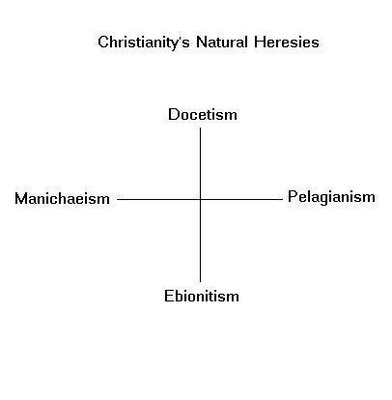


This diagram is of course just one possible way of expressing the complexities of Christian belief by means of a study of its natural heresies. This particular one was made famous by F. D. E. Schleiermacher in the introduction to his great work, The Christian Faith. By drawing on such a controversial modern theologian, this post intends to embody the very spirit it promotes: that we can learn from any Christian who takes the time to articulate affirmations about divine things.

Any thoughts?
Does this diagram illuminate how heresy can be used to gain deeper understanding of the faith?
What are some other natural heresies of Christianity?
Are there any heresies that do not come in such neat pairs?
Does such a procedure really work in the midst of a heretical controversy, or is it only possible as an after-the-fact reflection?

Wednesday, October 05, 2005

Do Christians make the Church or does the Church make Christians?

Does a gathering of individual Christians make a collective church of Christians? Or is there a realistic entity called “the Church” that makes its participants into Christians? This is the basic theological question that still plagues us today. This perennial tension between individualists and communitarians crops up both between and within the alternative proposals for renewal today. For instance, one can find within the emergent conversation both radical individualists and radical communitarians. Both claim to value community. That is not the issue. This issue is whether the basis of ecclesial community is found in the collective of free individuals or in the community itself as such which then grants communal identity to its members. An arsenal of arguments are assembled, the battle rages on, and yet no victor is in sight.

Part of the problem in the debate between communitarians and individualists is that it remains solely on the sociological plane. The missing piece to the puzzle is the very center of church life itself: Jesus Christ. The debate will go on in perpetuity as long as it remains a struggle between two foci. But when a third point is added, a triangle is formed and a more rich discussion can follow.

So then, how do the Church, the Christian and Christ relate?

The classic way to formulate the basic options was put forth by Schleiermacher (19th Cen). He put it in terms of a contrast between the Protestant and Catholic ecclesiological principles (Christian Faith 103-108):

The Protestant principle is that the relationship between the Christian and the Church depends on the Christian's relationship to Christ.

The Catholic principle is that the relationship between the Christian and Christ depends on the Christian's relationship to Church.

Of course, this leads us into a whole other web of problems. Which principle gives pride of place to Christ? Which principle avoids the perils of the extremes? Are these principles adequate descriptions of the Protestant/Catholic difference? How do we acknowledge both the freedom of Christ and the indispensability of the Church? Is there a way to synthesize the principles? Is there a third option? But at least they are properly theological problems and therefore we might be able to get somewhere. In other words, a good ecclesiology must deal in Christological currency.

Although I enjoy being provocative, it seems appropriate to at least sketch the beginnings of my own solution to this basis ecclesiological problem. I would recommend that we navigate Schleiermacher’s triangle by means of the concept of mission. My inspiration here is von Balthasar, who outlines a missional concept of theological personhood in his Theo-Drama vol. III. Balthasar’s advance is that our personhood is grounded neither in our individual Christianity nor our participation in the community of the Church as such, but rather in the fulfillment of our mission. We are sent by God. This is who we are, both as individual Christians and as a communal Church. Balthasar gives the example of Paul, who as an individual missionary was on the periphery of the church and yet served the church precisely in his peripheral mission. He notes rightly that individualism and communitarianism coincide for Paul, especially when he reflects on his suffering for the church (e.g., Colossians 2).

Here’s how one might render Balthasar’s insight in terms of Schleiermacher’s triangle:

The Missional principle is that the Christian's relationship to both Christ and the Church depends on her participation in the mission to which Christ sends the Church.

My hope is that this way of putting things will keep the Christian and the Church in proper balance as they subsist in the one mission of Christ. This certainly doesn’t solve all the problems, but it may help to reframe it in a fruitful way.


Any thoughts?
Any communitarians or individualists out there who want to take me to task?
Any objections to Schleiermacher’s way of Christologizing the problem?
Any suggestions toward a missional solution to these problems?
