This week I will conclude our summary and discussion of Roger Olson's book Arminian Theology: Myths and Realities with myths #8-10.
Myth 8: Arminians Do Not Believe in Predestination.
Reality: Predestination is a biblical concept; classical Arminians interpret it differently than Calvinists without denying it. It is God’s sovereign decree to elect believers in Jesus Christ and includes God’s foreknowledge of those believers’ faith.
Comment: I loved this chapter because this is such a common myth. The debate between Calvinists and Arminians is too often framed as between predistination and free will. The fact of the matter is that both Calvinists and Arminians believe in both predestination and free will. The question is how to define and relate the two concepts. The Arminian position on predestination is characterized by assigning priority to God's foreknowledge. "Those he foreknew he also predestined." Olson dedicated the second half of the chapter to differentiating Classical Arminianism from Molinist "middle knowledge" and open theism. Although I am not committed to either Molinism or open theism, I do think it unfortunate that Olson has determined to cut such a narrow path for Arminians. Many Open Theist I talk to consider themselves "consistent Arminians" or at least "revisionist Arminians." Maybe they are wrong about that (and I think Olson makes a good case that the Arminian position requires an affirmation of foreknowledge), but the author's political intention to distance Arminianism from controversial territory even within the Evangelical camp is glaring.
Myth 9: Arminian Theology Denies Justification by Grace Alone Through Faith Alone.
Reality: Classical Arminian theology is a Reformation theology; it embraces divine imputation of righteousness by God’s grace through faith alone and preserves the distinction between justification and sanctification.
Comment: This chapter is especially helpful as a corrective to the claim that Arminian theologies are by definition a Catholic compromise. This comes from Calvinists in the form of an accusation (which is Olson's obvious concern), but it is oft repeated by Arminians as a strength. Although it is true that Wesley has a "Catholic spirit" and many Arminians are more comfortable drawing on the Catholic spiritual tradition than their Reformed counterpoints, Arminians are at bottom Protestants. Even if Arminians come to conclusions that make rapprochement with Roman Catholics more likely, the questions they are asking reflect typically Protestant concerns. Hopefully this chapter will remind Arminians to speak in a more nuanced way about their relationship with Roman Catholicism. Beware of easy ecumenism; reconciliation requires work!
Myth 10: All Arminians Believe in the Governmental Theory of the Atonement.
Reality: There is no one Arminian doctrine of Christ’s atonement; many Arminians accept the penal substitution theory enthusiastically while others prefer the governmental theory.
Comment: As a Wesleyan-Arminians who uses substitionary categories to understand the atonement, I found this chapter especially reassuring. I had worried that my move away from governmental to more substitionary (including but not limited to penal imagery) thinking put me at risk of abandoning my heritage. Olson collects sufficient evidence to the contrary. He does not outright reject the governmental theory, but his "enthusiastic acceptance" of penal substitutionition shows. Nevertheless, this is one of the strongest chapters simply because it (unlike some of the others) acknowledges and even explores the diversity within the Arminian tradition.
MISSING! - Myth 11: Arminian Theology Undermines the Assurance of the Believer
Reality: Not all Arminians deny the eternal security of the believer, and even those who do still teach a Biblical doctrine of assurance based on the internal testimony of the Spirit.
Comment: I am adding this myth because I find it almost ridiculous that a book on Arminian theology written in the American Evangelical context would not address the matter of eternal security. Olson is certainly right to turn his attention to other more foundation matters (eteranl security may be a major point of contention at the popular level, it is not the crux of the matter between Arminians and Calvinists). But it should not be ignored wholesale! In an earlier book co-written with Stanley Grenz, Olson posits a spectrum of theologies with folk theology on one extreme as that which should be avoided. Maybe Olson has identified the argument over eternal security as matter for "folk theologians" and can thus be safely set aside. Perhaps the publishers wanted an even 10 myths, and this one simply had to go. Whatever the reason, it's absence is disappointment.
Conclusion: Rules of Engagement for Evangelical Calvinists and Arminians.
(1) Understanding precedes evaluation.
(2) Avoid straw man arguments.
(3) Admit our own paradoxes and mysteries.
(4) Avoid attribution of beliefs not actually held by opponent; instead, identify perceived logical consequences.
Comment: Olson's conclusion contains the "payoff" of the book. He pleads with evangelicals to approach their polemics with proper charity. Following these four rules is a good place to start in treating each other with intellectual (and Christian) respect. Whatever one thinks of Arminian theology and/or Olson's version of it, any reader should heartily accept these rules of engagement. Olson has followed them in his description of Calvinists; I have tried to follow them in my description of Olson; I trust that we will follow them in the comment board and beyond.
Any thoughts?
Have you encountered these last three myths?
Are Olson's theses describing the Arminian position accurate? Are they compelling?
Why do you think Olson neglected to discuss eternal security?
What rules of engagementgment for dialogue would you add?
Wednesday, September 27, 2006

Wednesday, September 20, 2006
Olson's Arminian Myths #4-7
Continuing on the heals of last week's post, here are myths #4-7 about Arminian Theology according to Roger Olson's book.
Myth 4: The Heart of Arminianism Is Belief in Free Will.
Reality: The true heart of Arminian theology is the character of God as love and justice; the formal principle of Arminianism is the universal will of God for salvation.
Comment: This may be the most important constructive chapter in Olson's book. Why so? Whenever Arminians treat the abstract philosophical concept of “Free Will” as their starting point, they get into trouble. I may have a minor nit to pick over Olson's choice of the technical phrase "formal principle" to describe God's universal will for salvation (is this a "principle," and, if so, is it "formal"?). But this technical attribution does not over-determine the argument of this chapter. His point is quite simple yet significant: Arminians start with a particular understanding of God, which then leads them to affirm free will. Keeping this straight is not only helpful when dealing with Calvinist critics; it’s just a good idea to start with God in any theological discussion.
Myth 5: Arminian Theology Denies the Sovereignty of God.
Reality: Classical Arminianism interprets God’s sovereignty and providence differently than Calvinism without in any way denying them; God is in charge of everything without controlling everything.
Comment: Although for a thoughtful Arminian this myth is laughable, it is repeated so frequently that it requires attention in a myth-busting book. Of course a Calvinist might claim that Arminians logically undermine the sovereignty of God. But Arminians certainly do not deny it! The sovereignty of God is the Calvinist watchword, and they are correct to observe that Arminians do not place as great an emphasis on it as they do. But a different approach is not a denial. This distinction is easy to see but hard to remember. So this chapter performs a great service for the continued dialogue.
They only concern I would like to raise is whether a black-coffee Calvinist has an inherently more consistent position when arguing from a foundation in classical theism. Arminians (like many Christians before them) are forced to introduce subtle distinctions such as God's "ordained" versus "permissive" will (John Damscene) or God being "in charge" of everything without "controlling" everything (Roger Olson). Calvinists have an uncanny ability to cut through this mishmash and follow through on the deterministic implications of classical theism. I don't want to go there with them, but I don't care for all the cooked up distinctions either. Could it be that the whole way of thinking about God in the first place is creating the kinds of problems solved by Calvinists on the one side and Arminians on the other? Could a revised understanding of God's identity and his relationship to the world avoid determinism without introducing dubious distinctions?
Myth 6: Arminianism Is a Human-Centered Theology.
Reality: An optimistic anthropology is alien to true Arminianism which is thoroughly God-centered; Arminian theology confesses human depravity including bondage of the will.
Comment: This is another helpful myth-buster, simply for the wealth of textual evidence Olson brings to the table to establish that the Arminian tradition has strongly affirmed Total Depravity. Despite many charts and graphs to the contrary, the "T" in TULIP has never been a major point of contention between Calvinists and Arminians. Arminians are pessimistic about humanity and its sin; they are optimistic only about grace - which makes one very optimistic indeed! I have nothing to add to or subtract from this chapter.
Myth 7: Arminianism Is Not a Theology of Grace.
Reality: The material principle of classical Arminian thought is prevenient grace; all of salvation is wholly and entirely of God's grace.
Comment: Olson here presents the classical Arminian position on grace. This may be one of the clearest explanations of prevenient grace on the market right now. A must read. After reading this chapter, however, I am beginning to wonder whether this little term can really do all the work assigned to it. Arminians try to solve every problem by invoking prevenient grace as a one-size-fits-all soteriological concept. If you fall asleep in a theology course at a Wesleyan-Arminian college and are woken by a question from the professor, just say "prevenient grace" and you'll probably be right. Olson goes so far as to identify prevenient grace as the Arminian "material principle," which seems a bit heavy-handed. I do not wish to reject the notion of prevenient grace, but I am looking for an adequate reformulation set on more secure ground. Fletcher's Proto-Charismatic personalizing of Wesleyan soteriology by assigning to the Spirit (the third person of the trinity) the work of prevenient grace (a mediating term lacking semantic concreteness) is perhaps helpful, although we must remember that the Spirit is the Spirit of Jesus Christ and that he is the prevenience of grace. Some kind of robustly trinitarian personalizing of the concept of prevenient grace is needed to refuel Arminian theology at this point.
Next week: Myths #8-10 and the conclusion of the series on Arminian Myths in conversation with Roger Olson's new book.
Any Thoughts?
Have you encountered these four myths? Any funny stories?
Are Olson's theses describing the Arminian position accurate? Are they compelling?
Do my responses hit or miss the mark in their critical appreciation of Olson?
What do you think of my alternative problems regarding #5 (God) and #7 (Grace)?
Myth 4: The Heart of Arminianism Is Belief in Free Will.
Reality: The true heart of Arminian theology is the character of God as love and justice; the formal principle of Arminianism is the universal will of God for salvation.
Comment: This may be the most important constructive chapter in Olson's book. Why so? Whenever Arminians treat the abstract philosophical concept of “Free Will” as their starting point, they get into trouble. I may have a minor nit to pick over Olson's choice of the technical phrase "formal principle" to describe God's universal will for salvation (is this a "principle," and, if so, is it "formal"?). But this technical attribution does not over-determine the argument of this chapter. His point is quite simple yet significant: Arminians start with a particular understanding of God, which then leads them to affirm free will. Keeping this straight is not only helpful when dealing with Calvinist critics; it’s just a good idea to start with God in any theological discussion.
Myth 5: Arminian Theology Denies the Sovereignty of God.
Reality: Classical Arminianism interprets God’s sovereignty and providence differently than Calvinism without in any way denying them; God is in charge of everything without controlling everything.
Comment: Although for a thoughtful Arminian this myth is laughable, it is repeated so frequently that it requires attention in a myth-busting book. Of course a Calvinist might claim that Arminians logically undermine the sovereignty of God. But Arminians certainly do not deny it! The sovereignty of God is the Calvinist watchword, and they are correct to observe that Arminians do not place as great an emphasis on it as they do. But a different approach is not a denial. This distinction is easy to see but hard to remember. So this chapter performs a great service for the continued dialogue.
They only concern I would like to raise is whether a black-coffee Calvinist has an inherently more consistent position when arguing from a foundation in classical theism. Arminians (like many Christians before them) are forced to introduce subtle distinctions such as God's "ordained" versus "permissive" will (John Damscene) or God being "in charge" of everything without "controlling" everything (Roger Olson). Calvinists have an uncanny ability to cut through this mishmash and follow through on the deterministic implications of classical theism. I don't want to go there with them, but I don't care for all the cooked up distinctions either. Could it be that the whole way of thinking about God in the first place is creating the kinds of problems solved by Calvinists on the one side and Arminians on the other? Could a revised understanding of God's identity and his relationship to the world avoid determinism without introducing dubious distinctions?
Myth 6: Arminianism Is a Human-Centered Theology.
Reality: An optimistic anthropology is alien to true Arminianism which is thoroughly God-centered; Arminian theology confesses human depravity including bondage of the will.
Comment: This is another helpful myth-buster, simply for the wealth of textual evidence Olson brings to the table to establish that the Arminian tradition has strongly affirmed Total Depravity. Despite many charts and graphs to the contrary, the "T" in TULIP has never been a major point of contention between Calvinists and Arminians. Arminians are pessimistic about humanity and its sin; they are optimistic only about grace - which makes one very optimistic indeed! I have nothing to add to or subtract from this chapter.
Myth 7: Arminianism Is Not a Theology of Grace.
Reality: The material principle of classical Arminian thought is prevenient grace; all of salvation is wholly and entirely of God's grace.
Comment: Olson here presents the classical Arminian position on grace. This may be one of the clearest explanations of prevenient grace on the market right now. A must read. After reading this chapter, however, I am beginning to wonder whether this little term can really do all the work assigned to it. Arminians try to solve every problem by invoking prevenient grace as a one-size-fits-all soteriological concept. If you fall asleep in a theology course at a Wesleyan-Arminian college and are woken by a question from the professor, just say "prevenient grace" and you'll probably be right. Olson goes so far as to identify prevenient grace as the Arminian "material principle," which seems a bit heavy-handed. I do not wish to reject the notion of prevenient grace, but I am looking for an adequate reformulation set on more secure ground. Fletcher's Proto-Charismatic personalizing of Wesleyan soteriology by assigning to the Spirit (the third person of the trinity) the work of prevenient grace (a mediating term lacking semantic concreteness) is perhaps helpful, although we must remember that the Spirit is the Spirit of Jesus Christ and that he is the prevenience of grace. Some kind of robustly trinitarian personalizing of the concept of prevenient grace is needed to refuel Arminian theology at this point.
Next week: Myths #8-10 and the conclusion of the series on Arminian Myths in conversation with Roger Olson's new book.
Any Thoughts?
Have you encountered these four myths? Any funny stories?
Are Olson's theses describing the Arminian position accurate? Are they compelling?
Do my responses hit or miss the mark in their critical appreciation of Olson?
What do you think of my alternative problems regarding #5 (God) and #7 (Grace)?
Wednesday, September 13, 2006
Olson's Arminian Myths #1-3
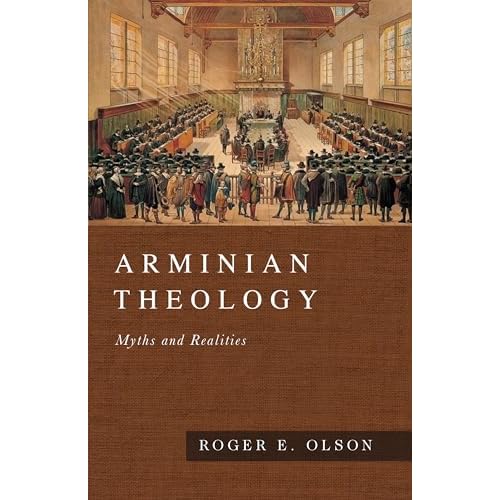 Last week I began my review of Roger Olson's primer Arminian Theology: Myths and Realities. The focus of last week's post was on the book's purpose, structure, and mode of argumentation. This week I will list and respond to Olson's first three myths and their contrasting realities. I am splitting up the ten myths in order to give me space and time to respond carefully to each one.
Myth 1: Arminian Theology Is the Opposite of Calvinist/Reformed Theology.
Reality: Jacobus Arminius and most of his faithful followers fall into the broad Reformed tradition; the common ground between Arminianism and Calvinism is significant.
Comment: This chapter is helpful because it reminds us that, at least genetically, Arminianism is a branch of the Reformed tradition. However, as a Wesleyan I find this version of the story a bit misleading, because although Jacobus Arminius and the Remonstrants are best understood as a revision within Calvinism, the Wesleyan tradition (fathering the world Methodist movement, grandfathering the American Holiness Movement, and great-grandfathering the Charismatic movement) is best understood as an independent tradition with its own spirit, governing ethos, and trajectory of development. Arminianism could be regarded as a speculative theological foundation commandeered by most (but certainly not all) Wesleyans. In other words, I'm not Wesleyan as an expression of my Arminianism; I'm Arminian because I'm Wesleyan!
Myth 2: A Hybrid of Calvinism and Arminianism Is Possible.
Reality: In spite of common ground, Calvinism and Arminianism are incommensurable systems of Christian theology; on issues crucial to both there is no stable middle ground between them.
Comment: This was one of my favorite chapters, because it cut through the sloppiness of many attempts to resolve the tension between these two traditions of thought. Olson makes a great case for rigorous doctrinal reflection. I believe there may be resolutions to some of these problems, but not without revising the foundations upon which these systems of thought are built. For instance, Karl Barth performs a massive overall to the Calvinist doctrine of predestination, but he does so by means of a Christocentric actualistic ontology that is a serious departure from classical theism. In the same way, there may be a distinctively Arminian (or at least a Wesleyan-Pentecostal) revision of these doctrines, but not without some kind of break from the traditions out of which these two systems emerged. So I am in complete agreement with Olson on the diagnosis of the issue: the two traditions are incommensurable and any Frankenstein Monster drawing on pieces from both will just terrorize the village. I differ with Olson only on the matter of prognosis: that we should consider revising the foundations that created these differences. Whether comparable differences will remain after the revision remains to be seen (because this work is unfinished).
Myth 3: Arminianism Is Not an Orthodox Evangelical Option.
Reality: Classical Arminian theology heartily affirms the fundamentals of Christian orthodoxy and promotes the hallmarks of evangelical faith; it is neither Arian nor liberal.
Comment: This chapter is probably the most important in achieving Olson's aim: making space for Arminian theology within the Evangelical movement. Dispelling the ridiculous myth that all Arminians are Arian in their Christology and Rationalistic in their approach to the Bible is particularly helpful. My only response is to suggest that Arminian forms of Evangelicalism may differ enough from their Calvinist brethren to justify an honest inheritance dispute. Olson implies that the Calvinist and Arminian accounts of the inspiration of Scripture are indistinguishable. Since the Arminian-Calvinist debate circles around the problem of divine and human agency, it would seem that each side would have a distinctive take on the divine inspirition of the human words of the Bible. This is a case were Olson - in order to achieve his primary purpose of de-stigmatizing Arminian theology - has managed to avoid the deeper issues at stake.
Any questions?
Have you encountered these three myths?
Are Olson's theses describing the Arminian position accurate? Are they compelling?
Do my responses hit or miss the mark in their critical appreciation of Olson?
Wednesday, September 06, 2006
Roger Olson's Arminian Theology: Myths and Realities (part one)

The most recent issue of Christianity Today addresses the resurgence of Calvinism among younger evangelicals. Accompanying any such Reformed resurgence is the re-appraisal of the status of Arminians within the Evangelical camp. Although it seems odd to even question whether Arminians are welcome among some of the very institutions they established, the question is being raised and cannot be ignored.
Roger E. Olson's timely book Arminian Theology: Myths and Realities offers a sustained description of Arminianism as a genuinely Evangelical and Protestant tradition. His motivation is both theological and sociological. Theologically, he intends to clear up misunderstandings about what Arminians actually believe. Sociologically, he aims to prevent any impending squeeze-out of Arminians from the Evangelical camp that the recent Reformed resurgence may entail. The result is an accessible introduction to Arminian theology that could be used in both Arminian and Calvinist circles: as a formative textbook for the former and as a supplemental text promoting generosity among the latter.
I am in the process of a reviewing an advance copy of this book for Koinonia Journal. I am half way through it and would like to "think out loud" about its strengths and weaknesses. I may continue these thoughts next week after I finish reading the rest of the book.
Myth-Busting Structure. The structure of the book is particularly interesting. Instead of laying out a deductive presentation of Arminian theology, Olson walks through ten common myths about Arminian theology. This "response-to-critics" approach reveals the polemical context which generated this book (Olson works at Baylor, a moderate Baptist institution that has become a haven for fallouts of the fundamentalist forms of Calvinism in the recent SBC takeover). Unfortunately, some may read this book as overly defensive and so miss the alternative vision Arminianism offers. This defensive position may serve to perpetuate the assumption that Calvinism is the gold standard by which all theologies are to be judged. However, a generous reader will discern that Olson is wisely engaging in a strategy of ad hoc apologetics: address the common objections to one's position in order to show that it has been misunderstood. Thus read, Olson's book is less a defense of Arminianism than it is a description of Arminianism. Such an accurate description is much needed for all the parties involved.
Historical Mode of Argumentation. Within each chapter, Olson dispels the myth at hand by tracing the "true" Arminian position as exposited by Jacobus Arminius, Simon Episcopius, John Wesley, 19th Century Methodists, and 20th Century Evangelical Arminians (esp. Nazarenes). Thus he offers a historical mode of argumentation: he is identifying the tradition of genuine Arminian thought, distinguishing it from Calvinism on the one side and its supposed bad reputation on the other. Such a historical approach allows the classical authors to speak for themselves through copious quoting, and accordingly initiates the reader into the Arminian tradition. However, Olson's approach tends to give the impression of a united Arminian theological heritage that may overlook the genuine diversity of Arminians. Arminius, Wesley, Miley, and Dunning are all different thinkers working in different contexts with different approaches and assumptions. They form more of a web than a line, both in their relationship to each other and vis-a-vis Calvinism. Furthermore, the construction of a "true" Arminian line requires the exclusion of the "false" Arminians. For Olson, this includes the later proto-liberal Remonstrants, the "vulgarized" Arminianism of Finney, and contemporary process theology. The complex historical relationship of Arminianism to Protestant liberalism, progressive revivalism, and process philosophy is very real, and these marginal figures cannot be simply set aside as aberrant or fallen Arminians. Olson's explicit exclusion of Finney is particularly suspect. Can such a significant and influential evangelical Arminian can be so easily excised from the story of Arminian theology? This story serves Olson's ends well by distancing Arminian theology from figures and movements on the current Evangelical hit-list. But such exclusionary tactics beg the question: on what basis does Olson differentiate a "true" from an "false" Arminian? It seems that for Olson the current strictures of American Evangelical identity are in the driver's seat, rather than anything inherent to Arminianism. Thus, Olson ironically engages in the very theological politics practiced by Calvinists which drove him to write this book in the first place.
I hope to follow up these methodological comments with more material discussions of Olson's ten myths in the following week(s). In the meantime ...
Any thoughts?
What do you think of Olson's approach?
Is myth-busting the best way to present Arminian theology?
What are benefits and costs of constructing a history of the "best" of Arminian theology?
Thursday, August 31, 2006
Trinitarian Heresies
I thought I would top off this month's series on heresies with the most heresy-haunted Christian doctrine of all: the Trinity. Augustine once quipped that to not think about the Trinity is to risk heresy, but to think about the Trinity is to risk lunacy. As for me and my house, we've chosen the second risk as the wiser venture. I think the Trinity exemplifies best of all the principle outlined in the previous post that the careful study of heresy illuminates Christian doctrine.
The heart of the doctrine of the Trinity is a four word theological affirmation: that God is one being, three persons. Despite the complaints of popular doubt promoters, understanding this is not the great barrier to belief. The real problem is grasping what is at stake in this affirmation. It just sounds like some kind of irrelevant and irreverent divine math. What makes this affirmation so much better than other ways of talking about the relationship between the Biblical names of Father, Son and Holy Spirit?
Enter the trinitarian heresies. By comparing and contrasting the classic and contemporary trinitarian heresies, we can see what is at stake in affirming the Trinity. It's not so much that "one being, three persons" is the best possible thing we could say about God's inner life, but rather that all the other alternatives are much worse. If we don't say this, then we logically fall in one of four traps:
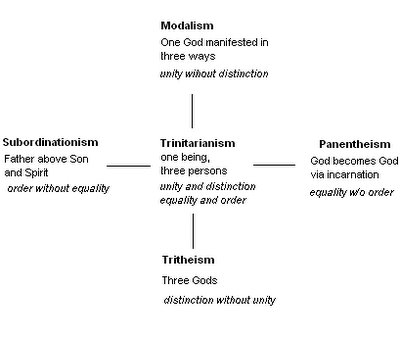
Once again, the doctrinal affirmation is found within the space between one-sided heretical options.
Any thoughts?
Are these terms and distinctions clear enough?
What other conceptual alternatives are there to speaking triple name of God?
What other doctrinal domains would you like to see this kind of analysis applied?
Which would you rather risk: heresy or lunacy?
The heart of the doctrine of the Trinity is a four word theological affirmation: that God is one being, three persons. Despite the complaints of popular doubt promoters, understanding this is not the great barrier to belief. The real problem is grasping what is at stake in this affirmation. It just sounds like some kind of irrelevant and irreverent divine math. What makes this affirmation so much better than other ways of talking about the relationship between the Biblical names of Father, Son and Holy Spirit?
Enter the trinitarian heresies. By comparing and contrasting the classic and contemporary trinitarian heresies, we can see what is at stake in affirming the Trinity. It's not so much that "one being, three persons" is the best possible thing we could say about God's inner life, but rather that all the other alternatives are much worse. If we don't say this, then we logically fall in one of four traps:
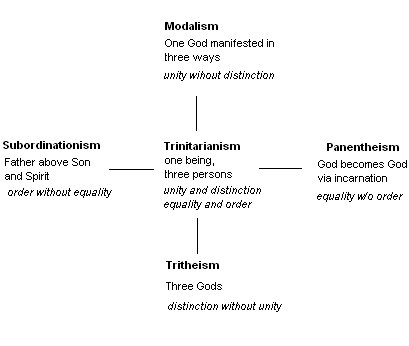
Once again, the doctrinal affirmation is found within the space between one-sided heretical options.
Any thoughts?
Are these terms and distinctions clear enough?
What other conceptual alternatives are there to speaking triple name of God?
What other doctrinal domains would you like to see this kind of analysis applied?
Which would you rather risk: heresy or lunacy?
Thursday, August 24, 2006
Christianity's Natural Heresies
Last week I suggested an alternative view of heresy that points towards its redemption rather than mere rejection. Such a redemptive attitude and procedure is not the only benefit of this view. In the process of redeeming a heresy, we can actually come to a deeper and wider understanding of the whole of Christian truth. If heresies bear witness to an aspect of the truth, the study of multiple heresies in tandem can shine a light on the picture of the faith.
Heresies do not arises out of nothing. By definition they latch on to some aspect of the truth. They have some organic or natural connection to Christian doctrine. By analyzing a heretical claim, we can identify this core of truth. After performing such an analysis on opposing heresies, we can synthesize the insights into a greater whole. Thus the heart of Christian doctrine can be displayed in relationship to its natural heresies.
In pursuing this task, it is particularly helpful that most classical heresies have an opposing counterpart. For instance, in the earliest centuries of the church, emerging Christology naturally leaned in one of two directions: either toward Docetism (the notion that Christ was divine being who only appeared to be human) or toward Ebionitism (the notion that Christ was a only a human being). The fully developed Christian claim is found in the space between these two extremes: that Christ is both divine and human.

The procedure of finding the truth between the extremes is not limited to the inherently paradoxical domain of Christology. The same program yields insights in the realm of Christian anthropology. As the early Christians began to think about humanity which is saved by Christ, two natural tendencies emerged. On the one hand, humanity might be regarded as so sinful that it is irredeemable, such that salvation is understood as an escape from human life. This perspective was advanced by many gnostic groups, but most sharply by Manichaeans. On the other hand, humans might be regarded as so ready for salvation that they essential save themselves. This perspective was advanced most famously by the Pelagians (although Pelagius himself may have been more subtle, Pelagianism has become the "name brand" for this heretical viewpoint). Once again, the fully developed Christian claim is found in the space between these two extremes: that humanity is utterly sinful yet grace is powerful enough to overcome sin and redeem humanity.

By combining the insights drawn from both sets of extremes, we can paint a pretty good picture of the heart of the Christian faith in counterpoint to its natural heresies. Christians affirm Jesus Christ as the fully divine and fully human savior of humanity from its sin. According to this procedure, orthodoxy is not achieved by rejecting a long list of heresies. Rather, Christian faith is best expressed in the space between its natural heresies, as the whole truth God which reconciles such oppositions.
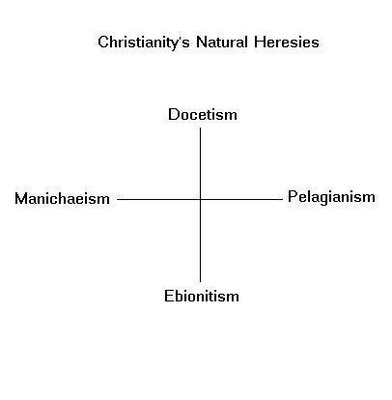
This diagram is of course just one possible way of expressing the complexities of Christian belief by means of a study of its natural heresies. This particular one was made famous by F. D. E. Schleiermacher in the introduction to his great work, The Christian Faith. By drawing on such a controversial modern theologian, this post intends to embody the very spirit it promotes: that we can learn from any Christian who takes the time to articulate affirmations about divine things.
Any thoughts?
Does this diagram illuminate how heresy can be used to gain deeper understanding of the faith?
What are some other natural heresies of Christianity?
Are there any heresies that do not come in such neat pairs?
Does such a procedure really work in the midst of a heretical controversy, or is it only possible as an after-the-fact reflection?
Heresies do not arises out of nothing. By definition they latch on to some aspect of the truth. They have some organic or natural connection to Christian doctrine. By analyzing a heretical claim, we can identify this core of truth. After performing such an analysis on opposing heresies, we can synthesize the insights into a greater whole. Thus the heart of Christian doctrine can be displayed in relationship to its natural heresies.
In pursuing this task, it is particularly helpful that most classical heresies have an opposing counterpart. For instance, in the earliest centuries of the church, emerging Christology naturally leaned in one of two directions: either toward Docetism (the notion that Christ was divine being who only appeared to be human) or toward Ebionitism (the notion that Christ was a only a human being). The fully developed Christian claim is found in the space between these two extremes: that Christ is both divine and human.
The procedure of finding the truth between the extremes is not limited to the inherently paradoxical domain of Christology. The same program yields insights in the realm of Christian anthropology. As the early Christians began to think about humanity which is saved by Christ, two natural tendencies emerged. On the one hand, humanity might be regarded as so sinful that it is irredeemable, such that salvation is understood as an escape from human life. This perspective was advanced by many gnostic groups, but most sharply by Manichaeans. On the other hand, humans might be regarded as so ready for salvation that they essential save themselves. This perspective was advanced most famously by the Pelagians (although Pelagius himself may have been more subtle, Pelagianism has become the "name brand" for this heretical viewpoint). Once again, the fully developed Christian claim is found in the space between these two extremes: that humanity is utterly sinful yet grace is powerful enough to overcome sin and redeem humanity.
By combining the insights drawn from both sets of extremes, we can paint a pretty good picture of the heart of the Christian faith in counterpoint to its natural heresies. Christians affirm Jesus Christ as the fully divine and fully human savior of humanity from its sin. According to this procedure, orthodoxy is not achieved by rejecting a long list of heresies. Rather, Christian faith is best expressed in the space between its natural heresies, as the whole truth God which reconciles such oppositions.
This diagram is of course just one possible way of expressing the complexities of Christian belief by means of a study of its natural heresies. This particular one was made famous by F. D. E. Schleiermacher in the introduction to his great work, The Christian Faith. By drawing on such a controversial modern theologian, this post intends to embody the very spirit it promotes: that we can learn from any Christian who takes the time to articulate affirmations about divine things.
Any thoughts?
Does this diagram illuminate how heresy can be used to gain deeper understanding of the faith?
What are some other natural heresies of Christianity?
Are there any heresies that do not come in such neat pairs?
Does such a procedure really work in the midst of a heretical controversy, or is it only possible as an after-the-fact reflection?
Wednesday, August 16, 2006
What is heresy?
Heresy is a term used either too much or too little in Christian circles. Either Christians call everything they disagree with a heresy, or they are so afraid of offended or exclusing someone that they are unwilling to employ it even when its appropriate.
I think that some of the problem with our misuse of the term heresy comes from an misunderstanding of what heresy is. The word heresy comes from the word for "faction" or "party." Heresies are parties within the church that make one doctrine or one perspective on a doctrine the centerpiece of the faith to the exclusion of the rest. Thus, heresy is not exactly the opposite of orthodoxy ("right teaching"), but is more precisely the opposite of catholic ("universal, complete"). Accordingly, heresy is best defined as substituting part of the truth for the whole. This is why heretics are not completely wrong and often have much truth to share. The problem with heresy is not its utter falsity, but its one-sidenesses.
How might this change our attitude toward heresy? Heresies are not extra-Christian viruses to be eradicated, but intra-Christian parasites that feed off the truth. The solution to heresy is not to push it out, but to draw its one perspective back into the whole truth of the Christian faith. In other words, heresy is to be redeemed.
Let me give an example.
In the 5th century, a certain party called the monophysites claimed that Christ had only one nature: the divinity of Christ subsumed his humanity so that the humanity was rendered divine. This heresy witnessed to the truth that Christ was not a schizophrenic half-man/half-God, but one single person, the Son of God become man. Unfortunately, they did so at the expense of the complete humanity of Christ.
Simultaneously, there was another party who bore the brand name of Nestorians who claimed that within Christ there were really two persons: the divine son of God and the human son of Mary. This heresy witnessed to the truth that both the divinity and humanity of Christ were complete and unaltered. Unfortunately, they did so at the expense of the integrity of Jesus Christ as one single person.
At the council of Chalcedon (451), the church affirmed the truth on both sides of the argument: Christ is one person with two natures. The heresies were not so much rejected as assimilated into a larger whole. The truth on both sides was affirmed, while the error was left behind. In other words, these heresies were redeemed.
Any thoughts?
How does viewing heresy this way help us to approach views other than our own?
Do you have any other examples of heresy being redeemed?
Are there any heresies that come to mind that seem "unredeemable"?
How do we practice the art of redeeming heresy without becoming misled ourselves?
I think that some of the problem with our misuse of the term heresy comes from an misunderstanding of what heresy is. The word heresy comes from the word for "faction" or "party." Heresies are parties within the church that make one doctrine or one perspective on a doctrine the centerpiece of the faith to the exclusion of the rest. Thus, heresy is not exactly the opposite of orthodoxy ("right teaching"), but is more precisely the opposite of catholic ("universal, complete"). Accordingly, heresy is best defined as substituting part of the truth for the whole. This is why heretics are not completely wrong and often have much truth to share. The problem with heresy is not its utter falsity, but its one-sidenesses.
How might this change our attitude toward heresy? Heresies are not extra-Christian viruses to be eradicated, but intra-Christian parasites that feed off the truth. The solution to heresy is not to push it out, but to draw its one perspective back into the whole truth of the Christian faith. In other words, heresy is to be redeemed.
Let me give an example.
In the 5th century, a certain party called the monophysites claimed that Christ had only one nature: the divinity of Christ subsumed his humanity so that the humanity was rendered divine. This heresy witnessed to the truth that Christ was not a schizophrenic half-man/half-God, but one single person, the Son of God become man. Unfortunately, they did so at the expense of the complete humanity of Christ.
Simultaneously, there was another party who bore the brand name of Nestorians who claimed that within Christ there were really two persons: the divine son of God and the human son of Mary. This heresy witnessed to the truth that both the divinity and humanity of Christ were complete and unaltered. Unfortunately, they did so at the expense of the integrity of Jesus Christ as one single person.
At the council of Chalcedon (451), the church affirmed the truth on both sides of the argument: Christ is one person with two natures. The heresies were not so much rejected as assimilated into a larger whole. The truth on both sides was affirmed, while the error was left behind. In other words, these heresies were redeemed.
Any thoughts?
How does viewing heresy this way help us to approach views other than our own?
Do you have any other examples of heresy being redeemed?
Are there any heresies that come to mind that seem "unredeemable"?
How do we practice the art of redeeming heresy without becoming misled ourselves?
Wednesday, August 09, 2006
What Wesleyans Can Learn from Karl Barth (Part Three): Theological Ethics
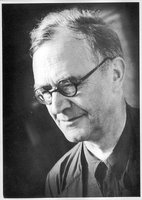

And now for our third installment of "What Wesleyans Can Learn from Karl Barth."
We have learned that Wesleyans can take a cue from Karl Barth in matters of theological authority and in doctrinal procedure. But the significance of Karl Barth is not limited to these theoretical matters alone. Barth is also a beneficial guide for the practical world of Christian living.
Wesleyans are known for their concern for ethics. We have a strong heritage of ethical action, both personal and social. Our distinctive doctrine itself has an ethical thrust. To be sanctified is to be empowered for obedience to Christ by his Holy Spirit. Wesleyans don't need any help caring about ethics.
And yet Wesleyans face the same challenges as every other Christian in the modern and post-modern world: How do we know what is right? How do we determine best way forward? How shall we then live? Wesleyans certainly know that we should pursue righteousness; but how do find the path of righteousness?
A pre-modern Christian might simply say, "I do what the Bible says." Wesleyans have always known that although this approach testifies to the authority of Scripture over our lives, it is still too simple. The Bible does not address every possible situation. Christians must make decisions and develop ends that guide us through the complexities of our concrete lives. In the midst of this hermeneutical struggle, Wesleyans have far too often been enticed by the sense of security provided non-theological foundations for ethical decision-making. Whether it be classical forms of Plato or Aristotle, the modern calculations of Kant or Mill or Marx, or contemporary contextualism or pragmatism, Wesleyans have often been quick to ground their ethical decisions on some external structure. Our motivations have remained distinctively Christian, but our mode of ethical deciding and acting has been guided by seemingly brighter lights.
So who can lead us out of this valley of confusion? How can we learn to decide and act in a distinctively Christian way? Enter Karl Barth. In his unfinished life-work, the Church Dogmatics, Barth did the unthinkable: he concluded each volume with a part-volume on ethics. Now this was not simply to make an already impossibly long work even longer. The purpose was to render ethics an explicitly theological task. Just this structural decision alone is commendable: Christian ethics not an independent discipline with its own ground but rather flows directly from the word and work of God reflected upon by theology. This may seem obvious to those of us living in the wake of the 50-year development of theological ethics since Barth. But in Barth's day this was a radical approach. And despite the proliferation of theological ethicists, it remains a radical reminder of the distinctively Christian core of ethics.
The material benefits of this structural move are even more crucial. Barth discusses all the classic and contemporary "issues" from a center in Jesus Christ. The contours of each issue are shaped by the character of God revealed in Jesus Christ. All human action is under the Lordship of God's action in Jesus Christ. Any good that is done (whether explicitly or implicitly related to Jesus) is a witness to Christ's act of reconciling God and humanity. The basis of determining the rightness or goodness of an action is its alignment (or "correspondence") with the action of God. Accordingly, Barth can take unique views on issues ranging from abortion to war to economics that are seldom found held by the same person. How is able to keep this all in tension? By moving out from Jesus Christ to human action as a witness to him, rather than being guided by some non-theological foundation or partisan ideology.
What does Barth's radically theological approach to ethics have to say to Wesleyans? The first lesson is a negative one: we ought to repent of our unhealthy reliance on non-theological foundations. Like the Ephesian Church in the Book of Revelation, we have forsaken our first love. Although we should not burry our heads in the sand, we must certainly avoid using these external frameworks as a ground for our ethics. Jesus is Lord. Neither Plato nor Aristotle, Kant nor Mill, Left nor Right have lordship over us. We ought to be in constant conversation with these traditions, but they must never supplant Jesus as the Church's one foundation.
But the lessons from Barth are not wholly negative. We can take a positive cue from his work by developing explicit connections between doctrine and ethics. The doctrine of sanctification has only done half of its job if it merely informs us of the spiritual power that enables us to perform the duties we know by other means. We ought to be asking about the implications of a sanctifying God for concrete ethical issues. Rather than taking for granted what God desires in an individual case, we should think through from the beginning what sanctification looks like for the people involved in the situation at hand. These are the kinds of questions that guide ethics down an genuinely theological path.
Finally, Barth's bold structural move to include ethics within dogmatics raises a question about Wesleyan theological education. In my ministerial training, the two courses that seemed to have the least to do with each other where "Ethics" and "Theology of Holiness." It is telling of their separation that the former bore the registration category PHL, while the latter was designated REL. And the foundational status of Ethics was revealed by it being placed before Theology of Holiness in the recommended sequence of courses. Finally, the difference in content was striking, as anyone who had read Wesley and Kant on the same day can testify. The two courses were simply not aimed at the same student. One taught us how to reason through moral problems; the other formed us in a tradition that testified to the power of the Holy Spirit in our lives. If Wesleyan ministers are going to not only profess holiness but live it out, there must be a more conscious connection between these two courses. What would this look like? It may be addressed simply by the Ethics and Holiness professors having a conversation about how these course form students. It may require more complex curricular solutions regarding designation, loading, and sequence. But whatever it looks like, the divorce between theology and ethics in Wesleyan institutions should be addressed.
So that’s the third reason why this Wesleyan has taken an interest in Karl Barth.
Any thoughts?
- What examples can you think of where Wesleyans having been enticed into drawing ethical reasoning from somewhere other than our Christian core?
- What specific ethical issues are illumined by a Christocentric starting point?
- How can we better connect theology and ethics?
Thursday, July 27, 2006
Laying of Hands: Becoming a Link in a Long Chain
This Sunday I got ordained. Beforehand my wife asked me what I was looking forward to the most about the service. I said that I was most looking forward to the laying on of hands by the other ministers. Why is this part of the act so special?
The laying on of hands was not special because I received some kind of special powers. I preached and administered the sacraments before my ordination and I will do so after without any substantive change. The ministry of the church does not require some special mystical power above and beyond the work of the Holy Spirit himself.
The laying on of hands could also be potentially significant as a symbol of the setting apart among the church for the role of equipping the saints. Now this is certainly an aspect of the act. But in my ordination experience, those who laid hands on me were the community of ministers, not the congregation as a whole. So the symbol in this instance is not so much being "set apart" as being "welcomed into." Certainly I am being set apart by the church as a whole, but the laying on of hands symbolizes more.
What hit me at my ordination was that those who layed hands on me had received the laying on of hands from someone else, and so on and so on back through history. Now I do not need to committ myself to some idea of historical succession to be able to affirm the significance of a long chain of ministry that traces back to Jesus himself. The practice of laying on of hands is practiced in the New Testament and has been a consistent part of ordination services throughout Christian history. Whatever else it means, the laying on of hands symbolizes my induction into a historical community of set apart ministers. I became a link in a long chain of ministers.
The resultant attitude from this realization is that I am particularly excited to some day lay my own hands on an ordinand. I do not want my branch of the chain to end with my link. I feel compelled to continue the chain beyond myself.
Any thoughts?
What "happens" at ordination services?
What experiences or reflections have you had on such acts?
What is the meaning of the symbolic act of the laying on of hands?
The laying on of hands was not special because I received some kind of special powers. I preached and administered the sacraments before my ordination and I will do so after without any substantive change. The ministry of the church does not require some special mystical power above and beyond the work of the Holy Spirit himself.
The laying on of hands could also be potentially significant as a symbol of the setting apart among the church for the role of equipping the saints. Now this is certainly an aspect of the act. But in my ordination experience, those who laid hands on me were the community of ministers, not the congregation as a whole. So the symbol in this instance is not so much being "set apart" as being "welcomed into." Certainly I am being set apart by the church as a whole, but the laying on of hands symbolizes more.
What hit me at my ordination was that those who layed hands on me had received the laying on of hands from someone else, and so on and so on back through history. Now I do not need to committ myself to some idea of historical succession to be able to affirm the significance of a long chain of ministry that traces back to Jesus himself. The practice of laying on of hands is practiced in the New Testament and has been a consistent part of ordination services throughout Christian history. Whatever else it means, the laying on of hands symbolizes my induction into a historical community of set apart ministers. I became a link in a long chain of ministers.
The resultant attitude from this realization is that I am particularly excited to some day lay my own hands on an ordinand. I do not want my branch of the chain to end with my link. I feel compelled to continue the chain beyond myself.
Any thoughts?
What "happens" at ordination services?
What experiences or reflections have you had on such acts?
What is the meaning of the symbolic act of the laying on of hands?
Wednesday, July 19, 2006
Specialized Ministry with Eyes Wide Open: A Sermon on Acts 6:1-10
Just this morning I preached the following sermon at Princeton Seminary Chapel.
Scripture Reading: Acts 6:1-10
Apparently this summer is not the first time Hebrews and Greeks have been found in competition with each other. Although this summer’s competition [Ultimate Frisbee tourney between Hebrew and Greek summer class] is significant as a Herculean clash for the honor of victory, the clash in our text is a matter of life and death. As this early chapter in the story of the church shows, cultural favoritism endangered the very livelihood of certain Jewish widows who had the unfortunate position of being Hellenized. And since Luke has an irenic tendency – telling the story of the early church in the best light possible – we can only imagine how bad the conflict got before the apostles stepped in to defend the needy. This is a serious problem that demands a serious solution.
What was their solution? They did what any administrative body would do: delegate. They took the problem seriously yet realized that they could not fix it by themselves. The problem required special attention from specially appointed leaders. So the community elected its first deacons – those set apart for the specialized ministry of helping the poor and needy. Thus begins the great churchly tradition of specialized ministry.
This notion of different ministers being called to different tasks is so often taken for granted by us ministers that we might miss its significance. God has gifted us in different ways. To announce to your family and friends that you are “called to the ministry” and “going to seminary” could mean all sorts of things today. I remember the first time I told an old friend from high school that I was going to seminary. “What? You in seminary? I just don’t see it.” Some of you have received the same reaction from your friends or even your family. We try to explain that we have been called to something specific: youth ministry, pastoral counseling, the mission field, academic research, religious art. But sometimes it is hard to convince them that ministry is more than lofty pulpits, big black bibles, gray hair and dark suits. Today’s text has a liberating message: ministry takes on all kinds of forms, and being called to the ministry looks different for each of us.
But wait. There’s a little twist in the story that we must be careful not to miss. Luke takes great care to list the names of each of the seven deacons chosen by the community and blessed by the apostles. Now, on the surface, Luke wants you to notice their Greeks names. These Hellenized Jews are perfectly fit for the diaconal care of Hellenized widows. But Luke, the master story-teller, is also foreshadowing later events by introducing a number of key characters. Immediately following this story is the story of Stephen. This man, who was called to the specialized ministry of the diaconate so that the apostles can focus on their preaching, is found in the synagogue … preaching. Apparently the Holy Spirit is not constrained by the boundaries of specialized ministries.
This little twist ought to serve as a warning against treating our specialized callings as absolute. The same Holy Spirit who gifts us for our current ministry has the freedom and power to gift us for a radically different form of ministry. Our responsibility is to be open to these other forms while we train for our specialization. What does this look like? Well, it certainly places a moratorium on lines like these: “I don’t need to learn Hebrew verb forms; I’m going to be a chaplain;” “I don’t need systematic theology; I’m going to be a youth pastor;” “I don’t need to pay attention in preaching class; I am going to be a professor.”
I know that I came here with blinders on, trying to turn my M.Div. into an M.A. in Theology. I am so thankful for that lunchtime acquaintance who said to me, “Oh, you will make a great pastor.” Those affirming words late in my Junior year opened my eyes to the pastoral training I was trying to avoid. As it turns out, I am going to be ordained this Sunday. I am still training for my specialized calling; but I am trying to be open to whatever kind of ministry the Spirit may call me.
Many other stories can be added to mine: Ron came here to study Hebrew Bible and is now a pastor in Trenton. Sarah had her sights on an academic career until a CPE transformed her and led her into chaplaincy. Mike came here to train for youth ministry, got a Ph.D. in theology along the way, and is now a full-time youth pastor. So, as we hear the liberating message of specialized ministry from Acts 6, let’s makes sure we keep our eyes and hearts open to wherever the Spirit leads. For “there are different kinds of gifts, but the same Spirit. There are different kinds of service, but the same Lord. There are different kinds of working, but the same God works all of them in all.” (I Corinthians 12:4-6). Amen.
Any thoughts?
Do you have any stories of the Spirit's freedom to add?
Any insights on the passage that I've not mentioned?
How can we best hold in tension a confidence in our call and openness to new leadings?
Scripture Reading: Acts 6:1-10
Apparently this summer is not the first time Hebrews and Greeks have been found in competition with each other. Although this summer’s competition [Ultimate Frisbee tourney between Hebrew and Greek summer class] is significant as a Herculean clash for the honor of victory, the clash in our text is a matter of life and death. As this early chapter in the story of the church shows, cultural favoritism endangered the very livelihood of certain Jewish widows who had the unfortunate position of being Hellenized. And since Luke has an irenic tendency – telling the story of the early church in the best light possible – we can only imagine how bad the conflict got before the apostles stepped in to defend the needy. This is a serious problem that demands a serious solution.
What was their solution? They did what any administrative body would do: delegate. They took the problem seriously yet realized that they could not fix it by themselves. The problem required special attention from specially appointed leaders. So the community elected its first deacons – those set apart for the specialized ministry of helping the poor and needy. Thus begins the great churchly tradition of specialized ministry.
This notion of different ministers being called to different tasks is so often taken for granted by us ministers that we might miss its significance. God has gifted us in different ways. To announce to your family and friends that you are “called to the ministry” and “going to seminary” could mean all sorts of things today. I remember the first time I told an old friend from high school that I was going to seminary. “What? You in seminary? I just don’t see it.” Some of you have received the same reaction from your friends or even your family. We try to explain that we have been called to something specific: youth ministry, pastoral counseling, the mission field, academic research, religious art. But sometimes it is hard to convince them that ministry is more than lofty pulpits, big black bibles, gray hair and dark suits. Today’s text has a liberating message: ministry takes on all kinds of forms, and being called to the ministry looks different for each of us.
But wait. There’s a little twist in the story that we must be careful not to miss. Luke takes great care to list the names of each of the seven deacons chosen by the community and blessed by the apostles. Now, on the surface, Luke wants you to notice their Greeks names. These Hellenized Jews are perfectly fit for the diaconal care of Hellenized widows. But Luke, the master story-teller, is also foreshadowing later events by introducing a number of key characters. Immediately following this story is the story of Stephen. This man, who was called to the specialized ministry of the diaconate so that the apostles can focus on their preaching, is found in the synagogue … preaching. Apparently the Holy Spirit is not constrained by the boundaries of specialized ministries.
This little twist ought to serve as a warning against treating our specialized callings as absolute. The same Holy Spirit who gifts us for our current ministry has the freedom and power to gift us for a radically different form of ministry. Our responsibility is to be open to these other forms while we train for our specialization. What does this look like? Well, it certainly places a moratorium on lines like these: “I don’t need to learn Hebrew verb forms; I’m going to be a chaplain;” “I don’t need systematic theology; I’m going to be a youth pastor;” “I don’t need to pay attention in preaching class; I am going to be a professor.”
I know that I came here with blinders on, trying to turn my M.Div. into an M.A. in Theology. I am so thankful for that lunchtime acquaintance who said to me, “Oh, you will make a great pastor.” Those affirming words late in my Junior year opened my eyes to the pastoral training I was trying to avoid. As it turns out, I am going to be ordained this Sunday. I am still training for my specialized calling; but I am trying to be open to whatever kind of ministry the Spirit may call me.
Many other stories can be added to mine: Ron came here to study Hebrew Bible and is now a pastor in Trenton. Sarah had her sights on an academic career until a CPE transformed her and led her into chaplaincy. Mike came here to train for youth ministry, got a Ph.D. in theology along the way, and is now a full-time youth pastor. So, as we hear the liberating message of specialized ministry from Acts 6, let’s makes sure we keep our eyes and hearts open to wherever the Spirit leads. For “there are different kinds of gifts, but the same Spirit. There are different kinds of service, but the same Lord. There are different kinds of working, but the same God works all of them in all.” (I Corinthians 12:4-6). Amen.
Any thoughts?
Do you have any stories of the Spirit's freedom to add?
Any insights on the passage that I've not mentioned?
How can we best hold in tension a confidence in our call and openness to new leadings?
Subscribe to:
Posts (Atom)

