Wednesday, February 28, 2007

The Tomb of Jesus and the Possibility of Disproving Christianity

The big religious news this week is, of course, the so-called tomb of Jesus. It is actually not news at all (since it's not "new"), but has garnered attention because of the well-planned media hype for James Cameron's upcoming documentary. In this post, I do not want to talk about the supposed tomb of Jesus, because persons more adequately trained in history and archaeology are addressing it sufficiently. It seems quite clear that this tomb neither proves nor disproves anything about Jesus. But the incident does raise an interesting question: What would it take to disprove Christianity? Or, more narrowly, what would it take to disprove that Jesus rose from the dead?

It seems to me that Christian claims about Jesus require that they can be disproved, at least in principle. I do not think this requirement is thrust upon Christianity by the world, so that Christians must be accountable to some sort of "universally recognized foundations" (whatever they may be). Rather, this requirement is entailed by the kinds of claims Christians make. Some (though perhaps not all) Christian beliefs are claims about states of affairs in the known universe. This is particularly the case with regard to our (putatively central) claims about Jesus, and eminently so regarding his resurrection from the dead. Although this event cannot be explained by the normal operations of the known universe, it took place within the known universe. Therefore, claims concerning this event are vulnerable to counter-claims that could perhaps undermine it. What might constitute a sufficient objection to the belief that Jesus was raised from the dead?

A certain theologian took up this very question and provides a scenario in which belief in resurrection could be undermined: "A letter is discovered in an ancient Mediterranean, now Turkish, village, addressed to one Paul, formerly Saul, of Tarsus. [It reads:] I can hardly believe we got away with it. The place where we hid the body was so obvious, and it took so long before we could finally get rid of it, that I'm amazed no one discovered it. And that story we cooked up about seeing him alive after they crucified him - not just once, but for forty days! Admittedly a few Athenians though this was pretty funny, but it's astonishing how many people have believed it. So let's press on to Rome and see how far we can carry this thing. Be careful, and write when you are able...As ever, Peter." (Bruce Marshall, Trinity and Truth [CUP, 2000] p. 167)

What I appreciate about this example is its literary character: Christian claims about Jesus rest primarily on literary evidence (apostolic letters, etc.), and thus counter-claims would be especially fitting if they also rested on literary evidence. Of course, such evidence would need to be thoroughly tested for authenticity. But if it passed such historical tests, a letter like this could perhaps undermine belief in Jesus' resurrection. If Christians kept on claiming that Jesus was raised while at the same time accepting the veracity of this letter, people would have good reason to question our integrity.

I, for one, do not think it is possible or desirable to try to prove Jesus' resurrection. However, I do think Christians have a vested interest in Jesus' resurrection not being disproved. I have observed that many Christians who (rightly, in my mind) eschew proving Christianity sometimes make the mistake of thinking Christianity cannot be disproved at all. In this case, an appropriate confidence (that our beliefs will not be undermined) slips into an inappropriate stubbornness (that our beliefs cannot be undermined). But if no evidence whatsoever could undermine our belief in Jesus' bodily resurrection, then it seems likely that we do not understand this belief to entail claims about real states of affairs in the real world. In other words, we don't really believe in the resurrection as an actual event in space and time. I do believe that the resurrection of Jesus actually happened. Thus I have to acknowledge that, in principle, this event could be disproved, although it has not yet been disproved, and it is practically-speaking quite difficult to disprove, and there are good reasons for thinking it never will be disproved.

Any thoughts?
Do you agree that Christian beliefs can at least in principle be disproved? Why or why not?
What other examples could be provided as a plausible basis for counter-claims against basic Christian beliefs?
Why does it matter that Christian claims be disprovable?
_

Saturday, February 24, 2007

The Writing of John Drury Revised and Updated

Check out these new items on the revised and updated version of The Writing of John Drury:

NEW>>> "Whatsoever is in God, is God: The Role of Simplicity in Thomas Aquinas' Doctrine of God" [Winter 2007]

NEW>>> "The Resurrection of Christ in Karl Barth's Church Dogmatics I/2, sect. 13-15" [Winter 2007]

The Writing of John Drury contains longer pieces, loose thoughts, and archived drulogion posts. Check it out!

Wednesday, February 21, 2007

Book Review: "Barth for Armchair Theologians" by John R. Franke

The following book review will appear in a forthcoming issue of Reviews in Religion and Theology. I am permitted to post it on my website prior to publication, so I thought I'd share my thoughts on John Franke's Barth for Armchair Theologians as this week's thursday theological thought.

It is notoriously difficult to summarize the contribution of any truly great theologian. This is especially true of Karl Barth on account of the quantity and complexity of his work. And yet John Franke has managed to produce a short overview of Barth’s life and thought that is both accurate and accessible. The book’s accessibility is aided by its remarkable brevity and amusing illustrations.

Franke wisely places Barth’s theology within its historical context. He provides just enough biographical data to coherently narrate Barth’s development without getting lost in minutia. In the first chapter, Franke describes the liberal theological tradition into which Barth was immersed as a student. Franke outlines the responses of Schleiermacher and Ritschl to the theological challenge of the Enlightenment and explains how Barth was initiated into a particular form of this tradition through his teacher, Wilhem Herrmann. Conspicuously absent from Franke’s narrative are Troeltsch and Harnack, both of whom are crucial for understanding Barth’s break with liberalism. This chapter also runs the risk of perpetuating unfair prejudices against protestant theology in the nineteenth century. But as it stands, this chapter is an adequate introduction to Barth’s liberal heritage from the vantage point of Barth’s own understanding of it.

In the two following chapters, Franke tells the story of Barth’s break with liberalism and the beginnings of his new theology. Franke shows how religious socialism and the Great War occasioned Barth’s discovery of the strange new world of the Bible. He then discusses the significance of Barth’s Romans commentary, especially regarding its critique of religion and dialectical approach to theological language.

The next two chapters trace Barth’s development from his explosion on the theological scene to his expulsion from Germany by the Nazis. Franke treats Barth’s engagement with the Reformed tradition, his programmatic essays on dialectical theology, and his first cycle of dogmatics lectures at Göttingen in a chapter bearing the title, “The Impossibility Possibility.” This title is unfortunate because Franke uses this phrase to describe Barth’s dialectical theology, whereas Barth uses the same phrase to describe sin! Franke then tells of Barth’s interaction with Roman Catholics at Münster and his courageous conflict with the Nazis at Bonn.

Franke dedicates the remainder of the book to introducing Barth’s Church Dogmatics and assessing Barth’s legacy. These last two chapters contain Franke’s most significant contribution. In an appropriately lengthy chapter, Franke offers what he aptly calls a “basic orientation tour” of the Church Dogmatics. After describing its method, shape, and motifs, Franke deftly summarizes this 8,000-page work in a mere 33 pages. He then concludes his book with an equally impressive tour of the contemporary reception of Barth’s theology. Franke identifies two tendencies in Barth interpretation (the neo-orthodox and the postmodern) and critically incorporates both within Barth’s own dialectic of veiling and unveiling.

Franke’s book performs a nearly impossible task: introduce the theology of Karl Barth without overwhelming its readers by complexity or underwhelming its readers by simplicity. It is therefore an ideal textbook for introductory courses in theology.

Any Thoughts?
What impression would you have of Franke's book if you'd only read this review?
What did you think of Franke's book (if you've read it)?
What is the best way to present accessibly the ideas of a great theologian?
_

Thursday, February 15, 2007

Bruce Metzger Passes Away at 93

Bruce Metzger, a teacher and model to so many of us, died Tuesday at 93. He truly was a "prince of the Church," one in whom religious interest and scientific spirit were united in the highest degree and with the finest balance. Below you will find the official announcement sent out by the President of Princeton Seminary. Please join me in using the comments board to share how Dr. Metzger touched your life.

Dear Friends,

It is with great sadness that I share the news of the death of Dr. Bruce Manning Metzger, New Testament professor emeritus at Princeton Theological Seminary and, I believe, the greatest American New Testament critic and biblical translator of the twentieth century, died February 13, 2007, at his home in Princeton at the age of 93.

Bruce Metzger was born in Middletown, Pennsylvania on the 9th of February 1914. After gaining a BA from Lebanon Valley College in 1935, he entered Princeton Theological Seminary, graduating with a ThB in 1938. So began a life-long association with Princeton Theological Seminary during which Bruce Metzger became not only a legend himself but also one of the school’s greatest intellectual ornaments. He was ordained in the United Presbyterian Church (now the PC[USA]) in 1939. In 1944 he married Isobel Elizabeth, the elder daughter of John Alexander Mackay, the great Third President of the Seminary, who rebuilt and revitalized the school after the divisions of the 1920s. Bruce Metzger’s sheer brilliance, clarity and Christian devotion set a standard all of his own. He taught while he continued to study (Princeton University, MA[1940], Ph.D. [1942], Classics), serving as Teaching Fellow in New Testament Greek 1938-40 and as Instructor in New Testament 1940-44. He was appointed Assistant Professor 1944-48; Associate Professor 1948-54 and Professor 1954-84. He was named the George L. Collord Professor of New Testament Language and Literature in 1964. He retired in 1984 and was named professor emeritus.

An absolutely preeminent New Testament scholar, Metzger was known internationally for his work in biblical translation and the history of the Bible’s versions and canonization. He was one of the world leaders in textual study of the New Testament, the Apocrypha and the Pseudepigrapha. He served as Chair of the Committee on Translation of the American Bible Society 1964-70, and as Chair of the Committee of Translators for the New Revised Standard Version of the Bible 1977-90. The impact of this work is incalculable and Bruce Metzger saw it through the press almost single-handedly. The NRSV, published in 1990, made changes to the RSV in paragraph structure and construction, eliminated archaisms while retaining the Tyndale-King James tradition, polished renderings in the interest of accuracy, clarity, and felicity of English expression, and eliminated masculine language referring to people, insofar as this did not distort historical accuracy. In 1993 Bruce Metzger presented a copy of the NRSV, Catholic Edition, to Pope John Paul II at the Vatican. Bruce Metzger understood and was passionate about the significance of biblical translation for ecumenical dialogue. In 1957 he served on the committee that translated the Apocrypha (the committee comprised the original RSV Committee plus Metzger, Floyd Filson, Robert Pfeiffer, and Allen Wikgren). In 1972 he chaired the sub-committee that translated 3 and 4 Maccabees and Psalm 151 for an expanded version of the Apocrypha. He personally presented this expanded version to His All Holiness Demetrios I in 1976. It was important to him that Roman Catholic, Greek Orthodox, and Protestant Christians be able to have recourse to a common biblical text as an instrument of unity.

Bruce Metzger cared about and provided for his students. Generations have been grateful for his Lists of Words Occurring Frequently in the Coptic New Testament, and his Lexical Aids for Students of New Testament Greek (first published in 1946) became a standard study tool. He edited The Oxford Annotated Bible in 1962, and in 1966, along with Kurt Aland, Matthew Black and Allen Wikgren, edited the United Bible Societies’ edition of the Greek New Testament. This text, especially adapted to meet the needs of Bible translators, with its beautiful original font and indication of the relative degree of certainty for each variant adopted in the text, proved to be an enduring landmark. The editors were later joined by Carlo Martini (the Cardinal Archbishop of Milan from 1980 to 2002). A warm friendship grew between Metzger and Matthew Black, the doyen of Scottish text-critical scholars. The honorary degree of Doctor of Divinity from St Andrews University was bestowed on Bruce Metzger in 1964, and all Scots are moved by seeing that he is wearing his St Andrews tie in his portrait in the Speer Library.

There were other honors. In 1994, Bruce Metzger was awarded the Burkitt Medal for Biblical Studies by The British Academy in London (of which he had been a Corresponding Fellow since 1978). This is only awarded in recognition of a lifetime of distinguished Biblical study. Bruce Metzger was elected president of Studiorum Novi Testamenti Societas (1971), the International Society of Biblical Literature (1971), and was the first president of the North American Patristic Society (1972). He was a member of the Institute for Advanced Study in Princeton (1969 and 1974) and visiting fellow at Clare Hall, Cambridge (1974) and Wolfson College, Oxford (1979).

There were many other books, among which the classic studies The Text of the New Testament, its Transmission, Corruption and Restoration (1964, and translated into German, Japanese, Korean, Chinese, Italian and Russian) and The Early Versions of the New Testament, their Origin, Transmission, and Limitations (1977) have been particularly influential. Bruce Metzger’s last publication before his death was Apostolic Letters of Faith, Hope, and Love: Galatians, 1 Peter, and I John (2006).

Bruce Metzger cared passionately about the Bible, and in 1982 became the general editor of the Reader’s Digest Condensed Bible. He lectured throughout the nation and the world, in North and South America, Europe, Australia, New Zealand, Korea, Japan, and South Africa, often at churches and universities where his former students ministered and taught. He was awarded honorary doctorates by Lebanon Valley College, Findlay College, St. Andrews University, the University of Münster, and Potchefstroom University in South Africa.

A Bible autographed by Bruce Metzger is sealed in the time capsule embedded in the corner of Scheide Hall.

Despite all his distinctions, Bruce Metzger never lost his modesty, or his courteous welcome, genuine interest in and encouragement for much younger scholars. He was a warm and supportive colleague within the Seminary and beloved by many scholars and lay people here in Princeton and throughout the world.

Bruce Metzger is survived by his wife Isobel and his sons John Mackay Metzger and James Bruce Metzger.

- Iain Torrance

Any thoughts?
How has Metzger's work influenced you?
Any personal stories?
_

Wednesday, February 07, 2007

"This generation shall not pass, till all these things be fulfilled" (Bible Brain Busters)

In each of the synoptic Gospels, we find Jesus preaching a "little apocalypse" upon his arrival in Jerusalem. After describing in graphic detail wars, weather, and wild things in the sky, Jesus states, "Truly truly I say to you, this generation shall not pass, till all these things be fulfilled" (Matt 24:34; Mark 13:30; Luke 21:32). What?! Did Jesus' generation really live to see these things? Did the world end and we missed it? Or was Jesus wrong? This a real Bible brain buster: biblical texts that become puzzling in light of central Christian affirmations. What should we do with this one?

This problem was thrust upon me for the first time in college. I have since then encounter a number of alternative solutions, none of which is entirely satisfying but each of which is helpful in thinking through the implications of interpreting these Jesus-logion. As is my custom, I'll lay out these basic alternatives for the purpose of further discussion.

(1) Jesus was wrong. The first and most straightforward response is to just admit that these words are wrong. Jesus predicted apocalyptic events that he thought would happen during the lifetime of his disciples, but they did not happen. Perhaps he was only wrong about the timing, and these things will still happen later. Perhaps these things will not happen at all. Jesus may still be a teacher or example worth following, but on this matter he dropped the ball. The benefit of this answer is its honest approach to the text (it does not require the kind of exegetical somersaults performed by many other options). The cost of this answer is that it undermines Jesus' credibility, which is not a very satisfying solution to a Bible brain buster, especially given that the "central Christian affirmation" that renders this text puzzling is Jesus' credibility as a prophet.

(2) The Evangelists were wrong. This response is really a variation on the first view, but differs enough in motive and results that it should be treated independently. Instead of impugning Jesus with false prophecy, one blames the apostles for getting the words wrong. Maybe they misheard Jesus. Maybe they misunderstood him. Maybe they assembled the texts in a misleading order. Maybe they let their apocalyptic agenda obscure the simple teachings of Jesus. However construed, this approach protects Jesus by getting behind the apostolic witness to him. The benefit of this option is that one can retain the intellectual integrity of the first option without having to discredit Jesus. The cost of this option is that it is strategically shaky: how does one determine which apostolic words are really from Jesus, given that what we know of Jesus is through the apostles? Surely there are some good historical claims that could be made regarding the difference between Jesus and the nascent Christian community, but one must be careful how far one goes with this strategy, because the temptation will always be to attribute to Jesus what we like and attribute to the early Church what we don't like. Such a distinction between Jesus and the church is true in principle and can be applied tactically in some cases (perhaps this one), but is a dangerous overall hermeneutical strategy.

(3) These words refer to spiritual, not historical, matters. This and the following responses attempt to close the credibility gap by tinkering with the referent these words. The first option is to "spiritualize" these predictions. These words are about the spiritual battle within or above, not on the historical plane. The benefit of this approach is that Jesus and the disciples are respected as credible prophets of God. Furthermore, these words have potential to be spiritually useful to readers in many contexts. The cost of this approach is the same as any spiritualistic interpretive maneuver: one is left wondering how to evaluate competing spiritual readings. Such a response "solves" the puzzle by creating a smoke-screen behind which to hide rather than trying hard to settle the matter.

(4) "This generation" refers to something later. Another way to close the credibility gap is to fix the referent of "this generation." There are a number of ways to do this. The term "this generation" could itself be taken as prophetic, speaking directly to the final generation of earthly time. Or the term "generation" could refer to the human race as a whole, which is a possible (though unlikely) meaning of the original Greek term. Either way, the phrase shifts in referent so that these events are still coming in the future. The benefit of this approach is that the rest of Jesus' words in this apocalyptic discourse can remain literal (wars, storms, etc.) and thus the plain sense of most of the text is affirmed. Also, this strategy of delay is a quite common Christian response with a respectable pedigree and should therefore be taken seriously. The cost of this approach is sacrificing any sensible meaning of this particular phrase. If "this generation" doesn't mean the generation addressed by Jesus and/or the Evangelists, it has no rhetorical force. Why put a time-line on your predictions if it is not really a time-line at all? It would have been better to just say nothing. A good interpretive rule of thumb is to avoid readings that render portions of texts superfluous and irrelevant to their first hearers. Mysterious, maybe; meaningless, never!

(5) "These things" refers to something earlier. Instead of pushing these events into the future by shifting the referent of "this generation," one could place these events in the past by shifting the referent of "these things" to events which did in fact occur during the lifetime of Jesus' contemporaries. The benefit of this approach is the avoidance of hermeneutical somersaults that explain away the striking seriousness with which these words are spoken. It also establishes Jesus' actual credibility by attributing to him fulfilled prophecy, rather than just protecting his potential credibility by attributing to him not-yet-fulfilled prophecy. The difficulty of this approach is that one must acknowledge the use of apocalyptic metaphor in describing real life events. This is tricky, but not uncontrollably slippery, since Jesus uses traditional apocalyptic language for which their is extant comparative literature.

To what events could these words refer? What happened soon after Jesus spoke these words that could be aptly described in these apocalyptic terms?

(5a) The Jewish War and the Destruction of the Temple (66-72 C.E.). This seems historically plausible. Some of Jesus' words bear uncanny resemblance to specific incidents surrounding the Jewish War (e.g., fleeing to the hills). The destruction of the Temple in Jersusalem was the big event for first century Jews, and Jesus' prediction of it would be a major point of emphasis for nascent Christianity. The benefit of this approach is its ability to sufficiently explain most of Jesus' apocalyptic discourse. The cost of this approach is that it has difficulty stretching to accommodate all of the apocalyptic teaching of Jesus, let alone the rest of the New Testament. Once again, good tactic for this text, but not necessarily a good general strategy.

(5b) The Death and Resurrection of Jesus Christ (30 C.E.). An alternative approach identifies these events as the apocalyptic passion and resurrection of Jesus Christ. A number of apocalyptic events are narrated as part of the passion story (e.g., darkening of the sky, the veil torn in two, seeing dead people walking about, the earth shaking, etc.). The New Testament certainly sees the death and resurrection of Jesus Christ as the most important apocalyptic event by which all other apocalyptic events should be understood, including the destruction of the Temple. The benefit of this approach is its focus on Jesus, thus carrying with it weighty theological overtones (that'll preach!). It also has a wider explanatory power for New Testament apocalyptic. The cost is that the metaphors of this particular passage may not fit well as descriptions of Jesus' passion. This may be a good interpretative strategy, but might not be tactically application to this case.

Any thoughts?
Do these cover the basic options? What's missing?
Which option do you lean towards? Why?
Does this typology of approach have a wider application to question of eschatology?
_

Thursday, February 01, 2007

The Ethics of God (Bible Brain Busters)

A common objection leveled at the Bible is its unseemly portrayal of God. The Bible attributes some pretty nasty stuff to God. Although these are not limited to the Old Testament, the OT provides the most striking and famous examples. For a sampling of such atrocities, see the list provided by a reader in the Bible Brain Busters suggestion box.

This is actually a very old objection, dating back to the earliest days of Christianity (and even before that the Jews were already facing this criticism). The age of this problem is both bad news and good news. The bad news is that, since some of the greatest minds have tried to tackle this problem, we will most likely continue to struggle with these texts until the end of time. The good news is that, again since some of the greatest minds have tried to tackle this problem, a number of rich options have been developed to help us begin thinking through this problem for ourselves. In order to keep us from reinventing the wheel, I'll lay out some of these options as a conversation starter.

(1) Reject the passages. One option is to simply reject these passages out of hand as not the genuine Word of God. This option should be praised for its intellectual honesty. But on what basis does one determine which parts of the Bible are good and which are bad? One would have to adopt an independent moral code and place the scripture under its authority.

(2) Accept the passages. The opposite approach is to just accept the passages as is. God is just like that. God does crazy things like this and tells others to do them. Who are we to judge God? Although this approach evidences a confidence in God's revelation, it does not really answer the question directly but avoids it. Clearly there is something strange about some of God's actions and commands in the Bible that should give us pause.

(3) Reject the OT. One famous option (associated with Marcion) has been to reject the Old Testament as the story of an evil God who has been replaced by the good New Testament God. The advantage here is its straightforward theological decisiveness and a seriousness about the newness of the New Testament. The problem, however, is that the New Testament at every point underlines the continuity of God's identity as the God of Israel. Also, this doesn't really solve the problem, since there are some troubling things in the New Testament too (e.g., the Book of Revelation gets pretty bloody!).

(4) Allegorize the Passages. A long standing tradition is to see these stories as allegories for one's spiritual life. Killing the prophets of Baal really means putting to death one's fleshy desires. This is a very practically fruitful option and is certainly useful in some cases. However, one runs against the trouble of determining which passages to allegorize and how to properly allegorize them. To answer this question, one is inevitably led to some external guide to make such decisions. Furthermore, the problem of the morality of God's actions is not really solved here, but avoided by a sort of spiritual slight-of-hand.

(5) Progressive Revelation. A more nuanced option is to say that God's revelation of himself is a slowly unfolding history whereby he unveils aspects of his character in a cumulative fashion over time. Thus we learn of the judgment of God in some passages, the grace of God in others, all of which come to their culmination in Jesus Christ, where God is definitively revealed. The advantage here is that one can acknowledge the morally objectionable character of some passages without having to right them off. The disadvantage is the can of worms open by a notion of progressive revelation: How do we know that God has definitively revealed himself? On what basis can we discern "progress" in revelatory history? If God was already all these things, why did he not reveal himself accordingly from the beginning? Is God himself progressively growing and figuring things out along the way?

(6) Progressive Reception of Revelation. An alternative version of progressive revelation is to see the Bible as God's chosen witness to revelation, and as a human witness it reflects its author's assumptions even as it sufficiently witnesses to God's self-revelation in history. God is who he is, and when he acts in history he acts fully as himself. Yet the human reception of this revelation is not always complete. The advantages here are similar to the notion of progressive revelation, except some of the problematic implications (e.g., progress in God) are cut off. The danger here is that one might be tempted to go through the Bible and says which parts are good and which are bad. Although we can do some internal discernment (according to the rule "scripture interprets scripture"), this is always a tricky thing.

Any thoughts?
Have a rightly described these options?
Are any major options missing?
Are you inclined towards one of these approaches? Why?
What are some additional strengths and weakness of each option?
_

Wednesday, January 24, 2007

"The Father is Greater than I" (Bible Brain Busters)

"The Father is Greater than I" - Jesus

Is the Son less than the Father? Is the Father greater than the Son? Even as it lifts up Jesus Christ to a high position in relationship to God the Father, the New Testament repeatedly and variously subordinates the Son to the Father. Since the church rejected the subordinationism of Arius at the most crucial moment in the development of the doctrine of the trinity (Nicaea 325), these texts deserve comment.

I would love to discuss each text in context with great detail. I may do so at some time. At this point, I'd simply like to highlight the subordinationist language of the Gospel of John, exemplified by but not limited to John 14:28: "The Father is great than I." How might we go about interpreting such statements?

Let me identify a few interpretive options:

(1) Functional Christology. One option is to say, "These are functional, not ontological statements." These statement ascribe a certain saving function to Jesus Christ and that's it. This may not necessarily imply a denial of Jesus' ontological status (a.k.a., the constitution of his being). One could simply say that such affirmations are post-Biblical and not relevant to interpreting the texts at hand. This approach has the advantage of letting the texts speak without overloading them with doctrinal questions. The disadvantage is that one's doctrinal reflection becomes dislodged from scriptural interpretation. Also, it's kind of a cop-out.

(2) Jesus is not divine. Another option is to say that these texts undermine the doctrines of the trinity and the incarnation. These are later traditions that do not match up with the scriptures. The New Testament tells the story of the man Jesus of Nazareth who is a great teacher, leader, and maybe even savior (in some sense), but he is certainly not God. He is a man under the authority of God. The strength of this position is it has the guts to take the scriptures at face value and see where they lead. (Whether this move is "gutsy" anymore is debatable.) The weakness of this approach is that is not only gives up on the tradition of the church but must now deal with the amazing affirmations the New Testament does makes about Jesus. How can the word-become-flesh have been with the father from the beginning? How can Christ be the firstborn of all creation? Basically, this approach trades one set of Bible brain busters for another. As before, one's "problem texts" reveal one's commitments!

(3) Jesus is divine-ish. A mediating option is to affirm the divinity of the Son, but in the sense of a heavenly being mediating between God the Father and us. He is a sort of a half-man, half-God. So the subordination language makes sense because Jesus is on the rung of the ladder right between God the Father and the rest of creation. This is actually a common Christian way of thinking. The strength of this position is that it is probably the easiest position to understand while still assenting to all the various and seemingly contradictory Christological affirmations in the New Testament. The problem with this approach is that it undermines the two-natures doctrine of the church by "mixing" the natures of Christ. It says Jesus is both divine and human, but so undermines the meaning of divinity and humanity that the affirmation becomes meaningless. Jesus becomes a sort of mythic being between God and humanity, rather than true God and true human.

(4) The Father and the Son are equally divine, but the Son's human flesh is subordinated to the Father. One classic "solution" to these subordination texts is to assign all of them to the human nature of Jesus Christ. The Son is the fully equal and co-eternal second person of the trinity. In the course of time, the Son adds a human nature. As a creature, this human flesh is of course subordinated to the Father as its creator. But this in no way impinges on Jesus' divine status. The advantage of this approach is that it is able to account for all kinds of texts by strategical attributing some to the divine nature and others to the human nature. It is also has a long pedigree in the history of the church, and so should be treated as serious option. The disadvantage of such an approach is one is forced to play hermeneutical games: Who are we to say that Jesus is talking about his human nature in one verse and his divine nature in another? On what basis can we make such decisions? Does it even make sense to divide Christ up this way?

(5) The Father and the Son are equally divine, but divinity permits some kind of subordination. A final option is to permit some kind of subordination within the divine nature. The driving assumption here is that one's God-concept should be based on the concrete revelation of God. Where has God revealed himself? In Jesus Christ, who is God-incarnate. If we start with where and when God shows up, the first thing we learn about God is that God can become human. More specifically, the Son became human. And this Son, who is fully God, willingly subordinates himself to the Father -- not just in time, but from all eternity, as the Father sends the Son and the Son proceeds from the Father. This approach helps make sense of why the same Gospel of John has both strong statements of Jesus' divinity and his subordination to the Father. The advantage of this approach is that the unity of Christ's person is held together even as his divinity and humanity are affirmed. No need to deny either of his natures or split up his natures to account for subordination texts. Rather, subordination is permitted but within God's very life, so that we can still proclaim that Jesus is the Son of God. The disadvantage should be obvious: how do we think coherently about subordination within God? This truly is a "hard saying." It might be worth the trouble, but is it inherently dangerous. Such an approach should not be taken without counting the cost.

Any thoughts?
Which of these options appeals to you? Why?
Any distinct options missing?
What are some additional benefits and costs of each of these approaches?
How do you generally deal with subordination texts?
__

Wednesday, January 17, 2007

Even what is impossible with God is possible with God

Many thanks to those who submitted those tantalizing Bible Brain Busters in the suggestion box. Please feel free to continue to suggest a Bible Brain Buster here. I look forward to addressing some of these in upcoming posts.

This week I am in the midst of writing one long research paper after another. I ask that you indulge me as I simply quote a great line from a text I was reading this week. Let this quote and following questions for discussion stand as a more than sufficient thursday theological thought:

"Not only what is impossible with us humans, but also what must rightly appear to us impossible with God himself, is possible with God."
- Karl Barth, Church Dogmatics I/2, p. 31, rev.).

Any thoughts?

What are some things that we usually think of as impossible with humans but possible with God? On what basis would we discern this difference?

What are some things that we usually think of as impossible for humans? On what basis could we impute any impossibilities to God?

In what contexts might this quote apply? Where do we need to be reminded that God's possibilities even exceed the boundaries of what we rightly appears to be impossible for God?
__

Wednesday, January 10, 2007

Suggestion Box: Bible Brain Busters

During last week's post I identified and addressed a particular interpretive issue (the Christological conundrum of Jesus' Gethsemane prayer) as an example of a Bible Brain Buster. A rich discussion followed. Thank you all for reading and pondering. Thanks especially to those who commented.

I would like to address some more Bible Brain Busters, perhaps in the form of a series. However, I do not want to pick them arbitrarily according to my own pet issues. Thus I would like to request suggestions from you.

Let the comments board for this post serve as a suggestion box for Bible Brain Busters: biblical texts that become puzzling in light of central Christian affirmations. Please identify specific scriptural passages and specific questions connected with those passages. No question is too "simple" or "obvious" (actually, the ones we are embarrassed to ask are usually the best ones, because they deal with the most basic and therefore most important matters). This would be a great time to hear from those of you who do not usually comment, since the request is open-ended and there is no pressure to take a "view" on anything.

I hope to see this suggestion box stuffed full over the course of the week!

Any suggestions?
Do you have any interesting Bible Brain Busters?
_

Wednesday, January 03, 2007

Bible Brain Busters: Gethsemane Prayer

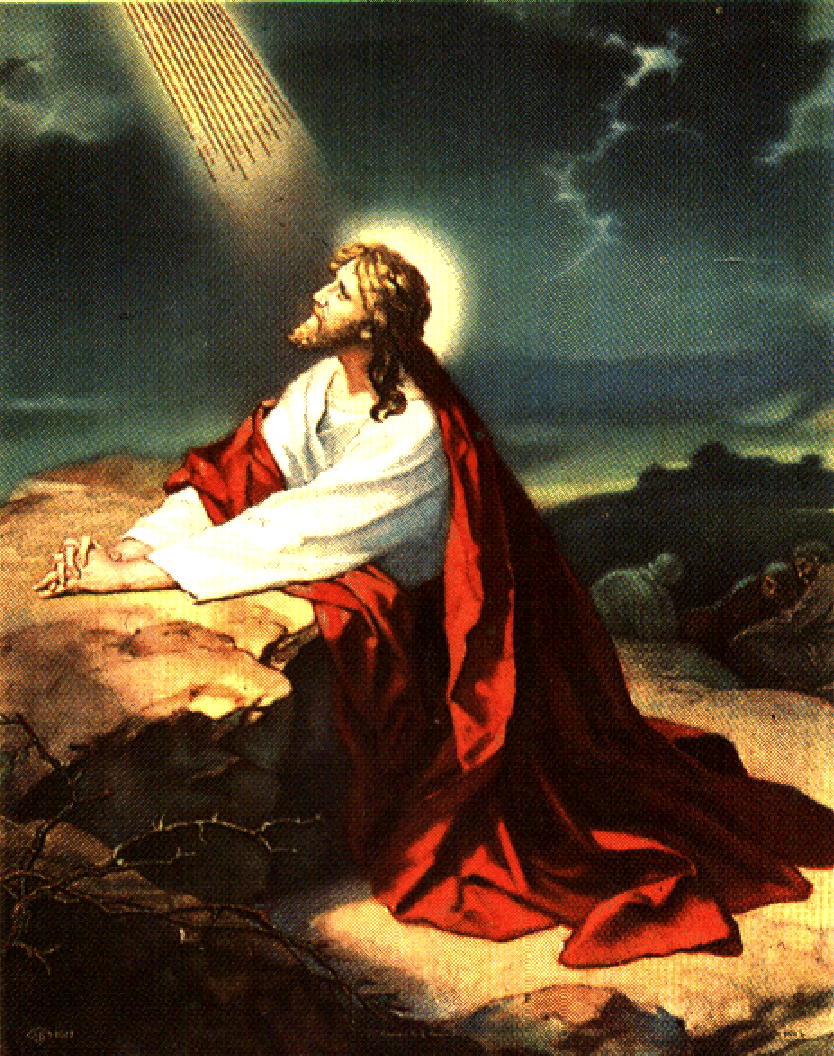
I recently had an interesting conversation about Jesus' prayer in Gethsemane, "Not my will but thine be done." What made the conversation so interesting was the lead question: to whom was Jesus' praying in the garden? God the Father? God, a.k.a. the entire trinity? Himself, a.k.a. God the Son? Our conversation marked this as a genuine Bible Brain Buster: a biblical text that becomes puzzling in light of central Christian affirmations. In this case, how do we think through the prayer life of Jesus in light of his divine nature?

Since the question itself is just as interesting as the answer, let me offer a few possible responses before reflecting directly upon the significance of the question:

Option 1: The man Jesus is praying to God.

This first option is not really a solution but a denial of the problem. The story of the Garden of Gethsemane is simply a story of a human being crying out to God. Jesus may have been a perfect human being, but he was a human being nonetheless, and so prays to God like any other human being. Within this option a number of approaches to the divinity of Jesus could be taken: God the Son emptied himself of all divine attributes at the incarnation; Jesus became divine after the resurrection; Jesus' divinity refers to his perfect reliance on God's Spirit; etc. The strength of this option is its emphasis on Jesus' true humanity and its straightforwardness with regard to this particular text. The weakness of this option is the corners it has to cut with regard to a robust affirmation of the divinity of Jesus.

Option 2: God the Son is praying to God the Father.

This second option grounds the historical Gethsemane prayer in the eternal life of the triune God. In the story of the Garden prayer we catch a glimpse into the inner life of the trinity: the Father sends, the Son is sent; the Father wills, the Son submits his will. The Christian doctrine of the Trinity tells us that God is not a single willing person but three persons, each with its own "personality" and therefore "will." So God has these sorts of internal conversations all the time; the Gethsemane prayer is simply a significant instance of this social life of God. The strength of this option is its emphasis on Jesus' true divinity and its decision to locate this problem within the dynamics of the trinity. The weakness of this option is the new problem this solution creates: is a God with three wills really the one God of Israel? To put it bluntly, this multiple-personality theory runs the risk of tritheism.

Option 3: The Incarnate Son as the man Jesus is praying to God the Father.

This third option tries to bring the doctrine of the trinity and the doctrine of incarnation in close connection with one another in order to make sense of the prayer life of Jesus. In the story of Gethsemane we see the temporal fulfillment of God's eternal purpose to become incarnate. The one God with one will chooses to send himself into human history by taking on the human flesh of Jesus. God's eternal constitution as one being in three persons has this incarnational end in view. So the eternal Son (who has no will other than the Father's) wills to take to himself a complete human nature. This complete human nature includes a fully human will. Therefore, God the Son has two wills: the common divine will shared by all three persons of the Godhead and the human will of Jesus. So, in the garden, the fully divine Son incarnate as a human being is praying to God the Father in the power of their Holy Spirit. The incarnate Son submits his human will to the will of God the Father. The strength of this option is the close connection drawn between the trinity and the incarnation as well as its use of the "two wills" doctrine affirmed at the Sixth Ecumenical Council (Constantinople 680-81). The weakness of this option is the possible implication that God must become incarnate in order to be triune. It is also a terribly complicated answer, which may be perceived as a strength depending on one's temperament.

Well, there's some possible responses to the question of "To whom was Jesus praying?" Now I find this question and the debate between these answers fascinating. I would be happy to discuss the particulars of the matter. But even more interesting to me is that one would even ask this question in the first place. The only person who would treat the Garden of Gethsemane story as a puzzle is someone who assumes a high Christology. You can tell a lot about a person's theological commitments by observing which biblical texts create interpretive difficulties for them. In other words, one's admitted Bible Brain Busters reveal one's deepest beliefs. Even if these beliefs are held implicitly or unreflectively, they exert pressure on us at these critical points. So identifying one's own (and others') Bible Brain Busters helps us to explicitly investigate our beliefs and how they relate to specific Scriptural passages. Hence, they are a worthy entry point for theological inquiry.

Any thoughts?
So, what are your Bible Brain Busters?
Which texts throw you for a loop?
Can you identify what basic beliefs make these texts particularly difficult?
Do you have any thoughts on the example of Jesus' Gethsemane Prayer?

NOTE: If I get a good list of Bible Brain Busters going, I may do a series on them at some point.