Showing posts with label Heresy. Show all posts

Thursday, August 31, 2006

Trinitarian Heresies

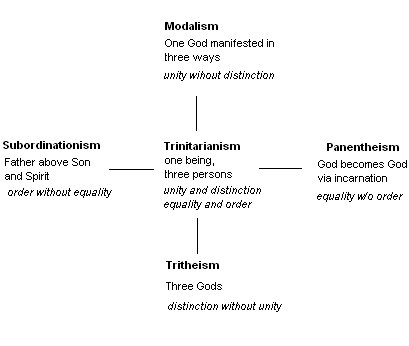
I thought I would top off this month's series on heresies with the most heresy-haunted Christian doctrine of all: the Trinity. Augustine once quipped that to not think about the Trinity is to risk heresy, but to think about the Trinity is to risk lunacy. As for me and my house, we've chosen the second risk as the wiser venture. I think the Trinity exemplifies best of all the principle outlined in the previous post that the careful study of heresy illuminates Christian doctrine.

The heart of the doctrine of the Trinity is a four word theological affirmation: that God is one being, three persons. Despite the complaints of popular doubt promoters, understanding this is not the great barrier to belief. The real problem is grasping what is at stake in this affirmation. It just sounds like some kind of irrelevant and irreverent divine math. What makes this affirmation so much better than other ways of talking about the relationship between the Biblical names of Father, Son and Holy Spirit?

Enter the trinitarian heresies. By comparing and contrasting the classic and contemporary trinitarian heresies, we can see what is at stake in affirming the Trinity. It's not so much that "one being, three persons" is the best possible thing we could say about God's inner life, but rather that all the other alternatives are much worse. If we don't say this, then we logically fall in one of four traps:


Once again, the doctrinal affirmation is found within the space between one-sided heretical options.

Any thoughts?
Are these terms and distinctions clear enough?
What other conceptual alternatives are there to speaking triple name of God?
What other doctrinal domains would you like to see this kind of analysis applied?
Which would you rather risk: heresy or lunacy?

Thursday, August 24, 2006

Christianity's Natural Heresies

Last week I suggested an alternative view of heresy that points towards its redemption rather than mere rejection. Such a redemptive attitude and procedure is not the only benefit of this view. In the process of redeeming a heresy, we can actually come to a deeper and wider understanding of the whole of Christian truth. If heresies bear witness to an aspect of the truth, the study of multiple heresies in tandem can shine a light on the picture of the faith.

Heresies do not arises out of nothing. By definition they latch on to some aspect of the truth. They have some organic or natural connection to Christian doctrine. By analyzing a heretical claim, we can identify this core of truth. After performing such an analysis on opposing heresies, we can synthesize the insights into a greater whole. Thus the heart of Christian doctrine can be displayed in relationship to its natural heresies.

In pursuing this task, it is particularly helpful that most classical heresies have an opposing counterpart. For instance, in the earliest centuries of the church, emerging Christology naturally leaned in one of two directions: either toward Docetism (the notion that Christ was divine being who only appeared to be human) or toward Ebionitism (the notion that Christ was a only a human being). The fully developed Christian claim is found in the space between these two extremes: that Christ is both divine and human.


The procedure of finding the truth between the extremes is not limited to the inherently paradoxical domain of Christology. The same program yields insights in the realm of Christian anthropology. As the early Christians began to think about humanity which is saved by Christ, two natural tendencies emerged. On the one hand, humanity might be regarded as so sinful that it is irredeemable, such that salvation is understood as an escape from human life. This perspective was advanced by many gnostic groups, but most sharply by Manichaeans. On the other hand, humans might be regarded as so ready for salvation that they essential save themselves. This perspective was advanced most famously by the Pelagians (although Pelagius himself may have been more subtle, Pelagianism has become the "name brand" for this heretical viewpoint). Once again, the fully developed Christian claim is found in the space between these two extremes: that humanity is utterly sinful yet grace is powerful enough to overcome sin and redeem humanity.


By combining the insights drawn from both sets of extremes, we can paint a pretty good picture of the heart of the Christian faith in counterpoint to its natural heresies. Christians affirm Jesus Christ as the fully divine and fully human savior of humanity from its sin. According to this procedure, orthodoxy is not achieved by rejecting a long list of heresies. Rather, Christian faith is best expressed in the space between its natural heresies, as the whole truth God which reconciles such oppositions.
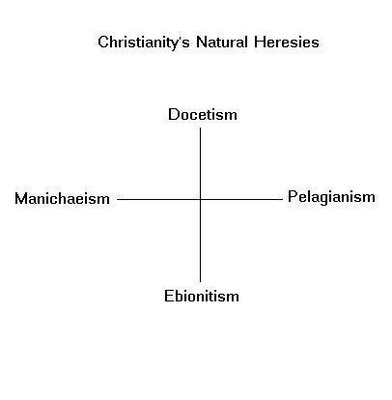


This diagram is of course just one possible way of expressing the complexities of Christian belief by means of a study of its natural heresies. This particular one was made famous by F. D. E. Schleiermacher in the introduction to his great work, The Christian Faith. By drawing on such a controversial modern theologian, this post intends to embody the very spirit it promotes: that we can learn from any Christian who takes the time to articulate affirmations about divine things.

Any thoughts?
Does this diagram illuminate how heresy can be used to gain deeper understanding of the faith?
What are some other natural heresies of Christianity?
Are there any heresies that do not come in such neat pairs?
Does such a procedure really work in the midst of a heretical controversy, or is it only possible as an after-the-fact reflection?
Wednesday, August 16, 2006

What is heresy?

Heresy is a term used either too much or too little in Christian circles. Either Christians call everything they disagree with a heresy, or they are so afraid of offended or exclusing someone that they are unwilling to employ it even when its appropriate.

I think that some of the problem with our misuse of the term heresy comes from an misunderstanding of what heresy is. The word heresy comes from the word for "faction" or "party." Heresies are parties within the church that make one doctrine or one perspective on a doctrine the centerpiece of the faith to the exclusion of the rest. Thus, heresy is not exactly the opposite of orthodoxy ("right teaching"), but is more precisely the opposite of catholic ("universal, complete"). Accordingly, heresy is best defined as substituting part of the truth for the whole. This is why heretics are not completely wrong and often have much truth to share. The problem with heresy is not its utter falsity, but its one-sidenesses.

How might this change our attitude toward heresy? Heresies are not extra-Christian viruses to be eradicated, but intra-Christian parasites that feed off the truth. The solution to heresy is not to push it out, but to draw its one perspective back into the whole truth of the Christian faith. In other words, heresy is to be redeemed.

Let me give an example.

In the 5th century, a certain party called the monophysites claimed that Christ had only one nature: the divinity of Christ subsumed his humanity so that the humanity was rendered divine. This heresy witnessed to the truth that Christ was not a schizophrenic half-man/half-God, but one single person, the Son of God become man. Unfortunately, they did so at the expense of the complete humanity of Christ.

Simultaneously, there was another party who bore the brand name of Nestorians who claimed that within Christ there were really two persons: the divine son of God and the human son of Mary. This heresy witnessed to the truth that both the divinity and humanity of Christ were complete and unaltered. Unfortunately, they did so at the expense of the integrity of Jesus Christ as one single person.

At the council of Chalcedon (451), the church affirmed the truth on both sides of the argument: Christ is one person with two natures. The heresies were not so much rejected as assimilated into a larger whole. The truth on both sides was affirmed, while the error was left behind. In other words, these heresies were redeemed.

Any thoughts?
How does viewing heresy this way help us to approach views other than our own?
Do you have any other examples of heresy being redeemed?
Are there any heresies that come to mind that seem "unredeemable"?
How do we practice the art of redeeming heresy without becoming misled ourselves?