Showing posts with label Wesleyan. Show all posts

Wednesday, November 14, 2007

Functional vs. Ontological Ecclesiology: Is that really the Question?

At a recent gathering of Wesleyan and Free Methodist theological educators, ecclesiological questions provided the common theme of the papers and discussion. During the course of the conversation, a conceptual distinction was introduced between functional and ontological ecclesiologies. The basic contrast is between understandings of the church which focus on her doing (function) and understandings of the church which focus on her being (ontology). Now, of course, no one would advocate reducing the church to either her doing or her being. But one can certainly detect tendencies in either direction among the many ecclesiological options available.

As you might have guessed, given the reductive connotation of the word "functional," this distinction often carries with it an agenda: namely, that we should moved from a "mere" functional ecclesiology to a "more robust" ontological ecclesiology. In Wesleyan circles, this prescription often trades on a descriptive narrative of Methodism, which supposedly lost its ontological grounding upon its break from the Anglican Communion. "Beware of treating the church as a mere means to some other end," is the watchword of a ontological ecclesiology.

But, this distinction could in fact be just as easily used to argue in the opposite direction. One could argue that the nature church should be defined by its purpose rather than the other way around. In Wesleyan circles, this prescription trades on the same narrative of Methodism told in a different light: the church was most alive when it was free to focus wholly on its mission without concern for ecclesial preservation. "Beware of an inward focus on the church," is the watchword of a functional ecclesiology.

Now this conversation could go on forever. There is no obvious resolution. The best arguments are usually based on reactions to the abuses of the other extreme. These kinds of arguments are ultimately unpersuasive, and perhaps even pernicious because they just keep the pendulum swinging without moving us forward.

The problem is exacerbated by the fact that the distinction in the end does not illumine very much. For instance, advocates of both functional and ontological ecclesiologies speak regularly of the mission of the church. In fact, the most extreme forms of each see themselves as representing a missional ecclesiology: the one in terms of mission as a divinely willed activity to which the church contributes in some way, the other in terms of mission as participation in the being of God and God's people. And yet despite these differences, both approaches can be and are used to validate the same old divisive ecclesial options (sacerdotal, evangelical, secularist). If such a basic concept as mission can be so easily shared by the two in such a way that the same old patterns are perpetuated, it is questionable whether the distinction really achieves all that much. You get a lot of idle talk about the church and its mission that in the end serves to justify one's agenda, whether it be liturgical renewal, evangelism programs, community service, etc.

In the face of these problems, I would like to suggest that the functional-ontological distinction itself is fundamentally flawed. The flaw is the presumed disjunction between being and act. Rather, the church's being is in her act. The church has no being prior to its active life as sent into the world as witnesses to the risen Lord Jesus Christ in the power of the Holy Spirit. Thus it has no "being" which can be cultivated without reference to her "function." And yet she is not "merely functional" in the sense of a dispensable instrument used toward the accomplishment of an end. The active life of missionary witness is a life lived in fellowship with God, which is the end God has in mind for his people and the world. So in her act the church lives and moves and has her being. I think the disjunction between being and act should be dropped, and with it the notion that one must choose between functional and ontological ecclesiology.

So the next time someone asks me whether I have a functional or ontological ecclesiology, I am going to say that I reject the premise of the question (if I'm feeling feisty) or just answer yes to both and explain why (if I'm sensing the need to be more gracious).

Any thoughts?
  • Have you encountered this distinction before?
  • Do you find it helpful? How so?
  • Have you tended to lean one way or the other? Why?
  • Can we speak generically of an "ontological" view of anything without specifying what kind of "ontology" we are presupposing?
  • Is the disjunction of being and act a problem?
  • How does the uniting of being and act bear on the question of mission?

Thursday, November 01, 2007

Sanctified from what? Sanctified for what?

I have been thinking about sanctification lately. As is my custom, I've been asking "grammatical" questions of our talk of sanctification.

First of all, if sanctification in its most basic sense means "to set apart" or "to separate," then sanctification must necessarily be "from" something. To be sanctified is to be set apart "from" x, y or z.

But once the preposition "from" is introduced, the question of what we are sanctified "for" must also be addressed. We are not only set apart "from" x, y or z, but also set apart "for" a, b or c.

What is of interest to me is how our understanding of that from which we are sanctified necessarily conditions our understanding of that for which we are sanctified.

For instance, if we are sanctified from ordinariness, then we are sanctified for usefulness. I am drawing here on the metaphor of ancient worship, whereby certain objects were "set apart" for use in sacred spaces. Something which is ordinary (e.g., goat), is set apart for a special use in worship (e.g., sacrifice). In a similar way, Christians are sanctified by the Spirit from their ordinariness to be used by God, in his service and for his glory. The risk in this language is to treat sanctification as some kind of priveledged status or sanctified persons as utterly cut off from the secular world. But the basic idea is a right one that has a place in an acccount of sanctification.

But we can and should go further. If we are sanctified from sin, then we are sanctified for righteousness. Of course, here we run into the issue of how to define sin. We can speak of both sin as nature and sin as acts. If we think of sin in terms of our sinful nature, then our sanctification means our being set apart for a righteous nature. Whether this means we are given a brand new nature or that the sinful aspects of our good nature are cleansed will depend on how we understand the effects of sin on our created human nature. If we think of sin in terms of our sinful acts, then our sanctification means our being set apart for righteous acts. Whether this means obedience to law or having right intentions will depend on how we understand what makes an act sinful. Of course, talk of nature and actions cannot be wholly separated. But it can be seen from the above how the understanding of that from which we are sanctified necessarily conditions our understanding of that for which we are sanctified.

Any thoughts?
Do you agree that the "from" of sanctification conditions the "for" of sanctification?
What are some other things from which we are sanctified?
What are some other things for which we are sanctified?
Is there a tendency to separate the "from" and the "for" of sanctification?
Why is this?
What happens when we do this?
Can you think of any "froms" in our talk of sanctification that need to be filled out by a "for"? Any "fors" that need to be connected with a "from"?
_

Wednesday, June 13, 2007

Wesleyan Doctrinal Symposium: "The Church as Sanctified Community of the Triune God"

A little over a week ago, my denomination (the Wesleyan Church) held a doctrinal symposium at its headquarters in Indianapolis. The topic was ecclesiology. Just the existence of such an event is heartening. And it turned out to be a rich and enjoyable experience with presentations, conversations and fellowship.

I happened to be one of the presenters. Below you will find my full paper (sans footnotes), which is also posted in pdf on my writing site. You can also follow this link to the symposium website for all the papers. Enjoy and feel free to make comments or raise questions about my or any of the papers by posting in the discussion board.


"The Church as Sanctified Community of the Triune God"

What is the church? What does it mean to identify a particular community as church? Is “church” merely a moniker for any religious community? Or does “church” have a distinctly Christian meaning? And can the word “church” in its distinctly Christian sense bear theological weight? In this paper I aim to tease out the theological meaning of “church.” If successful, these elucidations may serve as a framework for discussing the concrete ecclesiological issues of our day.

Unfortunately, the road to a properly theological understanding of the church is paved with difficulties. I do not refer merely to the disappointment, boredom, and suspicion concerning the church, both from within and from without. No, the greatest obstacles to theologizing about the church are themselves theological. How do we connect our talk of God with our talk of the church? Systematic theology is the activity whereby Christians make connections between our various beliefs in order to better perceive and present the fullness of the gospel. We are not looking for just any connections, however; we are looking for connections to our beliefs about God. “What’s God got to do with it?” is the theologian’s refrain. Only statements that attempt to answer the question of God are properly theo-logical.

So, why is it so difficult to connect our church-talk to our God-talk? Three particular obstacles come to mind. The first is the problem of theological presumption: we habitually take for granted our most basic beliefs. What we believe about God—who he is and what he does—is assumed to have been settled long ago. But is this really so? Can we really count on all of us to think spontaneously thoughts worthy of our God? A staff pastor I know once asked her senior pastor after an interview with a potential minister of congregational care, “Where is she at theologically?” The senior pastor responded, “I don’t know. Why would I ask theological questions of someone who will be visiting sick people?” Such presumption leads to neglect, confusion and ignorance. We ought not to take our most cherished beliefs for granted; rather, we should ask pointed questions about the identity and activity of the Christian God. Only then will be able to ground our ecclesiology in our theology.

The second problem is that of soteriological abstraction: we consistently separate our talk of salvation from our talk of God. This problem is a consequence of the first: we presume that we all agree about God, so let’s move on to the interesting, debatable stuff about conversion, predestination, sanctification, end times, etc. I recently taught a FLAME class in advanced theology. The focus was the doctrine of the trinity. One of the students objected, saying “This doesn’t sound like theology; theology is about the order of salvation: prevenient grace, justification, initial sanctification, etc.” In due time, she and (some of) the other students came to appreciate inquiry into the doctrine of God which lies behind our doctrine of grace. But her initial objection unmasked the soteriological abstraction of so much Wesleyan theology. For Wesleyan theology to be theology, we must begin again at the beginning and talk not only about sanctification, but about the Sanctifier. Only then will be about to inquire into a “Wesleyan view of the church.”

The third and final problem is that of ecclesiological reduction: our talk of the church has been reduced to sociological pragmatism. Now don’t hear me wrong: the church is an empirical reality and thus has benefited greatly from statistical research and demographic analysis. These tools have helped us stop groping in the dark for practical solutions. Anyone who rejects sociology wholesale denies the humanity of the church. But the church is more than a social system! It cannot be adequately explained or guided by empirical research alone. To reduce the church to observable phenomena is to deny the divine agency that creates, sustains and consummates her. As I’ve heard Harry Wood at a recent Penn-Jersey District event say, “Theology should be in the driver’s seat; sociology should be in the back seat.” We don’t need to kick sociology out of the car; we just need to prevent it from becoming a back seat driver. And the best way to do prevent sociological reductionism is to locate our talk of the church within our talk of God.

Now that I’ve painted myself into a corner, let me indicate how I plan to overcome the obstacles of theological presumption, soteriological abstraction, and ecclesiological reduction. In the remainder of this paper, I will perform trinitarian renditions of three prominent descriptions of the church: the people of God, the body of Christ, and the temple of the Holy Spirit. Each of these descriptions will be developed from the perspective of the triune God who sanctifies the church. The intended result is to join together the theological connections that have been torn asunder by our presumption, abstraction and reduction. I am not delusional enough to think that I can single-handedly surmount these obstacles by simply talking my way through these connections. However, inasmuch as these problems are perpetuated by bad habits of speech, the least a theologian can do is display what a good habit of speech looks like.

What follows is thus an exercise in grammatical analysis: identifying the subject, verb and object of each of the three ecclesial descriptions under investigation. The triune God is the subject of these sentences. Sanctification in its many aspects is the verb. The church is the object of God’s sanctifying action. Unfolded in trinitarian terms: the Father sets apart a people for the Son by the Spirit; the Son cleanses his body for the Father by the Spirit; the Spirit fills the temple for the Father and the Son. These are three distinct yet unified ways of saying “God sanctifies the church.” All this talk of grammar might make one wonder whether I am just “making this up.” I assure you that I am genuinely trying to perceive and present the inner logic of our beliefs. But, in case what follows is not self-authenticating, I will add to its appeal by indicating how this language can help reframe a concrete ecclesiological issue: membership commitments. Such practical benefits cannot alone make theological statements true. But the usefulness of theological language in the service of the church’s mission is certainly a point in its favor.

I. The Father sets apart a people for the Son by the Spirit

In God’s history with us, God has revealed that he is in eternity God for us. God in eternity self-differentiates his being as three persons: Father, Son and Holy Spirit. The Father begets the Son. The Son is not another God, but another in God. Even as God is centered on himself, God is also others-centered. These eternal persons in relationship are kept both united and distinct by the power of the Holy Spirit, who proceeds from the Father and the Son as their bond of love. These eternal relations are the basis for God’s self-differentiated action in time. God purposes from all eternity to enter into time to bring glory to himself and to share his glory with his creation. God sends himself. The Father sends the Son to become incarnate by the power of the Spirit. The Father and the Son send the Spirit as the outpouring of God’s power onto his creatures.

However, God does not simply “show up.” God sets in motion a history that will be fulfilled by his coming. This history centers on a particular people. God establishes a covenant with a particular people among whom he will dwell. In so choosing a people, God is sanctifying a people: setting them apart for divine service. Not just any service, but service for God’s Son. The Father in his mercy chooses this people from among all others so that his Son may be born among them. Toward this end, God keeps his people by the power of his Spirit. The Spirit leads them through the wilderness. The Spirit is present to them in temple, land, and book as they wait for the coming of the Son. The Spirit empowers prophets to orient the people toward their future. In short, the Father sets apart a people for the Son by the Spirit.

Who is this people? Whom does the Father set apart for the sake of his Son by the power of his Spirit? Well, it should be clear that we are talking about Israel. It is Israel whom God chooses. It is Israel in whom Jesus Christ is born. It is Israel whom God keeps by his Spirit. Israel is the people of God. If we want to understand what it means to be set apart by God for God, we must look to Israel, the people of God. Although this fits well within a broader view of the triune God’s sanctifying work, such a turn to Israel raises an ecclesiological problem: is the church also the people of God? By what right do we call this community of Jews and Gentiles who bear direct witness to Jesus Christ the people of God? Can the language of people be adapted or extended to include the church?

Needless to say, the relationship between Israel and the church raises complex questions that deserve complex answers. Some have called this the ecumenical problem — making intra-Christian divisions appear petty by comparison. I do not seek to answer it completely or conclusively here, but I would like to identify a potential Wesleyan contribution to this question.

Some of the greatest strides in re-conceiving the relationship between Israel and the church in more positive terms have been made by recent trends in Pauline scholarship. According to the “The New Perspective on Paul,” it is becoming increasingly clear that Paul had a much more positive attitude toward the Jewish law than some traditional interpretations have allowed. Judaism at the time of Jesus and Paul can be characterized by its covenantal nomism: by following the law, a Jew does not “get in,” but “stays in.” Even the law is a gift of grace. Paul’s theology was not so much a result of a search for grace after having being pressed under the weight of the law. Rather, Paul’s attitude to the law is shaped by the apocalyptic coming of God announced in the resurrection of Jesus Christ, which relativizes the law but does not abolish it. So the fulfillment of the law in Christ brings with it the triumph of God’s covenant with Israel.

The point of bringing all this up is simply to observe that Wesleyans are considerably less threatened by these developments than some of our fellow inheritors of the protestant reformation. We Wesleyans instinctually grasp that Paul has a complex attitude toward the law. We can stomach the notion of greater continuity between Israel and the church. A Pauline ecclesiology of Gentile inclusion in God’s covenantal community characterized by law-keeping fits well with the distinctive spirit of the Wesleyan/Holiness tradition. I do not think that this parity alone justifies the claims of either Wesleyan theology or the New Perspective. I only wish to indicate that Wesleyans should feel comfortable assimilating the insights of recent Paul scholarship inasmuch as they are helpful for developing a theology of continuity between Israel and the church.

So what ecclesiological lesson can the church learn from Israel? The triune God bears witness to himself through particularity. In other words, Israel fulfills its task simply by being different. This is also true of the church. God sets apart us so that the world will take notice of him. A holy church is a different church, a people that stands out among the many peoples of the world. We must, of course, beware of setting up arbitrary and inhospitable differences between the church and the world. But the church is not the world! Anyone who seeks to erase all difference between church and world is endangering the mission of the church to the world.

The implications for membership commitments should be evident: concrete identity markers are an aspect of God’s sanctification of the church. We need not apologize for our oddities. Actually, apologizing for them spoils them. We should celebrate our difference, although with an inviting rather than repelling attitude. Only if we are identifiable as a Christian community will the world see our works and praise our Father in heaven. You may recall a tragedy that took place in Pennsylvania a few months ago. A man killed three Amish school children in a fit of rage. You may also remember the amazing acts of reconciliation that followed. The News coverage did not treat these acts as a mere human interest story, but saw them as great acts of faith. Why? Because even the News could see the concrete identity markers that set apart the Amish as a community of faith. They bore witness to the world by their difference from the world. And thus they lived according to the truth that the Father sets apart of a people for the Son by the Spirit. In our own way, may it also be so with us.
II. The Son cleanses his body for the Father by the Spirit

Having set apart a people for himself, God becomes incarnate and dwells among us. God becomes human. As in the establishing of the covenant, so also in the fulfilling of the covenant God’s action is self-differentiated. In fact, it is here that God’s triune identity is definitively revealed, for the Son, in distinction from the Father and the Spirit, becomes incarnate. The Son alone becomes incarnate. Yet the triune God is indivisibly involved in the incarnation. As the Father generates the Son in eternity, so the Father sends the Son in time. And as the Spirit is the bond of love between the Father and the Son in eternity, so the Spirit binds the Son to the Father as he sojourns in time.

God sanctifies human flesh for the sake of his mission. God brings Jesus of Nazareth into strict identity with himself. The Son of God is Jesus of Nazareth. Jesus of Nazareth is the Son of God. In the context of this personal identity, the human flesh is utterly obedient to God. As such, the incarnate Son obeys the Father by the Spirit. The Spirit drives; the flesh obeys. The obedience of Jesus Christ runs from his conception through his whole active life and culminates in his passion and death. His entire life of obedience is affirmed when on the third day the Father raised the Son by the power of the Holy Spirit. By this history of obedience, sinful humanity is cleansed. In short, the Son cleanses his body for the Father by the Spirit.

It is by this history of obedience that our redemption is won. God has fulfilled the covenant by this history of obedience. God can look upon his creature and call it good, for Christ can look at his cleansed body and celebrate its obedience. But what about us? What does this have to do with the church? Certainly Christ’s body is cleansed, but are we not still dirtied by disobedience? Here is where the biblical language of body is so helpful. For although first and foremost the body of Christ refers to the human flesh named Jesus of Nazareth, in a secondary and dependent yet very real sense, the body of Christ refers to the church. We are united to him as body to head. This is not the hypostatic union of the incarnation, whereby God is identified as Jesus; but it is a union nonetheless. And so the Son’s cleansing of his body includes his cleansing of us! Now this cleansing might sound like some automatic mystical process, but that is not how body language operates in the New Testament. No, body language appears in the context of exhortation: because we are the body of Christ, we ought to do this or that. The cleansing of the body of Christ takes place as the church by the power of the Holy Spirit obeys the will of the Father revealed in Jesus Christ. Thus we are not only witnesses; we are obedient witnesses to the triune God.

What does this mean for the life of the church? An affirmation of Christ’s cleansing of his body inclines one toward a specific way of thinking about the marks of the church. During the ecclesiological revolution that came to be known as the reformation, the various protestant groups were compelled to defend themselves against the charge of schism. The general response was to develop a doctrine of the marks of the church whereby one can identify the true church from the false church. The list of marks varied from group to group. Martin Bucer, the leader of the reformation in the city of Strausbourg, recommended three marks of the church: wherever the pure word of God is preached, the sacraments are rightly administered, and discipline is properly executed. Because of the perceived abuses of the radical reformers in their emphasis and application of church discipline, the magisterial reformers dropped discipline as a mark of the church in favor of the twofold pattern of word and sacrament. The debate concerning two or three marks reemerged a century later during the Puritan controversy in England. The Puritans pushed for the return of discipline as the third mark of the church, and on its basis began to question the authority of the Anglican Church. Through the influence of his Puritan heritage, John Wesley affirmed the third mark and the churches that developed out of the Methodist revival include the third mark in their constitutional documents, many of which are not inconsequentially named “The Discipline.”

The point of this historical excursus is that the process of concrete discipleship is a critical aspect of what it means to be the church. To be the body of Christ is to be obedient to the triune God. Church discipline is not just institutional maintenance. More importantly, it is the process whereby the body of Christ is brought into submission to God. Church discipline is a spiritual exercise. The implication for membership commitments is that whatever “list” we come up with cannot simply be a matter of who’s in and who’s out. All too often membership commitments are too narrowly associated with the act of becoming a member. But these guidelines are not only boundaries, but also goals. We ought to seek after a life of obedience as a community. “Because you said you would” is an unsustainable basis for fulfilling membership commitments. Because they are an expression of our obedience to God is a much better reason. This raises the question of whether our commitments are really pleasing to God. But responsibly and constitutionally developing our commitments is itself part of our communal pursuit of obedience. Even as they undergo development, the process of accountability to our membership commitments is a direct expression of the Son’s cleansing of his body for the Father by the Spirit.

III. The Spirit fills the temple for the Father and the Son

Having enacted a life of obedience as the fulfillment of his covenant with Israel, the triune God reigns in glory as he ushers in his kingdom. The Spirit of God blows toward this final unity of all things. The same Spirit who unites Father and Son in eternal love and empowers the incarnate Son to obey the Father has now been poured out on God’s community of obedient witnesses. He has been given as a promissory down payment of things to come. It is by the Spirit that God raised Jesus from the dead as the first fruits of the resurrection of all flesh. The Spirit is thus fundamentally oriented toward the future. It is only at the end of history when the Spirit will complete his work of binding, recapitulating the eternal bond of love between the Father and the Son in the marriage of Christ and his church that places God and humanity in perfect harmony.

The Spirit of God is drawing all of humanity toward this end. He does this by filling specific human agents with his power that they might live in accordance with their future destiny. Although the church cannot be equated with the kingdom, it is the beachhead of the kingdom by the power of the Spirit dwelling within her. The church is thus rightly called the temple of the Holy Spirit. The Spirit fills this temple for the Father and the Son.

Having empowered the incarnate Son to obey the Father, the Spirit now empowers the church to obey the will of God. We are not given an impossible standard and then left to our own devices. The law of love enacted in Jesus Christ is written on our hearts by his Holy Spirit. We are empowered by the Spirit to live lives pleasing to God. As such we are an example of the future God desires for all people. We are not only obedient witnesses, but also exemplary obedient witnesses. If the world wants to know what the future holds, it should be able to look no further than the church.

What does this entail for our understanding of the church? It should at minimum give us pause before rejecting the language of “end times community.” The holiness movement from its inception has had a utopian impulse that must be acknowledged. Some early Wesleyan Methodists thought they were bringing in the kingdom with their social reforms. Some holiness camp meetings were perceived as a special outpouring of the Spirit in preparation for the return of Christ. Some holiness churches understood themselves as sojourners and pilgrims in a strange land. The very logic of a holiness movement presupposes a view of the church as a foretaste of heaven in some sense. It is this sort of eschatological consciousness that propelled holiness churches toward the future in their opposition not only to slavery, but also to the subordination of women and the sex trade. In these things the holiness movement was ahead of its time. While some Christians sat idly by, tolerating sin as a necessity in a fallen world, holiness movements pushed the church forward toward the future. This need not be an act of hubris, provided the church really is the temple of the Holy Spirit.

Now this utopian impulse is not without its problems. No one community can be identified with the fullness of the kingdom. God will finish his work by a sovereign upheaval beyond the forces immanent in this natural world. This radical limit must be set against any society, culture, or church that claims to be working toward the coming kingdom. But within these limits, an awareness of the Spirit’s filling should continue to propel us toward God’s future. We should ask what new thing God is doing and seek to participate in it. We should be ahead of the times. We should seek to become the community for which the world is groaning. In other words, we should be living in the end times.

An implication of this way of thinking is that membership commitments should reflect not only where we have been but also where we are going. Membership commitments should describe the kind of community that God wants the world to be. Membership commitments should thus describe the kind of community the world needs to be. The church ought to be attractive to the world, as an example of the world’s future. This does not mean merely revising our membership commitments in order to avoid offending the world. We can and should be different from the world, but not arbitrarily so. We should be different from the world in precisely the way the world desires to be different from itself. Everybody wants to make the world a better place. The church happens to know what that looks like, for it sees the future of the world in the face of the risen Lord Jesus Christ. This Spirit-filled orientation toward the future means we should ask tough questions about what the future holds. What attitudes will characterize the new heavens and the new earth? What kind of society will take shape at the marriage feast of the Lamb? What are the politics of the New Jerusalem? How can our ecclesial standards reflect this future reality? What must be added? What must be adapted? What must be removed? These sorts of questions will guide us in the development of membership commitments that exemplify the Spirit’s filling of the temple for the Father and the Son.

Conclusion

The church is the sanctified community of the triune God. The Father sets apart a people for the Son by the Spirit. The Son cleanses his body for the Father by the Spirit. The Spirit fills the temple for the Father and the Son. Thus we can say with boldness that the church is the people of God, the body of Christ, and the temple of the Holy Spirit. As such we are exemplary, obedient witnesses to the triune God. This pattern of thought does not solve every concrete ecclesial problem, but it does offer a language with which to discuss pressing issues of the day. My hope is that equipped with such good habits of speech we can stop talking past each other and start working together to live as the sanctified community of the triune God.

Any thoughts?
_
Wednesday, June 06, 2007

Review of Gary M. Best, Charles Wesley: A Biography

One way to commemorate the 300th anniversary of Charles Wesley’s birth is to tell the story of his life and work. Gary Best’s biography of the ‘man made for friendship’ highlights Charles’ unique contribution to the emergence of Methodism in the 18th century, and thus helps to bring Charles out from behind the shadow of his brother John. Although the wait for a modern biography of the younger Wesley brother has been far too long, the attention to detail and sensitivity to historical context that Best brings to his subject matter has been worth the wait. This biography has the potential to become the standard bearer of its kind for the foreseeable future.

Best begins by chronicling the key ecclesial and political events in the century prior to Charles’ birth, locating Charles’ forebears within this complex situation. The tension between loyalty and dissent already present in the Wesley family becomes a dominant theme in Charles’ story. This opening chapter would have benefited from greater sensitivity to the subtleties of the English reformation and the Puritan movement, but Best’s overview of the situation into which Charles was born is adequate for his purposes.

The remaining eleven chapters can be roughly divided into three parts: the early years from 1725 to 1741 (chapters 2-5), the turbulent 1740’s (chapters 6-8), and the remaining years from 1750 to Charles’ death in the late 1780’s (chapters 9-12). Adhering to the common pattern of biography in general and Methodist history in particular, Best gives disproportionate attention to Charles’ early years. Of particular interest is Best’s retelling of famous episodes in Wesley history (the Oxford Holy Club, the missionary fiasco in Georgia, the heart-warming conversion experience) from Charles’ perspective. Without denying John’s dominance, Best foregrounds Charles’ oft forgotten initiative and precedence in these and other incidences. Best displays Charles’ impact as a preacher and organizer in addition to his well-known hymn-writing abilities.

Charles’ conciliatory role during the conflicts with the Moravian and Calvinist branches of Methodism during the 1740’s shows that the epigram ‘the man made for friendship’ is more than mere sentimentality. Throughout the rest of Best’s biography, Charles finds himself standing between his brother John and other parties within and without the Methodist movement. In the 1750’s, clear division arises between the brothers concerning their loyalty to the Church of England. Best shows that Charles was more consistently opposed to dissent than John, in some cases almost single-handedly preventing premature separation. When dealing with this recurrent theme, the author at times advocates for Charles’ view, attitude, and approach. Whether or not such advocacy is appropriate for a critical biography, it is important that readers be made aware of Best’s partiality on this matter.

Although focused on the problem of loyalty versus dissent, the remaining chapters are not limited to this issue alone. Best deftly narrates the controversy surrounding the doctrine and experience of Christian perfection, the introduction of John Fletcher into Methodist leadership, the role of the Wesleys during the American War of Independence, and the growth of Charles’ family. Although these later chapters each cover about a decade of Charles’ life, Best’s attention to detail remains so that the reader continues to be exposed to lengthy citations from primary source material.

Best’s biography of Charles Wesley is a delightful exercise in social history. The figure of Charles emerges as an indispensable agent within Methodism and an affable friend and family man. He is carefully placed within the sociopolitical intrigue of his times. The reader comes away with a sense of his character and a grasp of his story. The ample use of primary source quotations brings historical voices alive. There is very little critical engagement with contemporary secondary sources, which is dissatisfying to the scholar but at least makes the book more accessible.

Best’s strengths as a social historian are unfortunately not accompanied by a strong theological interest. The development of Charles’ thought, alongside his life and work, is not analyzed in great detail. This is definitely not an intellectual biography of Charles Wesley. Best does not critically engage Charles’s complex relationship to various influences such as his Puritan roots, Oxford teachers, Moravian pietism, and Lockean empiricism. We learn precious little of how these ideas shaped Charles or how Charles in turn shaped these ideas. Of particular interest is the difference between John and Charles with regard to the doctrine of Christian perfection, which is identified but not explored. So, although Best’s biography of Charles Wesley has been worth the wait, we shall have to keep waiting for the definitive intellectual biography of Charles Wesley.

Within the bounds of his stated aim, Best has provided a solid biography of Charles Wesley that deserves to become the standard introduction to Charles’ life. The book would be appropriate for undergraduate and graduate courses in Methodist history, 18th century studies, and church history. Church groups or book clubs interested in Methodist roots would also find it accessible and enjoyable. Anyone who has been touched by Charles Wesley’s influence can aptly celebrate his contribution by reading this book.

Any Thoughts?
What impression would you have of Best's book if you'd only read this review?
What did you think of Best's book (if you've read it)?
What do you look for in a biography of a religious figure?
_

Wednesday, August 09, 2006

What Wesleyans Can Learn from Karl Barth (Part Three): Theological Ethics


And now for our third installment of "What Wesleyans Can Learn from Karl Barth."

We have learned that Wesleyans can take a cue from Karl Barth in matters of theological authority and in doctrinal procedure. But the significance of Karl Barth is not limited to these theoretical matters alone. Barth is also a beneficial guide for the practical world of Christian living.

Wesleyans are known for their concern for ethics. We have a strong heritage of ethical action, both personal and social. Our distinctive doctrine itself has an ethical thrust. To be sanctified is to be empowered for obedience to Christ by his Holy Spirit. Wesleyans don't need any help caring about ethics.

And yet Wesleyans face the same challenges as every other Christian in the modern and post-modern world: How do we know what is right? How do we determine best way forward? How shall we then live? Wesleyans certainly know that we should pursue righteousness; but how do find the path of righteousness?

A pre-modern Christian might simply say, "I do what the Bible says." Wesleyans have always known that although this approach testifies to the authority of Scripture over our lives, it is still too simple. The Bible does not address every possible situation. Christians must make decisions and develop ends that guide us through the complexities of our concrete lives. In the midst of this hermeneutical struggle, Wesleyans have far too often been enticed by the sense of security provided non-theological foundations for ethical decision-making. Whether it be classical forms of Plato or Aristotle, the modern calculations of Kant or Mill or Marx, or contemporary contextualism or pragmatism, Wesleyans have often been quick to ground their ethical decisions on some external structure. Our motivations have remained distinctively Christian, but our mode of ethical deciding and acting has been guided by seemingly brighter lights.

So who can lead us out of this valley of confusion? How can we learn to decide and act in a distinctively Christian way? Enter Karl Barth. In his unfinished life-work, the Church Dogmatics, Barth did the unthinkable: he concluded each volume with a part-volume on ethics. Now this was not simply to make an already impossibly long work even longer. The purpose was to render ethics an explicitly theological task. Just this structural decision alone is commendable: Christian ethics not an independent discipline with its own ground but rather flows directly from the word and work of God reflected upon by theology. This may seem obvious to those of us living in the wake of the 50-year development of theological ethics since Barth. But in Barth's day this was a radical approach. And despite the proliferation of theological ethicists, it remains a radical reminder of the distinctively Christian core of ethics.

The material benefits of this structural move are even more crucial. Barth discusses all the classic and contemporary "issues" from a center in Jesus Christ. The contours of each issue are shaped by the character of God revealed in Jesus Christ. All human action is under the Lordship of God's action in Jesus Christ. Any good that is done (whether explicitly or implicitly related to Jesus) is a witness to Christ's act of reconciling God and humanity. The basis of determining the rightness or goodness of an action is its alignment (or "correspondence") with the action of God. Accordingly, Barth can take unique views on issues ranging from abortion to war to economics that are seldom found held by the same person. How is able to keep this all in tension? By moving out from Jesus Christ to human action as a witness to him, rather than being guided by some non-theological foundation or partisan ideology.

What does Barth's radically theological approach to ethics have to say to Wesleyans? The first lesson is a negative one: we ought to repent of our unhealthy reliance on non-theological foundations. Like the Ephesian Church in the Book of Revelation, we have forsaken our first love. Although we should not burry our heads in the sand, we must certainly avoid using these external frameworks as a ground for our ethics. Jesus is Lord. Neither Plato nor Aristotle, Kant nor Mill, Left nor Right have lordship over us. We ought to be in constant conversation with these traditions, but they must never supplant Jesus as the Church's one foundation.

But the lessons from Barth are not wholly negative. We can take a positive cue from his work by developing explicit connections between doctrine and ethics. The doctrine of sanctification has only done half of its job if it merely informs us of the spiritual power that enables us to perform the duties we know by other means. We ought to be asking about the implications of a sanctifying God for concrete ethical issues. Rather than taking for granted what God desires in an individual case, we should think through from the beginning what sanctification looks like for the people involved in the situation at hand. These are the kinds of questions that guide ethics down an genuinely theological path.

Finally, Barth's bold structural move to include ethics within dogmatics raises a question about Wesleyan theological education. In my ministerial training, the two courses that seemed to have the least to do with each other where "Ethics" and "Theology of Holiness." It is telling of their separation that the former bore the registration category PHL, while the latter was designated REL. And the foundational status of Ethics was revealed by it being placed before Theology of Holiness in the recommended sequence of courses. Finally, the difference in content was striking, as anyone who had read Wesley and Kant on the same day can testify. The two courses were simply not aimed at the same student. One taught us how to reason through moral problems; the other formed us in a tradition that testified to the power of the Holy Spirit in our lives. If Wesleyan ministers are going to not only profess holiness but live it out, there must be a more conscious connection between these two courses. What would this look like? It may be addressed simply by the Ethics and Holiness professors having a conversation about how these course form students. It may require more complex curricular solutions regarding designation, loading, and sequence. But whatever it looks like, the divorce between theology and ethics in Wesleyan institutions should be addressed.

So that’s the third reason why this Wesleyan has taken an interest in Karl Barth.

Any thoughts?
- What examples can you think of where Wesleyans having been enticed into drawing ethical reasoning from somewhere other than our Christian core?
- What specific ethical issues are illumined by a Christocentric starting point?
- How can we better connect theology and ethics?

Wednesday, June 21, 2006

What Wesleyans Can Learn from Karl Barth (Part Two): Christocentric Procedure for Doctrinal Reformulation


And now for our second installment of "What Wesleyans Can Learn from Karl Barth."

Every tradition has its distinctive doctrine. Christian sub-groups foster their identity through the cultivation of their pet doctrine. Not only do they have a distinctive take on this doctrine, but they also place distinctive emphasis on it. The unique gift that each tradition offers the church universal is its distinctive doctrinal emphasis. Yet, the unique temptation of each tradition is to turn their distinctive doctrine into a trump card that subjects every other Christian doctrine to its service. The challenge for each tradition is to offer their gift to others while at the same time reformulating their doctrine in light of the whole Christian faith.

It should be uncontroversial that the distinctive Wesleyan doctrine is sanctification. Not only do Wesleyans have a distinctive take on this common Christian doctrine, but we lay particular emphasis on it as central to our theological formulations. To be part of the Wesleyan tradition is to be committed to “spreading Scriptural holiness across the land.” But as we spread this message, we run into problems because we begin to second guess it. We have questions about the legitimacy and appeal of the doctrine. So we have a choice to make: either keep affirming it with our fingers crossed behind our back, dump the doctrine entirely to focus on something else, or roll up our sleeves to begin reformulating the doctrine in a true and compelling way.

Hopefully, we choose the third option: reformulation. But if we choose this path, how will we go about it? What is the best way to reformulate a doctrine? Enter Karl Barth. He comes from a tradition with a distinctive doctrine that has created just as much (if not more) problems for them. Barth is a Reformed theologian. He hails from the Calvinist corner of the Christian community. (By the way, it is this reformed heritage that raises an eyebrow among Wesleyans about my interest in Barth and thus occasions this series of posts.)

The distinctive doctrine of the Reformed tradition is predestination. Barth wanted to stay true to his tradition by affirming this doctrine, but desired to reformulate it in a compelling way that took care of some of the inherent problems in this doctrine. Now I won’t go into the details of his reformulation, because what is most interesting to me is his procedure: he recasts the whole doctrine of election in Christocentric terms. He takes the triune God revealed in Christ as his central point and reorganizes the material accordingly. Thus, the electing God is not some unknown God above Christ, but rather Jesus Christ is the electing God. And the elected and rejected human being is not particular individuals, but rather Jesus Christ in his life, death and resurrection is the elect and rejected man. Surrounding the electing-and-elect God-man Jesus Christ is his chosen community of witness, Israel and the Church. The elect individual is the one who joins this community of witness to Jesus Christ’s election, e.g., the disciples. The reprobate is the one who fails to bear proper witness, e.g., Judas. This is only a sketch, so don’t make too much of it (see Church Dogmatics II/2 for the 500 page version). But you can see how this reformulates the doctrine of predestination in accordance with the central Christian affirmation that God was in Christ reconciling the world to himself.

The lesson here is not necessarily to follow Barth is his specific reformulations (although detailed study of the content is the best way to learn the procedure), but rather to cherry-pick his Christocentric procedure for doctrinal reformulation. The Wesleyan doctrine of sanctification is certainly in need of a shot-in-the-arm. Few will argue with this, although there are many suggested shots. My prognosis is that we take our cue from Barth to rework the doctrine sanctification from the bottom up with Christ at the center.

What would that look like? Well, I won’t go into the details here (this is a life-long project), but simply point out one aspect of the doctrine that would benefit from such a procedure. When we talk about sanctification there is a lot of talk about natures: human nature and sinful nature. How do we know about these so-called “natures”? It would seem to me that the best place to start in a Christian reflection on human nature, sinful nature, and what the divine nature does to them, is the meeting of divine and human natures in Jesus Christ. I intuitively suspect that starting here will yield fruitful insights about the way our “natures” are cured.

So that’s the second reason why this Wesleyan has taken an interest in Karl Barth.

Any thoughts?

Would you agree that detailed reformulation is the way to go?
Is Barth’s Christocentric procedure commendable?
How might this play out in a Wesleyan reformulation of sanctification?
Specifically with regard to natures, what insights might be drawn from Trinity/Christology?

Wednesday, May 31, 2006

What Wesleyans Can Learn from Karl Barth (Part One): The Threefold Word of God and the Wesleyan Quadrilateral


As a Wesleyan studying systematic theology at Princeton, I am often asked why I am here. Particularly, my interest in Karl Barth seems peculiar to both my fellow Wesleyans and my Princeton colleagues. Honestly, I have been asking myself for years how these two worlds might congeal. So, here is the first installment of a non-consecutive three-to-five part series on what Wesleyans (or at least this Wesleyan) can learn from Karl Barth.

What Wesleyans Can Learn from Karl Barth
Part One: The Threefold Word of God and the Wesleyan Quadrilateral

Both those within and without the Wesleyan tradition are familiar with the so-called Wesleyan Quadrilateral: Scripture, Tradition, Reason and Experience. The Quad was first lifted up by Albert Outler as a description of Wesley's eclectic use of sources and norms in his theology. From its inception, it was used as more than just a historical description of Wesley; it was offered as a normative method for establishing doctrine and guiding life.

As a method, the Quad has fallen on perennial hard times. Despite its initial attraction as a mediating and inclusive method, it unfortunately raises more questions than provides answers. How are these four entities to be related? Does one rule over the others? Are they sources or are they norms? Does the Quad affirm Sola Scriptura in any meaningful sense? Is there an ordering principle? All of these questions deserve answers, but this last one is particularly interesting to me. It comes up often when I have presented the Quad to others for the first time. Since I do not want to give up on the Quadrilateral entirely, I have long searched for a satisfactory understanding of the ordering of the four corners.

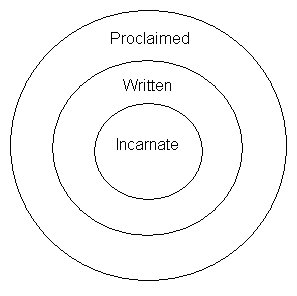
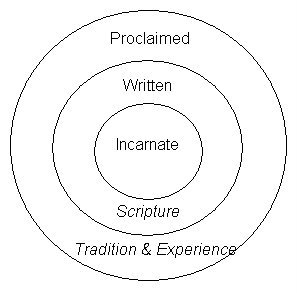
Enter Karl Barth. Barth's presentation of authority in theology is different than Wesley-via-Outler. Instead of a Quadrilateral, Karl Barth speaks of the threefold Word of God. There is one Word of God spoken to us and on which theology reflects. This one word of God can be found in three forms: (1) the incarnate Word, Jesus Christ, (2) the written Word of the Bible, (3) the proclaimed Word of Christian preaching through the centuries up to and including today. At the most basic level, this is just a linguistic insight into the three things which are referred to by Christians as the "word of God." But at a deeper level, Barth has found a way to affirm Sola Scriptura in a complex manner so that the lordship of Jesus Christ himself over even his Scriptural witnesses while at the same time the Bible is not set aside but re-established on the sure ground of the incarnate Word of God. The living Lordship of Jesus means also that he continues to call witnesses today. So all three (Jesus Christ, the Bible, and the proclamation of the church in word and deed), are the one Word of God, differentiated, united, and in proper order. So theology is not concerned with one thing, two things, or four things, but attends to the one threefold Word of God in all its unity and richness.


I think Barth's Threefold Word of God can embrace the best insights of the Wesleyan Quadrilateral while at the same time helping it to answer the question of an ordering principle. The ordered, differentiated unity of the Threefold Word of God includes the eclecticism of the Wesleyan Quadrilateral without the usual confusion. First of all, the center would remain firm as the incarnate Word, Jesus Christ. Secondly, the written Word of Scripture can be rightly placed in the second ring in close proximity to Christ yet under his authority. Next, the proclaimed word of God through history (tradition) and today (experience) forms the third ring. Note that I am adjusting Barth's language (though not necessarily his substance) in ordered to include Wesley's "experimental Christianity" or "practical divinity", treating the lives of believers as a testimony to Jesus Christ's living Lordship. This embrace of the Quadrilateral within the Threefold Word of God presents the authorities in an ordered unity that affirms a complex approach to theology yet anticipates the question of priority.


Finally, one might note a conspicuously absent member of the Quadrilateral from this diagram: reason. Now, I am no irrationalist. I love to think clearly and rationally. But reason, sorry to say, is not really something you have, but something you use. It is not "there" like the God-human Jesus, or the text of Scripture, or the Church's proclamation in word and deed. So I have not left reason out as much as redefined it as something that is in play at any moment of theological reflection on the threefold Word of God. Once again, I am taking my cue here from Karl Barth. While on his first and only lecture tour of American, Karl Barth was asked by a young University of Chicago graduate student, "What is the status of reason in your theology?" Barth replied, "I use it."

Any Thoughts?
Is the Threefold Word of God a compelling presentation of theological authority?
Does it really help solve some of the problems inherent in the Quadrilateral?
Does it ruin something you like about the Quad?
Have you had any additional misgivings about the Quadrilateral?
Could the threefold Word of God help these matters too?