During this most recent graduation season, I was reminded of the oft quoted remark in commencement addresses: "knowledge is power." As with all sentences with an "is" in them, the meaning can be interpreted in two different ways. It may seem like a simple equation, but it is actually unclear which way the equation runs. So I thought I would point out these two opposing meanings just to make sure we are reflecting on what we mean when we say "knowledge is power."
Meaning #1: If you have knowledge, then you will have power. The idea here is that the acquisition of knowledge results in social power. The one "in the know" holds a certain power over those who do not. The knower is a go-to-guy. This is the usual meaning at commencement addresses: "hey, don't worry that you have all this debt and will never make as much as your friends, because you have power on account of your knowledge."
Meaning #2: If you have power, then you will have knowledge. This is the opposite of the above meaning. Although the former is more traditional and therefore quite common, this meaning is gaining significance in our contemporary world. The basic idea here is that knowledge is really just power in disguise. Another phrase illustrates this: "the winners write the history." In other words, those who exert power have the influence to promulgate their view of what has happened and therefore generate knowledge. The social critic is the one who is able to unmask the power dynamics behind so-called knowledge. This need not be a cynical vew: if you want to be apart of the spread of knowledge, put yourself in a center of great influence.
Any thoughts?
Is there some other sense to the equation I have missed?
Which meaning do you usually imply when you say this phrase?
What happens when we mean it one way but it is taken another?
Wednesday, June 28, 2006

Wednesday, June 21, 2006
What Wesleyans Can Learn from Karl Barth (Part Two): Christocentric Procedure for Doctrinal Reformulation

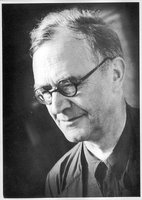
And now for our second installment of "What Wesleyans Can Learn from Karl Barth."
Every tradition has its distinctive doctrine. Christian sub-groups foster their identity through the cultivation of their pet doctrine. Not only do they have a distinctive take on this doctrine, but they also place distinctive emphasis on it. The unique gift that each tradition offers the church universal is its distinctive doctrinal emphasis. Yet, the unique temptation of each tradition is to turn their distinctive doctrine into a trump card that subjects every other Christian doctrine to its service. The challenge for each tradition is to offer their gift to others while at the same time reformulating their doctrine in light of the whole Christian faith.
It should be uncontroversial that the distinctive Wesleyan doctrine is sanctification. Not only do Wesleyans have a distinctive take on this common Christian doctrine, but we lay particular emphasis on it as central to our theological formulations. To be part of the Wesleyan tradition is to be committed to “spreading Scriptural holiness across the land.” But as we spread this message, we run into problems because we begin to second guess it. We have questions about the legitimacy and appeal of the doctrine. So we have a choice to make: either keep affirming it with our fingers crossed behind our back, dump the doctrine entirely to focus on something else, or roll up our sleeves to begin reformulating the doctrine in a true and compelling way.
The distinctive doctrine of the Reformed tradition is predestination. Barth wanted to stay true to his tradition by affirming this doctrine, but desired to reformulate it in a compelling way that took care of some of the inherent problems in this doctrine. Now I won’t go into the details of his reformulation, because what is most interesting to me is his procedure: he recasts the whole doctrine of election in Christocentric terms. He takes the triune God revealed in Christ as his central point and reorganizes the material accordingly. Thus, the electing God is not some unknown God above Christ, but rather Jesus Christ is the electing God. And the elected and rejected human being is not particular individuals, but rather Jesus Christ in his life, death and resurrection is the elect and rejected man. Surrounding the electing-and-elect God-man Jesus Christ is his chosen community of witness,
Any thoughts?
Would you agree that detailed reformulation is the way to go?
Is Barth’s Christocentric procedure commendable?
How might this play out in a Wesleyan reformulation of sanctification?
Specifically with regard to natures, what insights might be drawn from Trinity/Christology?
Thursday, June 15, 2006
Critical Receptivity, or, How to avoid becoming a theological jerk

Recently a student of mine asked me if my theological studies have spoiled my capacity to enjoy a worship service. “Do you find yourself picking apart the lyrics or the sermon?” He sensed his own critical awareness rising and wisely wanted to avoid becoming a theological jerk – you know, the guy who sits in the back with arms folded judging the shallowness of church. I shared with him a bit of my own journey on this issue, and yet the question has stuck with me long enough to deserve a fuller response. So here goes.
Note: These reflections can be seen as a follow-up to last week's hunt for theological parapraxes. No matter how attuned we are to the church's slip-ups, we must diligently fight against arrogance. This is my own attempt to mitigate the danger of pride in my intellectual life.
Let me narrate the three stages of development I have experienced myself and witnessed in others on this matter.
Stage One: Critical Spirit. At some point, many of us have been turned on to critical thinking. It is common to happen in college, but I have seen it kick in before, after or without formal education. Critical thinking is that wonderful tool whereby we do not accept what we hear at face value but ask tough questions and think for ourselves. This is a wonderful tool, but it can be used for evil. The place where is becomes particularly dangerous is in times set aside for edification: preaching, worship, bible studies, etc. It's times like these that seem to be "spoiled" by critical thinking, as we put up a wall of questions that block the movement of the spirit within. Yet critical thinking is not a bad thing, and so we rightfully defend ourselves by saying that we are "loving God with our mind" or "testing the spirits." This defense is correct from a certain point of view, and such walls might be necessary for a time to hone our critical skills. But it is dangerous to stay here because we may become cold and isolated.
Stage Two: The On/Off Switch. Early on I discovered that I could not go on with such a critical spirit. I had to open up to edification from others. One option would be to simply reject my critical training. But my critical skills were given to me by godly teachers whom I trusted. So I had to find a way to be both critical and open to edification. So I created an on/off switch: I could turn off my critical tools for moments of edification. I would pray at the beginning of a worship service that God would quiet my mind and open my heart. I would "set aside all my learning" for the moment and seek the transforming power of God. Many of us in college and seminary adopt this kind of language and thinking. This worked for a while, but there were still problems. First, in a desire to prove my openness, I uncritically accepted all kinds of things that I would have questioned even in my pre-critical days. Second, I encountered the problem of a double standard: for which times of edification do I turn the criticism off? On what basis do I make such a decision? Third, I was not yet treating my critical skills as a good gift from God to be used in his service. During the on/off stage, critical thinking has not yet become a spiritual discipline.
Stage Three: Critical Receptivity. This is the stage I am trying to grow into now. My attitude or posture towards a time of edification is to listen critically in order to receive the spirit of the message/song/moment. I do not check my brain at the door, but diligently ask tough questions and examine ideas. But I do not stop there. I use these critical tools to adjust and modify inadequate ideas, hopefully refining them in my mind so that I can receive the benefit of the most edifying message. I use the critical skills charitably, searching for the most subtle way of restating the ideas put forth. I find ways to affirm what is right, gently set aside what is wrong, and develop everything in between. The result is that I have become an active and engaged listener. I am not sitting in the back with my arms crossed. But I am also not just removing the filter and letting everything in. Actually, I am in a sense even more receptive to edification than I used to be, because I am not just accepting someone else's ideas. Rather, I am processing their ideas through my critical tools with the result that their ideas become my ideas. Therefore, I am truly being changed. This is at least an ideal toward which I aim and a practice which I slowly learning.
Any thoughts?
Have you had similar experiences?
How have you dealt with the threat of intellectual arrogance?
Can we ever be truly receptive and simultaneously critical, or is this wishful thinking?
Wednesday, June 07, 2006
Theological Parapraxes
Do you ever hear a preacher or worship leader say something odd about God that made you do a double take? Have you ever been busted for one of these foibles yourself? Have you ever been humored by the implications of the statement? Have you ever realized after the fact that this unintended phrase revealed the mind the speaker?
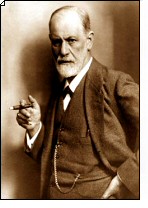
I would like to give these moments a name: theological parapraxes. A "paraprax" is an unintended action that reveals one's hidden thoughts, first celebrated by Sigmund Freud. Although Freud was quite proud, he was not arrogant enough to give this phenomenon its street name: "Freudian Slip." A theological paraprax is an unintended statement that reveals one's actual theological leanings.
For instance, I recently heard a Catholic Priest preach a sermon on John 14:6. During his exposition, he accidentally switched up the verse . Instead of the only way to the Father being through Jesus, he said that the only way to Jesus is through the Father! Now this slip-up was an innocent mistake, and we all make mistakes. But this was more than just a mistake; it was a theological paraprax, for it reveals the structure of a Catholic theology of ministry and grace.
At the most obvious and most humorous level, one could hear the Priest's reversal of John 14:6 as implying that the only way to Jesus is through a "Father" - a Catholic priest. Now the Catholic conception of sacramental ministry is a lot more complicated than simple mediation of Jesus via the Priest. But I couldn't help but do a double-take. It is at least enough to raise an eye-brow.
At a deeper level, this theological paraprax reveals a Catholic understanding of nature and grace. According to the classic maxim "Grace Perfects Nature," the Catholic habit of mind posits a natural human capacity given by the creator ("the Father") which is actualized in us by grace ("Jesus"). So the only way to Jesus is through the Father.
Now am I implying that this sweet Parish Priest was thinking all this when he mixed up the verse? No. That's what makes theological parapraxes so interesting: they reveal the assumptions and trajectories of our formation.
Any thoughts?
What theological parapraxes have you encountered or committed?
Please share your stories!
Wednesday, May 31, 2006
What Wesleyans Can Learn from Karl Barth (Part One): The Threefold Word of God and the Wesleyan Quadrilateral
As a Wesleyan studying systematic theology at Princeton, I am often asked why I am here. Particularly, my interest in Karl Barth seems peculiar to both my fellow Wesleyans and my Princeton colleagues. Honestly, I have been asking myself for years how these two worlds might congeal. So, here is the first installment of a non-consecutive three-to-five part series on what Wesleyans (or at least this Wesleyan) can learn from Karl Barth.
What Wesleyans Can Learn from Karl Barth
Part One: The Threefold Word of God and the Wesleyan Quadrilateral
Both those within and without the Wesleyan tradition are familiar with the so-called Wesleyan Quadrilateral: Scripture, Tradition, Reason and Experience. The Quad was first lifted up by Albert Outler as a description of Wesley's eclectic use of sources and norms in his theology. From its inception, it was used as more than just a historical description of Wesley; it was offered as a normative method for establishing doctrine and guiding life.
As a method, the Quad has fallen on perennial hard times. Despite its initial attraction as a mediating and inclusive method, it unfortunately raises more questions than provides answers. How are these four entities to be related? Does one rule over the others? Are they sources or are they norms? Does the Quad affirm Sola Scriptura in any meaningful sense? Is there an ordering principle? All of these questions deserve answers, but this last one is particularly interesting to me. It comes up often when I have presented the Quad to others for the first time. Since I do not want to give up on the Quadrilateral entirely, I have long searched for a satisfactory understanding of the ordering of the four corners.
Enter Karl Barth. Barth's presentation of authority in theology is different than Wesley-via-Outler. Instead of a Quadrilateral, Karl Barth speaks of the threefold Word of God. There is one Word of God spoken to us and on which theology reflects. This one word of God can be found in three forms: (1) the incarnate Word, Jesus Christ, (2) the written Word of the Bible, (3) the proclaimed Word of Christian preaching through the centuries up to and including today. At the most basic level, this is just a linguistic insight into the three things which are referred to by Christians as the "word of God." But at a deeper level, Barth has found a way to affirm Sola Scriptura in a complex manner so that the lordship of Jesus Christ himself over even his Scriptural witnesses while at the same time the Bible is not set aside but re-established on the sure ground of the incarnate Word of God. The living Lordship of Jesus means also that he continues to call witnesses today. So all three (Jesus Christ, the Bible, and the proclamation of the church in word and deed), are the one Word of God, differentiated, united, and in proper order. So theology is not concerned with one thing, two things, or four things, but attends to the one threefold Word of God in all its unity and richness.
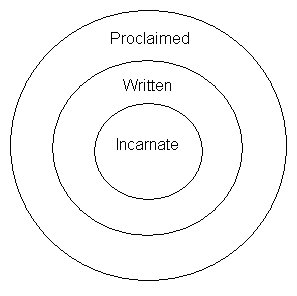
I think Barth's Threefold Word of God can embrace the best insights of the Wesleyan Quadrilateral while at the same time helping it to answer the question of an ordering principle. The ordered, differentiated unity of the Threefold Word of God includes the eclecticism of the Wesleyan Quadrilateral without the usual confusion. First of all, the center would remain firm as the incarnate Word, Jesus Christ. Secondly, the written Word of Scripture can be rightly placed in the second ring in close proximity to Christ yet under his authority. Next, the proclaimed word of God through history (tradition) and today (experience) forms the third ring. Note that I am adjusting Barth's language (though not necessarily his substance) in ordered to include Wesley's "experimental Christianity" or "practical divinity", treating the lives of believers as a testimony to Jesus Christ's living Lordship. This embrace of the Quadrilateral within the Threefold Word of God presents the authorities in an ordered unity that affirms a complex approach to theology yet anticipates the question of priority.
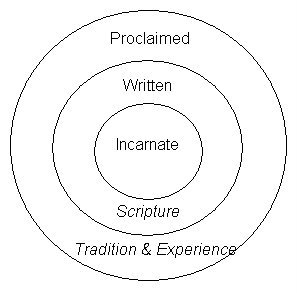
Finally, one might note a conspicuously absent member of the Quadrilateral from this diagram: reason. Now, I am no irrationalist. I love to think clearly and rationally. But reason, sorry to say, is not really something you have, but something you use. It is not "there" like the God-human Jesus, or the text of Scripture, or the Church's proclamation in word and deed. So I have not left reason out as much as redefined it as something that is in play at any moment of theological reflection on the threefold Word of God. Once again, I am taking my cue here from Karl Barth. While on his first and only lecture tour of American, Karl Barth was asked by a young University of Chicago graduate student, "What is the status of reason in your theology?" Barth replied, "I use it."
Any Thoughts?
Is the Threefold Word of God a compelling presentation of theological authority?
Does it really help solve some of the problems inherent in the Quadrilateral?
Does it ruin something you like about the Quad?
Have you had any additional misgivings about the Quadrilateral?
Could the threefold Word of God help these matters too?
Wednesday, May 24, 2006
Could Jesus have had a wife?
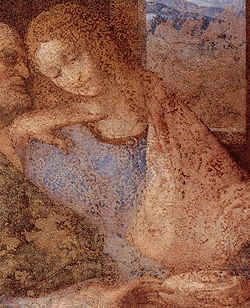
In the wake of the DaVinci Code release, I thought it would make for a nice thought experiment to ask whether Jesus could have had a wife. Does it matter? What's at stake in the question? What significance does Jesus' marital status have for his identity as Lord and Savior of the world?
Note that I am not asking the very different question "did Jesus have a wife?" Such a question is rightly established by historical inquiry.
For instance, I find the specific suggestion that Jesus hooked up with Mary Magdalene highly dubious, as there are no trustworthy documents that make such a claim. Even those that hint at it do so in a mythological way that has little to do with history and are embedded in a gnostic philosophical schema that identifies their relationship as a sort of mind-meld, and therefore the furthest thing from fleshy relations. In light of the historical record, a cover-up surrounding a marriage between Jesus and Mary Magdalene is pure fantasy .
The broader historical question of whether Jesus had a wife (other than Mary Magdalene) is best left open. Most of the documentation makes no mention of Jesus' marital status. To say conclusively that Jesus was single is an argument from silence. We hear about his father, mother and brothers, and therefore could say that if he had a wife she would have been at least mentioned as they are. It is thus probable that Jesus was single. But probability is not conclusive certainty. What we can say with certainty is that if Jesus had married, we know nothing of it nor was it particularly relevant information to those who preserved his memory.
The stark silence on the matter from the Gospels and other records makes possible the pure speculative (i.e., not historical) thought experiment I want to explore: Could Jesus have had a wife? Is there some reason why Jesus must be single to be who he is and do what he does?
Some would be inclined to say that Jesus' singleness is connected to his sinlessness. Jesus was sinless and so therefore does not engage in the "necessary evil" of sexual intercourse. Needless to say, I think such a connection is an incredibly bad idea. I do not believe that sex is inherently sinful. Therefore, there is no logical necessity requiring Jesus to abstain from sex in order to be a sinless sacrifice.
More to the point, some might say that Jesus' divinity is at stake in this matter of his singleness. If Jesus had a wife, then he could not be divine. This seems to the assumption of The DaVinci Code, which incorrectly and unimaginatively represents the problem of Christology as a choice between the divinity and humanity of Jesus. Orthodoxy Christianity has from early times affirmed both the divinity and the humanity of Jesus. It is not a coincidence that The DaVinci Code focuses exclusively on Nicaea 325, which affirmed the full deity of Christ, but makes no mention of Chalcedon 451, which affirmed the full humanity of Christ. Christians need not feel threatened by the suggestion that Jesus led a fully human life, which in principle could have included marital relations. Of course, I am not saying that he did have a wife. I am just saying that Christians can handle the thought that he could have had a wife.
Of course, this is just a thought expiriment. We ought not to speculate about such things for too long. Precisely because the Gospels do not speak about the matter, we should be careful not to focus too much on these distracting lines of inquiry. We are called to attend to Scripture in what it does say, not what it could have said.
Nevertheless, this thought experiment hopefully shows what is at stake in the ideas and objections that are floating around today: namely, not that much. The drama of The DaVinci Code might make it seem like a big deal, but Christians have dealt with greater challenges than this before. In the face of such "heresy lite," we can calmly but confidently respond to the objection by pointing back to the truth of Jesus Christ.
Any thoughts?
Have I misrepresented the historical record concerning Jesus' marital status?
Is there some good theological reason for denying even the possibility that Jesus was married?
Does the sheer vehemence of Christian reaction to The DaVinci Code reveal something about our own forgetfulness of the full humanity of Christ?
How do we best respond to such tantalizing alternatives?
Wednesday, May 17, 2006
How Princeton Seminary Changed Me
I am back home in Indiana this week, and as always I am asked how Princeton has changed me. As I am still at PTS, my answers are still developing. But I have been here long enough and have enough distance from my MDiv years to begin to assess the affect it has had on me. I will list five things below that are particularly interesting, but certainly not exhaustive. This list may also serve to help those consider whether PTS is the place for them.
1) I read slower. Before I went to seminary, I learned how to speed read. I used this skill to my advantage in college and intended to use it to get through seminary. We are assigned so many pages that this is a must. However, at PTS I learned how to read slowly. I still speed read from time to time out of necessity, but I learned at PTS how to really digest and study a book. As one of my teachers says, "a book not worth reading slowly is a book not worth reading." This was a critical skill for which I have PTS to thank.
2) I initiate spirituality. At PTS there are endless opportunities for spiritual growth, but there is no longer the social pressure or institutional requirement to be engaged therein. So, I learned how to take the initiative in my spiritual life. This was a risk as I could simply have fallen through the cracks. But the risk was worth it, because to become a spiritual leader I a must learn to initiate spirituality for myself and others and not rely on my context to feed me.
3) I think systemically. I know longer think about issues as distinct topics, but as embedded in larger conceptual and social contexts. This plays itself out theologically by drawing connections between on doctrine and another, and furthermore tying all doctrines together in a way that coheres as much as possible. This plays itself out socially by looking for the larger family/social systems at work in particular cases that emerge in ministry and life. Systemic thinking is a critical skill for theological and ministerial work, and I learn it at PTS.
4) I am more Wesleyan. This does not happen to everyone when they "go away" to a school outside their tradition, but I certainly become more secure in my Wesleyan identity at Princeton than ever before. Just as anyone who as studied a foreign language knows, you learn the grammar of your native tongue (often for the first time) in the process of translation. In order to figure out the grammar of the Reformed tradition, I had to double-back and figure out my own Wesleyan grammar. In the process, I re-discovered and re-embraced my Wesleyanism.
5) I am more laid back. In college, I got the feeling like few students cared about academics (this was one part reality and one part pride). Therefore, I sought to differentiate myself from the mass of students by avoiding a lot of fun activities, wearing slacks to class, hanging out with profs, etc. But at PTS, I immediately sensed that the bulk of the community actually cared about learning. Hence, there was no threat to also join in the fun of frisbee, jam sessions, dressing-my-age, trips to the shore, etc. I could do all these things without worrying that I was aligning myself with an anti-academic spirit. This was a major personality shift that emerged while at PTS.
Well, there's my answer ... for now. I am sure PTS is still changing me. And I suspect that I will realize more changes with increased hindsight. But these are enduring changes I have discovered.
Any thoughts?
How have you changed since college?
If you went to seminary, how did it change you?
For those of you who know me, do you see some more significant change than these?
Normative Question: How SHOULD a seminary change its students?
1) I read slower. Before I went to seminary, I learned how to speed read. I used this skill to my advantage in college and intended to use it to get through seminary. We are assigned so many pages that this is a must. However, at PTS I learned how to read slowly. I still speed read from time to time out of necessity, but I learned at PTS how to really digest and study a book. As one of my teachers says, "a book not worth reading slowly is a book not worth reading." This was a critical skill for which I have PTS to thank.
2) I initiate spirituality. At PTS there are endless opportunities for spiritual growth, but there is no longer the social pressure or institutional requirement to be engaged therein. So, I learned how to take the initiative in my spiritual life. This was a risk as I could simply have fallen through the cracks. But the risk was worth it, because to become a spiritual leader I a must learn to initiate spirituality for myself and others and not rely on my context to feed me.
3) I think systemically. I know longer think about issues as distinct topics, but as embedded in larger conceptual and social contexts. This plays itself out theologically by drawing connections between on doctrine and another, and furthermore tying all doctrines together in a way that coheres as much as possible. This plays itself out socially by looking for the larger family/social systems at work in particular cases that emerge in ministry and life. Systemic thinking is a critical skill for theological and ministerial work, and I learn it at PTS.
4) I am more Wesleyan. This does not happen to everyone when they "go away" to a school outside their tradition, but I certainly become more secure in my Wesleyan identity at Princeton than ever before. Just as anyone who as studied a foreign language knows, you learn the grammar of your native tongue (often for the first time) in the process of translation. In order to figure out the grammar of the Reformed tradition, I had to double-back and figure out my own Wesleyan grammar. In the process, I re-discovered and re-embraced my Wesleyanism.
5) I am more laid back. In college, I got the feeling like few students cared about academics (this was one part reality and one part pride). Therefore, I sought to differentiate myself from the mass of students by avoiding a lot of fun activities, wearing slacks to class, hanging out with profs, etc. But at PTS, I immediately sensed that the bulk of the community actually cared about learning. Hence, there was no threat to also join in the fun of frisbee, jam sessions, dressing-my-age, trips to the shore, etc. I could do all these things without worrying that I was aligning myself with an anti-academic spirit. This was a major personality shift that emerged while at PTS.
Well, there's my answer ... for now. I am sure PTS is still changing me. And I suspect that I will realize more changes with increased hindsight. But these are enduring changes I have discovered.
Any thoughts?
How have you changed since college?
If you went to seminary, how did it change you?
For those of you who know me, do you see some more significant change than these?
Normative Question: How SHOULD a seminary change its students?
Wednesday, May 10, 2006
What's up with the Ascension?
Recently my sister-in-law called my wife and asked for helped on a sermon. (This is a commonplace in a family full of ministers.) My wife cordially offered her services: "Sure, I'd love to help. What's it on?" a question to which my sister-in-law replied, "The Ascension." "Oh, can't help you there," was the response.
What's up with the Ascension? It is narrated in Scripture. It is in the Creed. It is part of the church year. But what does it mean? What significance does it have the identity of Jesus? What difference does it make for the Christian life?
I must confess that have little help to offer on this matter. Such a confession, of course, merely compels my curiosity to investigate the matter. I started by simply re-reading on the relevant portions of Scripture. As yet, I do not have a worked out presentation on the doctrine of ascension. But I do have a number of theses I would like to share to spur comment and discussion.
Thesis 1 - The ascension is conditioned by the resurrection. Whatever it may be, the meaning of the ascension is theologically dependent on the resurrection. The ascension of Jesus signals the completion of the 40-day Easter history and therefore its meaning is co-extensive with the meaning of the resurrection.
Thesis 2 - The ascension is linked to final judgment. At the ascension, Jesus takes his place as lord and judge of the world. This status is in effect immediately, though it awaits execution. The time between the times is for Christ the time of being ascended to the Father.
Thesis 3 - The ascension is linked to mission. Jesus commissions the Disciples unto a universal mission immediately prior to ascension (Acts), in conjunction with ascension (John) or in place of ascension (Matthew). For some reason, the ascension institutes the mission of the Church.
Thesis 4 - The ascension is the precondition for the outpouring of the Spirit. In Luke-Acts, Jesus must ascend to the Father in order for the Spirit to be outpoured. John narrates the outpouring on the evening of Easter, possibly from an already ascended Jesus (who tells Mary not to touch him because he has not yet ascended but invites Thomas to touch him, implying that he has). The Spirit functions in both as the mediator of Jesus' presence and power for the Disciples post-Easter. However one harmonizes the narrative details of accounts, the ascension and the Spirit are theologically linked.
Thesis 5 - The ascension contributes to the universal scope of the cross. According to the Epistle to the Hebrews, one reason why Jesus' sacrifice is once-for-all is because he offers his blood in the heavenly tabernacle. The metaphorical nature of this priestly language does not preclude it from having theological significance: the ascension of Christ (narrated by Hebrews chapter 1) "relocates" his blood to a place where it can be shed on behalf of all.
Thesis 6 - The ascension signifies our eschatological ascent to God. As the recapitulation of human history, the narrative of Jesus is a compressed version of the history of humanity. On the basis of his work, we too will be resurrected and ascend to God.
Any thoughts?
Would you be able to affirm any of these theses as true?
Would you object to any of them?
Can you help to nuance these ideas?
Do you have theses to add?
What's up with the Ascension? It is narrated in Scripture. It is in the Creed. It is part of the church year. But what does it mean? What significance does it have the identity of Jesus? What difference does it make for the Christian life?
I must confess that have little help to offer on this matter. Such a confession, of course, merely compels my curiosity to investigate the matter. I started by simply re-reading on the relevant portions of Scripture. As yet, I do not have a worked out presentation on the doctrine of ascension. But I do have a number of theses I would like to share to spur comment and discussion.
Thesis 1 - The ascension is conditioned by the resurrection. Whatever it may be, the meaning of the ascension is theologically dependent on the resurrection. The ascension of Jesus signals the completion of the 40-day Easter history and therefore its meaning is co-extensive with the meaning of the resurrection.
Thesis 2 - The ascension is linked to final judgment. At the ascension, Jesus takes his place as lord and judge of the world. This status is in effect immediately, though it awaits execution. The time between the times is for Christ the time of being ascended to the Father.
Thesis 3 - The ascension is linked to mission. Jesus commissions the Disciples unto a universal mission immediately prior to ascension (Acts), in conjunction with ascension (John) or in place of ascension (Matthew). For some reason, the ascension institutes the mission of the Church.
Thesis 4 - The ascension is the precondition for the outpouring of the Spirit. In Luke-Acts, Jesus must ascend to the Father in order for the Spirit to be outpoured. John narrates the outpouring on the evening of Easter, possibly from an already ascended Jesus (who tells Mary not to touch him because he has not yet ascended but invites Thomas to touch him, implying that he has). The Spirit functions in both as the mediator of Jesus' presence and power for the Disciples post-Easter. However one harmonizes the narrative details of accounts, the ascension and the Spirit are theologically linked.
Thesis 5 - The ascension contributes to the universal scope of the cross. According to the Epistle to the Hebrews, one reason why Jesus' sacrifice is once-for-all is because he offers his blood in the heavenly tabernacle. The metaphorical nature of this priestly language does not preclude it from having theological significance: the ascension of Christ (narrated by Hebrews chapter 1) "relocates" his blood to a place where it can be shed on behalf of all.
Thesis 6 - The ascension signifies our eschatological ascent to God. As the recapitulation of human history, the narrative of Jesus is a compressed version of the history of humanity. On the basis of his work, we too will be resurrected and ascend to God.
Any thoughts?
Would you be able to affirm any of these theses as true?
Would you object to any of them?
Can you help to nuance these ideas?
Do you have theses to add?
Monday, May 08, 2006
New Essays up at The Writing of John Drury
There are two new essays up at The Writing of John Drury:
-
- Paul Lehmann’s Christian Contextual Ethic [May 2006]
Wednesday, May 03, 2006
The Shepherd and the Witness
This week I am concluding a series of sermons on the Gospel of John coordinated with the church calendar. The last few weeks have concentrated on the Resurrection narratives in John 20-21. There is an intriguing sub-theme running through the appearances: the relationship between Peter and the Beloved Disciple, who I will name John (acknowledging the debate and mystery surrounding his identity). I'd like to share the data with you, reflect on its meaning, and suggest some implications.
- John is the first to reach the empty tomb and see the linen (20:5-6)
- Peter is the first to go inside the empty tomb (20:6)
- Peter is the first to see the burial cloth (20:7)
- John is the first to believe (20:8)
- Peter decides to go fishing (21:3)
- John & the others follow (21:3)
- John is the first to recognize Jesus (21:7)
- Peter swims ahead of John & the others (21:7)
- Peter is commissioned to feed/tend Jesus' sheep/lambs (21:15-18)
- John is identified as the true witness of Jesus (21:20-25)
What is the significance of this relationship?
First of all, at the textual level Peter is identified as the first in action among the disciples. He is the mover and shaker, while the others follow his lead. He is the symbolic leader of the apostles, the titular head of the church, and Jesus' appointed shepherd of the flock. We get the impression that the disciples (including John) would not do anything until Peter does it first.
John, on the other hand, is first in insight among the disciples. He sees and understands what is going on. He is the true witness, the recorder of facts and insights, the seer into the deep truths and mysteries of the story of Jesus. We get the impression that the disciples (including Peter) would not know anything until John knows it first.
Secondly, it is clear that the community surrounding the author/compiler of the Fourth Gospel is concerned about the relationship between Petrine and Johannine authority. The Gospel of John acknowledges the authority of Peter (and his successors in Rome?), while at the same time establishing the authority of John (and his successors in Ephesus?). The Evangelist is able to acknowledge both simultaneously by employing the above distinction between the authority of leadership and the authority of witness.
Thirdly, the relationship between Peter and John raises questions about how we understand authority in the church today. I suspect that we assume authority of leadership and authority of witness are usually found in the same person. We expect our leaders (organically and institutionally, locally and denominationally) both to lead us into action and to express insight into truth. While it is not impossible that both charisms may be found in one person, the final chapters of John should give us pause in our expectations.
Could it be that we have expected too much from our authorities? Could it be that our greatest frustrations emerge when we expect witness from a leader and leadership from a witness? Could it be that a differentiated authority structure is possible (organically and institutionally, locally and denominationally)? Could it be that some of us are called to one form authority and not the other, and we should learn to respect those called to the other? Could it be that we would fulfill our vocations more fully if we stayed within our particular given authority?
Any thoughts?
Do you buy the distinction between leadership-authority and witness-authority?
What would a differentiated authority structure based on this distinction look like?
What other implications might this distinction have?
- John is the first to reach the empty tomb and see the linen (20:5-6)
- Peter is the first to go inside the empty tomb (20:6)
- Peter is the first to see the burial cloth (20:7)
- John is the first to believe (20:8)
- Peter decides to go fishing (21:3)
- John & the others follow (21:3)
- John is the first to recognize Jesus (21:7)
- Peter swims ahead of John & the others (21:7)
- Peter is commissioned to feed/tend Jesus' sheep/lambs (21:15-18)
- John is identified as the true witness of Jesus (21:20-25)
What is the significance of this relationship?
First of all, at the textual level Peter is identified as the first in action among the disciples. He is the mover and shaker, while the others follow his lead. He is the symbolic leader of the apostles, the titular head of the church, and Jesus' appointed shepherd of the flock. We get the impression that the disciples (including John) would not do anything until Peter does it first.
John, on the other hand, is first in insight among the disciples. He sees and understands what is going on. He is the true witness, the recorder of facts and insights, the seer into the deep truths and mysteries of the story of Jesus. We get the impression that the disciples (including Peter) would not know anything until John knows it first.
Secondly, it is clear that the community surrounding the author/compiler of the Fourth Gospel is concerned about the relationship between Petrine and Johannine authority. The Gospel of John acknowledges the authority of Peter (and his successors in Rome?), while at the same time establishing the authority of John (and his successors in Ephesus?). The Evangelist is able to acknowledge both simultaneously by employing the above distinction between the authority of leadership and the authority of witness.
Thirdly, the relationship between Peter and John raises questions about how we understand authority in the church today. I suspect that we assume authority of leadership and authority of witness are usually found in the same person. We expect our leaders (organically and institutionally, locally and denominationally) both to lead us into action and to express insight into truth. While it is not impossible that both charisms may be found in one person, the final chapters of John should give us pause in our expectations.
Could it be that we have expected too much from our authorities? Could it be that our greatest frustrations emerge when we expect witness from a leader and leadership from a witness? Could it be that a differentiated authority structure is possible (organically and institutionally, locally and denominationally)? Could it be that some of us are called to one form authority and not the other, and we should learn to respect those called to the other? Could it be that we would fulfill our vocations more fully if we stayed within our particular given authority?
Any thoughts?
Do you buy the distinction between leadership-authority and witness-authority?
What would a differentiated authority structure based on this distinction look like?
What other implications might this distinction have?
Subscribe to:
Posts (Atom)