Wednesday, January 03, 2007

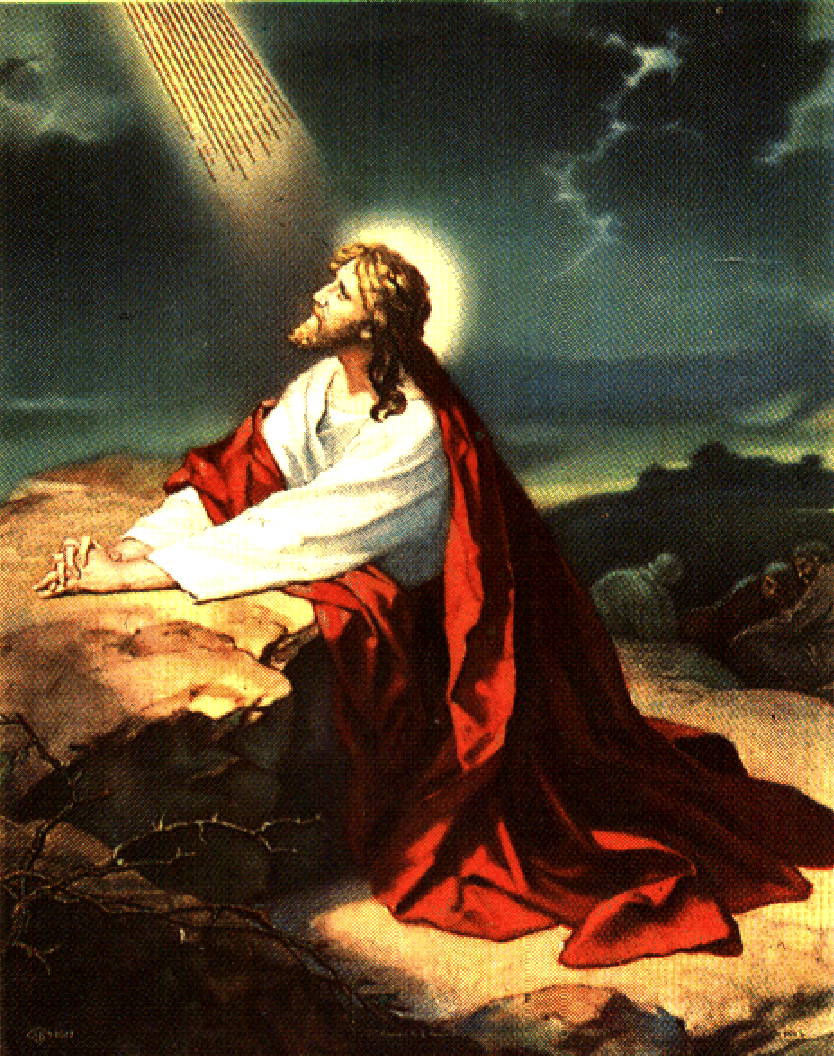
Bible Brain Busters: Gethsemane Prayer

I recently had an interesting conversation about Jesus' prayer in Gethsemane, "Not my will but thine be done." What made the conversation so interesting was the lead question: to whom was Jesus' praying in the garden? God the Father? God, a.k.a. the entire trinity? Himself, a.k.a. God the Son? Our conversation marked this as a genuine Bible Brain Buster: a biblical text that becomes puzzling in light of central Christian affirmations. In this case, how do we think through the prayer life of Jesus in light of his divine nature?

Since the question itself is just as interesting as the answer, let me offer a few possible responses before reflecting directly upon the significance of the question:

Option 1: The man Jesus is praying to God.

This first option is not really a solution but a denial of the problem. The story of the Garden of Gethsemane is simply a story of a human being crying out to God. Jesus may have been a perfect human being, but he was a human being nonetheless, and so prays to God like any other human being. Within this option a number of approaches to the divinity of Jesus could be taken: God the Son emptied himself of all divine attributes at the incarnation; Jesus became divine after the resurrection; Jesus' divinity refers to his perfect reliance on God's Spirit; etc. The strength of this option is its emphasis on Jesus' true humanity and its straightforwardness with regard to this particular text. The weakness of this option is the corners it has to cut with regard to a robust affirmation of the divinity of Jesus.

Option 2: God the Son is praying to God the Father.

This second option grounds the historical Gethsemane prayer in the eternal life of the triune God. In the story of the Garden prayer we catch a glimpse into the inner life of the trinity: the Father sends, the Son is sent; the Father wills, the Son submits his will. The Christian doctrine of the Trinity tells us that God is not a single willing person but three persons, each with its own "personality" and therefore "will." So God has these sorts of internal conversations all the time; the Gethsemane prayer is simply a significant instance of this social life of God. The strength of this option is its emphasis on Jesus' true divinity and its decision to locate this problem within the dynamics of the trinity. The weakness of this option is the new problem this solution creates: is a God with three wills really the one God of Israel? To put it bluntly, this multiple-personality theory runs the risk of tritheism.

Option 3: The Incarnate Son as the man Jesus is praying to God the Father.

This third option tries to bring the doctrine of the trinity and the doctrine of incarnation in close connection with one another in order to make sense of the prayer life of Jesus. In the story of Gethsemane we see the temporal fulfillment of God's eternal purpose to become incarnate. The one God with one will chooses to send himself into human history by taking on the human flesh of Jesus. God's eternal constitution as one being in three persons has this incarnational end in view. So the eternal Son (who has no will other than the Father's) wills to take to himself a complete human nature. This complete human nature includes a fully human will. Therefore, God the Son has two wills: the common divine will shared by all three persons of the Godhead and the human will of Jesus. So, in the garden, the fully divine Son incarnate as a human being is praying to God the Father in the power of their Holy Spirit. The incarnate Son submits his human will to the will of God the Father. The strength of this option is the close connection drawn between the trinity and the incarnation as well as its use of the "two wills" doctrine affirmed at the Sixth Ecumenical Council (Constantinople 680-81). The weakness of this option is the possible implication that God must become incarnate in order to be triune. It is also a terribly complicated answer, which may be perceived as a strength depending on one's temperament.

Well, there's some possible responses to the question of "To whom was Jesus praying?" Now I find this question and the debate between these answers fascinating. I would be happy to discuss the particulars of the matter. But even more interesting to me is that one would even ask this question in the first place. The only person who would treat the Garden of Gethsemane story as a puzzle is someone who assumes a high Christology. You can tell a lot about a person's theological commitments by observing which biblical texts create interpretive difficulties for them. In other words, one's admitted Bible Brain Busters reveal one's deepest beliefs. Even if these beliefs are held implicitly or unreflectively, they exert pressure on us at these critical points. So identifying one's own (and others') Bible Brain Busters helps us to explicitly investigate our beliefs and how they relate to specific Scriptural passages. Hence, they are a worthy entry point for theological inquiry.

Any thoughts?
So, what are your Bible Brain Busters?
Which texts throw you for a loop?
Can you identify what basic beliefs make these texts particularly difficult?
Do you have any thoughts on the example of Jesus' Gethsemane Prayer?

NOTE: If I get a good list of Bible Brain Busters going, I may do a series on them at some point.

Saturday, December 30, 2006

OUTLINE for Attributes of God series

Attributes of God Series (Fall 2006):

Part One: NOTs (negative metaphysical attributes)
I. Simplicity (or unity) [Oct 4]
II. Infinity (or greatness) [Oct 11]
III. Immutability (or constancy) [Oct 18]
IV. Impassibility (or freedom) [Oct 25]

Part Two: OMNIs (eminent metaphysical attributes)
V. Omnipresence (or eternity) [Nov 1]
VI. Omniscience (or wisdom) [Nov 8]
VII. Omnipotence (or power) [Nov 15]

Part Three: MORAL ATTRIBUTES
VIII. Love [Nov 29]
IX. Grace and Holiness [Dec 6]
X. Mercy and Justice [Dec 13]
XI. Patience and Goodness [Dec 20]
_

Wednesday, December 27, 2006

Christmas Connections Preaching

I've begun to notice a pattern. Most of the Christmas sermons I've heard (and preached) in the last few years went out of their way to make a connection between Christmas and something else. Christmas and the life of Christ. Christmas and the expectation of Israel. Christmas and the Cross. Christmas and Easter. Christmas and the Holy Spirit. Christmas and the Christian life. Christmas and ...

The great thing about these "Christmas connections" is that it keeps things interesting. New insights are brought in. Deep Biblical themes are interwoven. We avoid repeating the same thing every year. The one sermon heard by the most people in a congregation is probably the Christmas sermon. Attendance is up: the regulars are there, family is in town, the fringe folk come out of the woodwork, and guests abound. Because of this, we preachers are understandably worried about repetition. We don't want to preach the "same old Christmas sermon" every year. So Christmas connections keep everybody on their toes.

However, I am beginning to ask myself whether this habit has an unintended and unfortunate side effect: preaching Christmas connections gives the impression that Christmas is not interesting enough on its own. If we must speak of "Christmas and ...", what does that tell us about the significance of Christmas itself? Why can't we just speak of Christmas ... period? Why can't we just remind ourselves that one day God became human and that in itself is a pretty big deal. Sure, that is not the whole Christian story. But this important part gets its own day, and maybe we should give it proper attention.

I do not wish to reject Christmas connections preaching. I practice them and appreciate hearing them. But I do want to identify this possible danger. Even as we seek to interweave Christmas into the larger tapestry of belief, let us be sure keep the main thing the main thing.

Keeping this possible danger in mind, I would love to hear back from you what Christmas connections you heard or preached this year.

Any thoughts?
What connections have you heard or made?
Were they fitting or forced?
Did they illumine Christmas or distract from it?

Wednesday, December 20, 2006

Attributes of God (XI): Patience and Goodness

This week we come to the conclusion of our semester-long exploration into the attributes of God. Before addressing our final pair of divine characteristics (patience and goodness), I would like to retrace our steps by means of an outline:

NOTs -
I. simplicity (or unity)
II. infinity (or greatness)
III. immutability (or constancy)
IV. impassibility (or freedom)

OMNIs -
V. omnipresence (or eternity)
VI. omniscience (or wisdom)
VII. omnipotence (or power)

CHARACTERISTICS -
VIII. love
IX. grace and holiness
X. mercy and justice
XI. patience and goodness

Although reviewing the whole of our series has some inherent value, I have presenting this outline for a specific reason related to this week's post. The structure of our series relies upon a noteworthy distinction between incommunicable and communicable attributes. This classical notion distinguishes between those attributes of God which can be shared with creatures (communicable) and those which cannot (incommunicable). Our first two categories (the NOTs and the OMNIs) are traditionally considered to be God's incommunicable attributes, whereas our final category (the CHARACTER attributes) are considered to be communicable. Creatures, including human beings, cannot be called simple, infinite, immutable, impassible, omnipresent, omniscient, or omnipotent. But creatures, at least human creatures, can be called loving, gracious, holy, merciful and just.

This distinction is of particular interest to our final pair of character attributes: patience and goodness. As this week's image reminds us, patience and goodness are found among the gifts of the Spirit. As a human being is filled with the divine Spirit, she shares in God's communicable attributes. God "communicates" these attributes to us by grace.

Although I find this distinction interesting and instructive, I need to register one criticism. My criticism has two aspects corresponding to the two sides of the distinction. On the one hand, I don't think we can so easily discern which attributes are incommunicable. On the other, I don't think we can so easily assume that we share in any of God's attributes. Let me address each in turn, the second aspect dealing directly with patience and goodness.

The first side of the criticism has been implicit throughout my treatment of the "metaphysical" attributes (the NOTs and the OMNIs). I have tried to suggest alternative terms that avoid some of the methodological problems involved in metaphysical God-talk (see outline above). Note that each of these alternative terms is apparently more communicable than the metaphysical term it is replacing. Even the attribute of eternity will be given to human beings, as God has promised to give us eternal life. This is an gift of grace beyond our natural ability, but we will receive it nevertheless. There seems to be a human way of sharing in many if not all of God's attributes. So the distinction runs into problems because of the difficulty of identifying any inherently incommunicable attributes.

The second side of the criticism comes into sharp relief when speaking of the patience and goodness of God. At first glance, these two seem to be obviously communicable. We comfortably speak of both God and humans being good and patient. So these must be communicable attributes. But the problem with such an easy assumption is that the manner of God's goodness and patience is radically different than the manner of our goodness and patience. Since I have already addressed this problem in connection with divine goodness in an earlier post, I will focus my comments on patience.

We often speak of our being patient with God. We learn to be patient as we wait for God's timing. But can this really be thought of as sharing a divine attribute? Is our patience so similar to God's patience? When God is patient with us, he is not waiting on our timing. Rather, he is waiting for us to learn and grow, giving time and space for our freedom, even mercifully overlooking our sins. This is the meaning of divine patience. Human patience, in contrast, trusts in the Lord as he works out his good will. In other words, we are patient with God because he is good, whereas God is patient with us because he is good and we are not (yet). Again, there seems to be a distinctively human way of sharing in God's attributes. So the distinction between incommunicable and communicable attributes again runs into problems because even the most obviously communicable attributes are shared with us in a way that differs radically from God.

The bottom line of this criticism is that the more crucial distinction is not between incommunicable and communicable attributes but between God's way of being his own attributes and the human way of sharing in God's attributes.

The implication for our talk of patience and goodness is that we should begin with God's patience and goodness and only then, with proper distinctions in mind, speak of our human patience and goodness. I suggest that such a habit of mind would apply across the board to all the attributes explored these last few months, though defending or applying this suggestion is beyond the scope of this already long post. I'll leave that task to you.

Any thoughts?
What is your initial reaction to the distinction between incommunicable and communicable attributes?
Do the two aspects of my criticism of this distinction hit or miss the mark?
Is the notion of a human way of sharing in God's attributes helpful?
Would you agree that there is a distinctively human way of sharing in any of God's attributes, provided he chooses to share them with us? Why or why not?
Does my description of God's patience as ordered to the working out of his goodness ring true? Why or why not?

Wednesday, December 13, 2006

Attributes of God (X): Mercy and Justice

Our reflections on the attributes of God continue with another pair of characteristics: mercy and righteousness. These two attributes of God are often set alongside each other, and so it is not controversial to treat them together. However, there is no consensus on how to treat them in tandem. Consider the following as one way to think through the matter of their interrelationship in God.

Let's look first at God's righteousness. What does it mean to say God is righteous? Righteousness is liked to matters of justice, rights and law. To be righteous is to be found in accordance with law. When we say that God is righteous, we are saying that his being and action are in full accordance with law. But what law? Since God himself is the standard of justice and the ultimate law-giver, this attribute must be necessarily reflexive: God lives according to the standard of his law.

With such an understanding of righteousness, it should be obvious why we might encounter some choppy waters when we turn to God's mercy. Mercy is most basically understood as withholding the execution of what is just or right. You deserve one thing, but get another -- that's the heart of mercy.

If mercy is so understood, how can God be both merciful and righteous? For God to be perfectly merciful, there must be a lessening of his righteousness. For God to be perfectly righteous, there is a definite limit set on his mercy -- if he can be said to be merciful at all.

There are a number of solutions to this puzzle. We could abandon divine righteousness. We could abandon divine mercy. We could say God moves from righteousness to mercy (maybe by means of some kind of crude OT/NT distinction). We could try to hold them together as inherently paradoxical affirmations that bear witness to God's mystery. We could just give up on the theological task altogether, opting to speak haphazardly of both attributes in so-called "balance."

In the contrast of these alternative solutions, my approach (big surprise!) would be to redefine mercy and righteousness according to the history of God's dealings with us. Where is God in his mercy and righteousness revealed? In Jesus Christ, God deals with us rightly and merciful.

In Jesus Christ, God's righteousness is not a subservience to an abstract law. God's right is precisely his freely chosen covenant of mercy whereby humble and even sinful human beings are brought into fellowship with God and each other. God doesn't speak his law into a vacuum, but gives his law to his people. That God even has a people is a consequence God's merciful decision. Thus, God's mercy is the content of God's righteousness.

In Jesus Christ, God's mercy is not a lessening of the demands of righteousness. God's mercy is executed by God's righteous right hand, whereby he takes sin seriously and opposes it as his enemy. That God is righteous -- that God takes a stand for what is right between him and us -- is good news for us. It is through his righteousness that God enacts his mercy. Thus, God's righteousness is the form of God's mercy.

So, when understood in tandem with each other and in correspondence to God's history with us, the divine attributes of mercy and righteousness bear witness to the character of God as the one who is in himself for us and with us.

Any thoughts?
Have I misrepresented the general definitions of righteousness and mercy offered as foils at the beginning of this post?
Do my reformulations of mercy and righteousness sound right? On what basis would you judge them?
Has this exercise served to commend my preferred procedure (used throughout this series) of defining God's attributes in accordance with God's history with us in his covenant with Israel fulfilled in his Son, Jesus Christ? Does this particular example indicate any flaws or dangers in this procedure?

Wednesday, December 06, 2006

Attributes of God (IX): Grace and Holiness

As we continue the third and final phase of our series on the attributes of God, we will dedicate these last three weeks to three different pairs of character attributes: grace and holiness, mercy and justice, patience and goodness. There are numerous reasons for exploring these divine characteristics in pairs: (1) these attributes are easier to understand than the previously addressed "metaphysical" attributes, (2) they are less contentious and therefore less interesting unless brought into conversation with each other, (3) although not yet employed, the method of juxtaposing two seemingly contradictory affirmations is always an illuminating procedure, (4) such a procedure especially befits God, whose simplicity and perfection indicates that all his attributes describe him fully and thus modify each other, and (5) believe it or not, it was my plan all along. So here goes.

Our first pair of divine characteristics is grace and holiness.

Let's start with holiness.

What does is mean to say that God is holy? A common definition of holiness that accounts for most of its Biblical usage is "set apart for God's use." This general definition is great for creatures, but how exactly would such a definition be applied to God? Is God set apart for God's use? That's seems oddly reflexive.

I think this very oddity is illuminating. The attribute of holiness bears witness to God's distinctness, his set-apartness, his otherness. God is God. "God is not 'man' said in a loud voice," to quote a phrase. God is set apart from all that is not-God.

Although this may sound a bit empty, we must remember that what God is (in contrast to what he is not) has been revealed in the history of the covenant fulfilled in Jesus Christ. So God's holiness doesn't just mean he is nothing like us; rather, God's holiness refers to the distinctive shape of life God takes in the history of his dealings with us. God is this God, and no other

But to even speak of God's holiness in this specified historical way, we are affirming that God has actually chosen to enter in history with us. God has condescended to us, coming among us by becoming one of us. The term which characterizes this act of condescension is grace. God is gracious. He doesn't abandon us in our sin, but enters into our sinful condition to overcome our plight and bring us back into relationship with him. That God has done this is sheer grace: God was not compelled to join with us, but he does it anyway.

God is God. He is set apart from all that is not-God. And so out of reverence we declare that God is holy.

God is this God. What sets this God apart is that he cares for us humans. And so out of gratitude we declare that God is gracious.

Any thoughts?
Do you have any misgivings about the procedure of pairing up divine attributes?
Does talk of holiness in terms of God's set-apartness make sense? Does it befit God?
What is missing from my account of God's grace? Is the act of condescension get to the heart of the matter, or is there a better point of departure?
How might God's holiness and God's grace further illuminate each other?

Wednesday, November 29, 2006

Attributes of God (VIII): Love

As a recent commentator noted "God is love. Does it get any simpler than that? Does it get any more magnificent? I think not." Thanks, anonymous, for supplying a segue to this third and final segment of our series on the attributes of God.

We began with the negative attributes (the NOTs) and then turned to the super-eminent attributes (the OMNIs). Now we come to what I will call, for lack of a better term, the character attributes. These terms attempt describe the quality of God's being and act. They are generally less "metaphysical" and thus require less explanation and/or criticism. However, they raise equally interesting and deep questions about who God is and how we come to know him.

We will start with that most famous appellation: God is love.

The love of God has earned its fame for good reason. It is one of the few things the Bible straightforwardly says God is (cf. I John 4:16). The Prophets state many divine attributes in the form of first person oracles. The Psalms declare many divine attributes in the form of second person praise. But the First Epistle of John states the attribute of divine love in the form of a third person proposition. God is love. In light of its unique character as a direct biblical statement, the attribute of divine love must be attended to with all seriousness despite contemporary romantic distortions.

But the very form of the statement raises a serious question. Can the statement "God is love" be revered to say "love is God"? It is certainly grammatically possible, since the verb "is" can function as an equals-sign, implying that the subject and predicate nominative can switch places without any change in meaning. The formula 5 + 7 = 12 is exactly the same as 12 = 5 + 7. That's the point of an equals-sign.

Although the phrase "love is God" may sound odd to some, the substance of this reversal can be found sprinkled throughout our God-talk. For example, we say that where there is love, God is there. We say that God is mysteriously present in the love between human beings. We wax eloquently about the superiority of agape and that we draw near to God when our love for others becomes agape in form. We talk about "seeing God" in the midst of loving acts. All these notions imply that God and love are equivalent terms: we can enter the proposition from either side and get the same result.

However, I would like to post a warning against reversing the statement "God is love." My warning is not because I do not believe God is present in genuine human love. It seems to me that divine omnipresence would take care of that. I raise a warning flag because I think it is crucial that in the case of divine love (as with every other divine attribute), we ought to let God himself define the meaning of love. The reversal of the phrase plays too easily into our inclination to control God by means of our pre-conceived definitions. A ubiquitous example of this kind of definitional control would be the rejection of a doctrine by identifying its inconsistency with divine love. This kind of argument is made so often that it makes one wonder whether love has been defined in a way that prevents the God of the Bible from ever fitting without significant remainder. When find ourselves cornered by such contradictions, we are better off going back to the drawing board in order to try to define divine love in accordance with the character of God revealed in the history of the covenant with Israel fulfilled in Jesus Christ.

In support of my warning, I dare to suggest that this procedure of definition is actually the logic of the Biblical proposition within its literary context. A few verses prior to saying "God is love," the First Epistle of John states clearly that God's love is revealed in the incarnation of the Son of God: "This is how God showed his love among us: he sent his one and only son into the world that we might live through him" (I John 4:9). The apostle goes on to differentiate the content of this love from other human loves: "This is love: not that we loved God, but that he loved us and sent his Son as an atoning sacrifice for our sins" (I John 4:10). The apostle Paul concurs: "But God demonstrates his own love toward us, in that while we were still sinners, Christ died for us" (Roman 5:8). So, at least the apostolic witnesses have tried their best to define divine love according to God's own self-defining action. Why should we do any different?

Any thoughts?
Can you think of examples where the statement "God is love" has been implicitly or explicitly reversed?
Do you see the implications of this reversal as negative or positive?
What other implications might there be?
Do you have any examples of rejecting a doctrine by appealing to God's love?
If we take our cue from the history of God with us when defining divine love, what might we say about the meaning of the statement, "God is love"?

Wednesday, November 15, 2006

Attributes of God (VII): Omnipotence

Our ongoing series on the attributes of God is approaching a turning point. We began with the NOTs -- the negative approach to God's attributes. We then turned to the OMNIs -- the positive approach. Both of these approaches are "metaphysical," in the sense that they begin with our knowledge of the world and try to think how God relates to us. Next we will turn to the attributes of character (love, mercy, etc.), which will consume us for the remainder of this series.

But first, we must add one last OMNI: omnipotence.

This may be the most well-known and most obvious divine attribute. Whatever God is, he must be the most powerful being imaginable, right?

In light of its familiarity - and also out of a desire to avoid a stylistic rut with this series - I think I will just raise a classic question about divine omnipotence and sketch some possible answers. You may have heard it before, but here goes:

Can God create an object too large to move?

Here are some classic answers to this classic question:

1) No. God's power extends to that which is logically possible. Omnipotence properly defined means that God is able to do anything that is not logically impossible. God cannot do something and also not do it. That's just logically impossible. God's power is not diminished by limiting it in this way.

2) Yes. God's power is exhibited precisely in his ability to limit himself in relationship to other creatures. God is able to create not only powerful forces but also free agents whom he cannot control. God's power is not limited but rather displayed by his free engagement with a free world. God need not coerce to be powerful.

3) Yes and No. The question reveals an absolute paradox that cannot be solved. If God is genuinely omnipotent, then he must be able both to create an object to heavy for him and to lift every possible object. This paradox may lead to three different conclusions: (a) God is not omnipotent because it would introduce contradiction into God's perfect being, (b) there is no God because the concept "God" requires omnipotence by definition, or (c) the contemplation of this paradox draws us into the mystery of the unknowable God, teaching us to affirm both his power and his weakness.

4) No comment. The question begins with a false premise and therefore should not be dignified with an answer. This false assumption is that God's power can be thought of in quantitative terms based on the analogy of created power dynamics. God is not human power multiplied to the nth degree. God's power is utterly unlike created power, as is shown by the Cross of Christ as the power of God. If we begin from the correct starting point (the revelation of God), we will avoid such speculative questions.

Any thoughts?
What answer would you give to this question?
Do you agree with any of the above answers?
How might you tweak them to fit more nearly your thoughts on God's power?
Is there an alternative answer that is not listed above?

Wednesday, November 08, 2006

Attributes of God (VI): Omniscience


During the discussion following last week's post on omnipresence, it was insightfully noted that omnipresence and omniscience seem to blur together. God's presence to all things and his knowledge of all things are related features of his being. The connection is even stronger if we speak of omnipresence as all things being present to God (as suggested last week). According to such an understanding, omnipresence and omniscience are very close indeed.

So what's the difference? Well, its important to remember that the difference between each of God's attributes are strictly logical differences. If we learned anything from the attribute of simplicity, it was that all God's attributes are unified within his one divine life. So God does knowing something today and become present to it tomorrow, nor is God righteous yesterday and gracious today. God is all his attributes all at once. We divide them up based on logical distinctions that make sense to us. It makes sense to distinguish between God's knowledge and God's presence because they are quite obviously distinct domains of activity.

Does this mean we should avoid making such distinctions entirely? I don't think so, because it is an act of faithfulness and obedience to use our minds as far as we able. Taking cues from Scriptural revelation, we ought to think carefully about how to talk about God intelligibly. We should be resist the temptation to throw up our hands and give up on God-talk. If we are to be faithful witnesses, then we should talk about God. Given that he has talked about himself, who are we to say we can't follow his lead and talk about him?

Enough prelimaries. We should say something about omniscience. Omni means all, and science means knowledge. Omniscience is thus God's all-knowing. I personally don't find this attribute to be that objectionable. Omniscience simply means that God knows all things. It would seem that this is exactly the kind of affirmation one would be inclined to make in light of God's dealings with us revealed in Scripture.

However, a common objection is raised that should at least be noted. Some have suggested that if God knows the future, then the future is determined, and therefore omniscience undermines human freedom.

In light of this objection, some have recommended an alternative understanding of omniscience. One could grant that since the future has not yet happened, then the future does not "exist" in the same sense as the past and present. Therefore, God can be said to know all there is to know without knowing the future.

I personally do not think the above objection sticks. Why would God's knowledge of the future determine it? Surely God knows things according to their nature, so that he knows which things are determined and which are not. Surely God can know something without controlling it. If I have missed the force of this objection, please let me know. But until I am convinced by it, I see no need to retreat to the alternative understanding of omniscience outlined above. Anyway, God knowing the future seems to be the "good news" about omniscience as a divine attribute.

My own beef with omniscience is not its classical definition but its language. As one of the OMNIs, it follows the via eminentia from the creation to the creator. I am suspicious of this line of reasoning. I would rather move from how the creator has engaged with us his creatures and learn from that how God is in himself. Omniscience sounds a lot like a human projection: we wish we knew more things (especially the future), and so we project this attribute onto God. The language of omniscience (and all the OMNIs) cannot easily escape this problem.

So what should we then say? How can we speak of God's knowledge? Scripture does speak of God's all-surpassing knowledge. The history of God with us hinges on God's gifts of promise and prophecy, both of which presuppose God's awareness of the future. The Bible repeatedly speaks of God's perception into the depths of the human soul, and it is such a perception as attributed to Jesus in the Gospels which signifies the deity of Christ. So we have every good reason to attribute something like omniscience to God. What linguistic alternative is there? I would recommend we reappropriate the language of God's wisdom. The wisdom of God in the Bible is not limited to God "knowing what is best for us" but also includes his knowledge of all things. God's providential care of the present in fact rests on his pre-eminent knowledge of the future. So God's wisdom seems to be an apt and sufficient alternative to the language of omniscience.

Any thoughts?
Does my mention of the unity of God's attributes help or hurt the sensibility of our God-talk?
Does my definition of omniscience ring true?
Do you feel the force of the objection discussed above? If so, why?
Is the language of God's wisdom a sufficient alternative to the langauge of omnisience? What is lost in the transition? What is gained?

Wednesday, November 01, 2006

Attributes of God (V): Omnipresence

This week we are entering a new phase in our series on divine attributes. We will turn our attention from the NOTs to the OMNIs. This shift is not only verbal (from im- to omni-), but also methodological. To discover the NOT attributes, we travel along the via negativa (way of negation), removing from God creaturely characteristics that do not befit him. To discover the OMNI attributes, we travel along the via eminentia (way of eminence), attributing to God creaturely characteristics which do befit him -- with the significant difference that they apply to him eminently (in the greatest possible degree). Hence the prefix omni, which means "all." So, by travelling along this path we will speak of God as omnipresent, omniscient, and omnipotent.

We begin with omnipresence. To say that God is all-present is to say that God is present to all times and places. We know what it means for us to be present in one particular place at one particular time. But the creator's presence to his creation is not limited to this place at this time. God is present to this place and that place, at this time and at that time. God is all-present: present-to-all.

As the above description shows, the term "present" is conveniently ambiguous. It refers to both time and place. Present means here rather than there. But present also means now rather than then. This should not surprise us, considering time and space go together: we can measure one by the other, and our awareness of one carries with it an awareness of the other. When a teacher takes attendance and a student says, "Present," it refers to both their presence in the room and their presence at this time. They are here-and-now. That's what presence means. So by virtue of his omnipresence, God is here and there, now and then.

Of course, this raises an obvious problem: What does it mean to say that God is present at a particular time and place? Is it really so special to say that God was present with his people Israel? Is it really so special to say that God is immanuel in Jesus Christ? Is it really so special to say that God is present in a sacred time and space? It seems like the significance of God's particular covenant history with his people is undermined by this notion of omnipresence.

This problem is far from insolvable. The key is to think of omnipresence as trans-presence. God is not simply everywhere in the way that we are somewhere. God is not just a human being writ large. Rather, God transcends space and time, and so in his freedom may engage with time and place as he wills. So God may be present-to his creation in a multiplicity of forms. Omnipresence doesn't set a limit on God, making it necessary that be "everywhere" in a strict sense. Omnipresence bears witness to God's freedom from such limitation (either the limitation of being only here or the limitation of being everywhere). God is so omnipresent that he is even capable of being present to this time and place in a way that he is not present to that time and place.

This modification seems necessary for those who believe in Jesus Christ as the incarnation of God. But one may rightfully ask whether such a modification of omnipresence twists the term beyond its plain sense. Would it be better to just drop omnipresence? I don't think so (though I'd love to hear your thoughts on the matter), because I am still affirming the point of the term: God's transcendence of time and space.

Furthermore, we can avoid an outright rejection of the term by turning the meaning of omnipresence on its head. Omnipresence focuses on God being present to all. But I am a bit more interested in saying that all are present to God. In other words, all things are laid before God. The term usually used for this God's eternity: God simultaneously engages all of time. Omnipresence also points to this divine reality, just from a different angle. I personally prefer the language of eternity, but see no reason to eliminate omnipresence from my vocabulary -- provided it is understood in terms of God's history with us.

Any thoughts?
Which way do you prefer: the way of negation or the way of eminence? Why?
Does my description of omnipresence make sense?
Do you think omnipresence is rightfully attributed to God?
How else might the attribute of omnipresence be reconciled with God's history?