One of the most engaging panels at the recent ecumenical gathering at Oberlin dealt with religious pluralism. During the Q&A session, it became clear that there was some confusion and concern over the place of inter-religious dialogue within the church's ecumenical task. During and after this discussion, a number of alternatives presented themselves concerning the relation between inter-church dialogue and inter-religious dialogue.
(1) Inter-Church Dialogue, Good; Inter-Religious Dialogue, Bad. Some expressed concern that we would even speak of inter-religious dialogue at all. The purpose of ecumenism is to unite the churches for common witness and mission. This witness and mission is directed to the world, which includes other religions. Dialogue undermines this witness, and so should be avoided.
(2) From Narrower to Wider Ecumenism. Others indicated that the call to embrace the whole household (oikomene) of God cannot stop with other Christians but must press on to all people. And so inter-religious dialogue is the logical extention of inter-church dialogue. The difference between the two dialogues is primarily quantitative: more are included in the later.
(3) Distinct Tasks Differentiated by Distinct Goals. One participant suggested that both forms of dialogue are appropriate and share certain formal similarities, but at bottom the two can be differentiated by their goals. The goal of inter-church dialogue is full communion, whereas the goal of inter-religious dialogue is mutual understanding and cooperation. Perhaps the goals of each task could be construed differently than this, but you get the idea of how the two could be differentiated with rejecting one or conflating both.
Any thoughts?
Are there some fundamental options I have neglected to mention?
Are you inclined toward any of these ways of thinking? Why?
Do you have any additional thoughts about the relation of these dialogues?
_
Wednesday, July 25, 2007

Adventures in Ecumenism (I) - Revealing Questions
 This past weekend I had the privilege of participating in an ecumenical conference held at Oberlin College in Ohio to commemorate the 50th anniversary of Faith and Order in the United States. The papers and discussions are worthy of extended reflection, and so I am going to share some stories and thoughts over the next few weeks in a series entitled "Adventures in Ecumenism."
One particular afternoon during a discussion group, a young Lutheran minister asked for clarification on the notion of "apostolic power," a term which had been mentioned a few times earlier that day. A few of us from Holiness and Pentecostal traditions explained how we speak of the power of the apostles being given to believers today. After hearing this explanation, the young collared Lutheran asked a Texan Pentecostal, "And how is it conferred?"
Now it took us a while to even answer this question, because the question itself presupposed forms of institutional mediation foreign to the traditions that speak of apostolic power. Because of this, the question itself turned out to be more interesting than the answer. It is an example of a revealing question: one which tells us more about a person's commitments and concerns than a summary of belief could ever do. The take-away for the practice of dialogue is that we not only learn about others through asking good questions, but we also learn about others through listening to their questions.
Any thoughts?
Can you think of examples of revealing questions in the context of ecumenical encounter?
What revealing questions do you find yourself asking regularly? What do they reveal?
How can we unveil the deeper meaning behind someone's question in a gracious way that does not merely reject their question?
_
Thursday, July 19, 2007
How should we organize doctrines?
The discussion following last week's post (concerning when to bring up the trinity) revealed that some might object to the premise of the question. The question seemed to presuppose that one should bring up doctrinal topics one-by-one. However, this is not the only way to think, write and teach theologically. So, let me step back and raise the prior question: how should organize doctrines?
Note that I am restricting this question to doctrinal theology, recognizing that there are many other aspects to the theological task (exegetical, historical, practical, etc.). However, I am narrowing our attention to the question of doctrinal organization not only for the sake of time and space but also because doctrinal theology is especially interested in the question of the organization of topics. This is one reason why doctrinal theology is also called "systematic" theology. This concern arises from the fact that organizational decisions can have material consequences. So this is not only an aesthetic or pedagogical question (though it includes these concerns).
A few organizational options come immediately to mind. Note that these may be overlapping, and so it is no surprise that some of the greatest minds in Christian history transcend the boundaries of these categories. But thinking about the basic alternatives is a good exercise.
(1) Topical. A long-standing way of organizing doctrines for teaching and writing is to move one-by-one through the main topics of doctrinal theology. This is also known as the Loci method (most likely traceable to Philip Melanchthon's Loci Communes). The strength of this approach is its clarity of presentation and balanced focus on numerous theological questions. The risk is that one may disconnect the various topics from one another and thereby fall short of a robustly systematic theology.
(2) Foundational. Another approach is to take either a specific doctrine or a particular perspective (philosophical, contextual, etc.) as one's starting point. This starting point might be located at the beginning of a theological text or course, and/or may be reiterated throughout. The point is that every doctrine is at least controlled by if not derived from this starting point. The strength of this approach is the consistency that tends to flow from it. The danger is that one may choose the starting point point poorly. In fact, even a good starting point can spoil doctrines by exercising tyrannical control over one's thought.
(3) Architectonic. One more way to organize doctrines is to interrelate them to one another in a larger superstructure. This could be done by means of broad categories which include doctrines, perhaps placing doctrinal topics in parallel sequences. Such an architectonic organization could perhaps be drawn by a diagram with major categories and sub-categories within each category. The advantage here is all the doctrines would be interrelated without one doctrine or perspective controlling every detail. The disadvantage is that some important topics might slip through the cracks because they do not fit neatly into the architecture. Furthermore, one might become intoxicated by the aesthetic appeal of certain organizational decisions to the point of distraction from the main task of expositing Christian doctrine.
Any thoughts?
Does organization matter? Why or why not?
Are there any options I have neglected?
What are some additional strengths and weaknesses of each approach?
Which approach appeals to you? Why?
_
Note that I am restricting this question to doctrinal theology, recognizing that there are many other aspects to the theological task (exegetical, historical, practical, etc.). However, I am narrowing our attention to the question of doctrinal organization not only for the sake of time and space but also because doctrinal theology is especially interested in the question of the organization of topics. This is one reason why doctrinal theology is also called "systematic" theology. This concern arises from the fact that organizational decisions can have material consequences. So this is not only an aesthetic or pedagogical question (though it includes these concerns).
A few organizational options come immediately to mind. Note that these may be overlapping, and so it is no surprise that some of the greatest minds in Christian history transcend the boundaries of these categories. But thinking about the basic alternatives is a good exercise.
(1) Topical. A long-standing way of organizing doctrines for teaching and writing is to move one-by-one through the main topics of doctrinal theology. This is also known as the Loci method (most likely traceable to Philip Melanchthon's Loci Communes). The strength of this approach is its clarity of presentation and balanced focus on numerous theological questions. The risk is that one may disconnect the various topics from one another and thereby fall short of a robustly systematic theology.
(2) Foundational. Another approach is to take either a specific doctrine or a particular perspective (philosophical, contextual, etc.) as one's starting point. This starting point might be located at the beginning of a theological text or course, and/or may be reiterated throughout. The point is that every doctrine is at least controlled by if not derived from this starting point. The strength of this approach is the consistency that tends to flow from it. The danger is that one may choose the starting point point poorly. In fact, even a good starting point can spoil doctrines by exercising tyrannical control over one's thought.
(3) Architectonic. One more way to organize doctrines is to interrelate them to one another in a larger superstructure. This could be done by means of broad categories which include doctrines, perhaps placing doctrinal topics in parallel sequences. Such an architectonic organization could perhaps be drawn by a diagram with major categories and sub-categories within each category. The advantage here is all the doctrines would be interrelated without one doctrine or perspective controlling every detail. The disadvantage is that some important topics might slip through the cracks because they do not fit neatly into the architecture. Furthermore, one might become intoxicated by the aesthetic appeal of certain organizational decisions to the point of distraction from the main task of expositing Christian doctrine.
Any thoughts?
Does organization matter? Why or why not?
Are there any options I have neglected?
What are some additional strengths and weaknesses of each approach?
Which approach appeals to you? Why?
_
Thursday, July 12, 2007
When should we bring up the Trinity?
I have been asking myself when we should bring up the doctrine of the trinity. I am asking this question for a number of overlapping contexts: christian education, theology courses, textbooks, systematic theologies, etc. When should it come up? When does it make sense to come up? Where does it best fit? Where does it do its best work?
Here are some options that come to mind:
(1) At the end of the Doctrine of God. This is probably the most "traditional" place for the doctrine of the trinity. After introducing the subject of theology and discussing God's existence, nature and attributes, one turns to the persons in God to round out the doctrine of God. The advantage here is that one has the trinity up an running early without having to deal with it too early. The disadvantage is that it might give the impression that all the stuff before the trinity is just about "god-in-general" and not the specifically Christian God.
(2) Piecemeal. Another option is to address the doctrine of the trinity in pieces: first the Father under the doctrine of God at the beginning, then the Son under the doctrine of salvation in the middle, and finally the Spirit in conjunction with ecclesiology and eschatology. The advantage here is one is that the complex and cumulative character of trinity doctrine is respected and utilized. The disadvantage is that God's triunity may be split up into parts in the process. Plus, the terminology and concepts needed for trinitarian reflection are deeply intertwined and so may need to stay together to make sense.
(3) First. One way to deal with the problems in both of the above approaches is to front-load the doctrine of the trinity so that it controls all our theological language. The advantage here is that the specificity of the Christian God is emphasized and the triune shape of all theological language can be thereafter perceived. The disadvantage is that, if one is not careful, the trinity doctrine appears to just fall out of the sky without reference to the full history of salvation. Additionally, trinitarian ideas are some of the most demanding and do not make for good "introductory" material.
(4) Last. Another way to deal with the problems above is to do the opposite: put the doctrine of the trinity at the end as a triumphant conclusion of sorts. The advantage here is that the complex and cumulative character of trinity doctrine is respected and utilized yet without splitting the doctrine into pieces. Plus, one will be more ready for the demands of trinity doctrine at the end of theological inquiry rather than the beginning. The serious disadvantage is that the trinity could become a forgotten appendix and the trinitarian shape of all theological language would be at best implicit.
Any thoughts?
Are there any other good options I have overlooked?
Which of these options appeal to you? Why?
Should any of these options be ruled out? Why?
_
Here are some options that come to mind:
(1) At the end of the Doctrine of God. This is probably the most "traditional" place for the doctrine of the trinity. After introducing the subject of theology and discussing God's existence, nature and attributes, one turns to the persons in God to round out the doctrine of God. The advantage here is that one has the trinity up an running early without having to deal with it too early. The disadvantage is that it might give the impression that all the stuff before the trinity is just about "god-in-general" and not the specifically Christian God.
(2) Piecemeal. Another option is to address the doctrine of the trinity in pieces: first the Father under the doctrine of God at the beginning, then the Son under the doctrine of salvation in the middle, and finally the Spirit in conjunction with ecclesiology and eschatology. The advantage here is one is that the complex and cumulative character of trinity doctrine is respected and utilized. The disadvantage is that God's triunity may be split up into parts in the process. Plus, the terminology and concepts needed for trinitarian reflection are deeply intertwined and so may need to stay together to make sense.
(3) First. One way to deal with the problems in both of the above approaches is to front-load the doctrine of the trinity so that it controls all our theological language. The advantage here is that the specificity of the Christian God is emphasized and the triune shape of all theological language can be thereafter perceived. The disadvantage is that, if one is not careful, the trinity doctrine appears to just fall out of the sky without reference to the full history of salvation. Additionally, trinitarian ideas are some of the most demanding and do not make for good "introductory" material.
(4) Last. Another way to deal with the problems above is to do the opposite: put the doctrine of the trinity at the end as a triumphant conclusion of sorts. The advantage here is that the complex and cumulative character of trinity doctrine is respected and utilized yet without splitting the doctrine into pieces. Plus, one will be more ready for the demands of trinity doctrine at the end of theological inquiry rather than the beginning. The serious disadvantage is that the trinity could become a forgotten appendix and the trinitarian shape of all theological language would be at best implicit.
Any thoughts?
Are there any other good options I have overlooked?
Which of these options appeal to you? Why?
Should any of these options be ruled out? Why?
_
Thursday, July 05, 2007
Theological Photo Album: The Seven Ecumenical Councils
During my recent visit to Turkey, we managed to visit the sites of the seven ecumenical councils. Check out these pictures.
 1. Nicaea (325)
 2. Constantinople (381)
 3. Ephesus (431)
 4. Chalcedon (451)
 5. Constantinople (553)
 6. Constantinople (680-1)7. Nicaea (787)
Any thoughts?
_
_
Thursday, June 28, 2007
Can one really fill up in one's flesh what is still laking in Christ's afflictions? (Col 1:24)
 I am spending some time in Paul's Letter to the Colossians this summer. Just this week I came upon that perpetually perplexing verse: "Now I rejoice in what was suffered for you, and I fill up in my flesh what is still lacking in regard to Christ's afflictions, for the sake of his body, which is the church" (Col. 1:24).
For me, this is quite the Bible Brain Buster: a biblical text that becomes puzzling in light of central Christian affirmations. As with all Bible Brain Busters, it may say more about my assumptions that it does about the difficulty of the text itself. But in this case I think my perplexity is warranted.
The counterweight notion that renders this text puzzling is the affirmation that Christ's suffering is sufficient. Has he not died once for all? Is his suffering not perfect, lacking nothing? Certainly I can understand that our suffering for the gospel might participate in Christ's sufferings. But to think of our suffering as a supplement to something lacking in Christ's suffering seems odd to me.
Perhaps I am misunderstanding the sense in which Christ's suffering is sufficient. Perhaps I am misunderstanding the sense in which Paul is filling up what is lacking. Perhaps I am misunderstanding both. Perhaps this is just an unresolvable contradiction.
Any thoughts?
What do you think this text means?
Does it seem odd to you in light of the sufficiency of Christ's suffering?
Should we revise our talk of the sufficiency of Christ in light of this passage?
Should we allow our talk of the sufficiency of Christ to control our interpretation of this passage?
_
Thursday, June 21, 2007
Belief and Submission
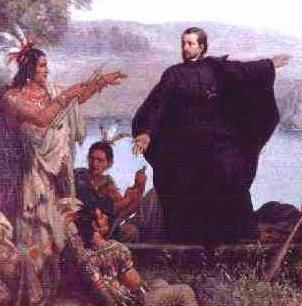
I once heard a story about a 16th century Jesuit mission in Brazil. After a long interaction with the people and some individual conversions, the chief decided to become a Christian (presumably bringing with him the rest of the tribe). As part of the process, the chief met with the leader of the mission to be examined. The priest began asking doctrinal questions. He asked the chief, "How many natures does our Lord have?" The chief responded, "As many natures as you say he has, Father."
Setting aside the more obvious missiological issues surrounding such a tale, this story raises for me the question of the role of submission in belief. To what extent was the chief's answer the right one? To what extent is submission to authority an aspect of conversion and faith? To what extent does such submission include submission to authority of the church? Or, is such submission indicate a lack of genuineness? Does one who publicly submits to the beliefs of his or her church while at the same time questioning them lack integrity?
I don't have any full blown answers to these questions, though I have come to some existential peace about these matters in my own life. I am more interested in raising them for further reflection and discussion. So ...
Any thoughts?
What role should submission play in belief?
Specifically, what role should submission to one's church play in belief?
Does submission spoil belief?
Is belief possible without submission?
_
Wednesday, June 13, 2007
Wesleyan Doctrinal Symposium: "The Church as Sanctified Community of the Triune God"
A little over a week ago, my denomination (the Wesleyan Church) held a doctrinal symposium at its headquarters in Indianapolis. The topic was ecclesiology. Just the existence of such an event is heartening. And it turned out to be a rich and enjoyable experience with presentations, conversations and fellowship.
I happened to be one of the presenters. Below you will find my full paper (sans footnotes), which is also posted in pdf on my writing site. You can also follow this link to the symposium website for all the papers. Enjoy and feel free to make comments or raise questions about my or any of the papers by posting in the discussion board.
What is the church? What does it mean to identify a particular community as church? Is “church” merely a moniker for any religious community? Or does “church” have a distinctly Christian meaning? And can the word “church” in its distinctly Christian sense bear theological weight? In this paper I aim to tease out the theological meaning of “church.” If successful, these elucidations may serve as a framework for discussing the concrete ecclesiological issues of our day.
Unfortunately, the road to a properly theological understanding of the church is paved with difficulties. I do not refer merely to the disappointment, boredom, and suspicion concerning the church, both from within and from without. No, the greatest obstacles to theologizing about the church are themselves theological. How do we connect our talk of God with our talk of the church? Systematic theology is the activity whereby Christians make connections between our various beliefs in order to better perceive and present the fullness of the gospel. We are not looking for just any connections, however; we are looking for connections to our beliefs about God. “What’s God got to do with it?” is the theologian’s refrain. Only statements that attempt to answer the question of God are properly theo-logical.
So, why is it so difficult to connect our church-talk to our God-talk? Three particular obstacles come to mind. The first is the problem of theological presumption: we habitually take for granted our most basic beliefs. What we believe about God—who he is and what he does—is assumed to have been settled long ago. But is this really so? Can we really count on all of us to think spontaneously thoughts worthy of our God? A staff pastor I know once asked her senior pastor after an interview with a potential minister of congregational care, “Where is she at theologically?” The senior pastor responded, “I don’t know. Why would I ask theological questions of someone who will be visiting sick people?” Such presumption leads to neglect, confusion and ignorance. We ought not to take our most cherished beliefs for granted; rather, we should ask pointed questions about the identity and activity of the Christian God. Only then will be able to ground our ecclesiology in our theology.
The second problem is that of soteriological abstraction: we consistently separate our talk of salvation from our talk of God. This problem is a consequence of the first: we presume that we all agree about God, so let’s move on to the interesting, debatable stuff about conversion, predestination, sanctification, end times, etc. I recently taught a FLAME class in advanced theology. The focus was the doctrine of the trinity. One of the students objected, saying “This doesn’t sound like theology; theology is about the order of salvation: prevenient grace, justification, initial sanctification, etc.” In due time, she and (some of) the other students came to appreciate inquiry into the doctrine of God which lies behind our doctrine of grace. But her initial objection unmasked the soteriological abstraction of so much Wesleyan theology. For Wesleyan theology to be theology, we must begin again at the beginning and talk not only about sanctification, but about the Sanctifier. Only then will be about to inquire into a “Wesleyan view of the church.”
The third and final problem is that of ecclesiological reduction: our talk of the church has been reduced to sociological pragmatism. Now don’t hear me wrong: the church is an empirical reality and thus has benefited greatly from statistical research and demographic analysis. These tools have helped us stop groping in the dark for practical solutions. Anyone who rejects sociology wholesale denies the humanity of the church. But the church is more than a social system! It cannot be adequately explained or guided by empirical research alone. To reduce the church to observable phenomena is to deny the divine agency that creates, sustains and consummates her. As I’ve heard Harry Wood at a recent Penn-Jersey District event say, “Theology should be in the driver’s seat; sociology should be in the back seat.” We don’t need to kick sociology out of the car; we just need to prevent it from becoming a back seat driver. And the best way to do prevent sociological reductionism is to locate our talk of the church within our talk of God.
Now that I’ve painted myself into a corner, let me indicate how I plan to overcome the obstacles of theological presumption, soteriological abstraction, and ecclesiological reduction. In the remainder of this paper, I will perform trinitarian renditions of three prominent descriptions of the church: the people of God, the body of Christ, and the temple of the Holy Spirit. Each of these descriptions will be developed from the perspective of the triune God who sanctifies the church. The intended result is to join together the theological connections that have been torn asunder by our presumption, abstraction and reduction. I am not delusional enough to think that I can single-handedly surmount these obstacles by simply talking my way through these connections. However, inasmuch as these problems are perpetuated by bad habits of speech, the least a theologian can do is display what a good habit of speech looks like.
What follows is thus an exercise in grammatical analysis: identifying the subject, verb and object of each of the three ecclesial descriptions under investigation. The triune God is the subject of these sentences. Sanctification in its many aspects is the verb. The church is the object of God’s sanctifying action. Unfolded in trinitarian terms: the Father sets apart a people for the Son by the Spirit; the Son cleanses his body for the Father by the Spirit; the Spirit fills the temple for the Father and the Son. These are three distinct yet unified ways of saying “God sanctifies the church.” All this talk of grammar might make one wonder whether I am just “making this up.” I assure you that I am genuinely trying to perceive and present the inner logic of our beliefs. But, in case what follows is not self-authenticating, I will add to its appeal by indicating how this language can help reframe a concrete ecclesiological issue: membership commitments. Such practical benefits cannot alone make theological statements true. But the usefulness of theological language in the service of the church’s mission is certainly a point in its favor.
I. The Father sets apart a people for the Son by the Spirit
In God’s history with us, God has revealed that he is in eternity God for us. God in eternity self-differentiates his being as three persons: Father, Son and Holy Spirit. The Father begets the Son. The Son is not another God, but another in God. Even as God is centered on himself, God is also others-centered. These eternal persons in relationship are kept both united and distinct by the power of the Holy Spirit, who proceeds from the Father and the Son as their bond of love. These eternal relations are the basis for God’s self-differentiated action in time. God purposes from all eternity to enter into time to bring glory to himself and to share his glory with his creation. God sends himself. The Father sends the Son to become incarnate by the power of the Spirit. The Father and the Son send the Spirit as the outpouring of God’s power onto his creatures.
However, God does not simply “show up.” God sets in motion a history that will be fulfilled by his coming. This history centers on a particular people. God establishes a covenant with a particular people among whom he will dwell. In so choosing a people, God is sanctifying a people: setting them apart for divine service. Not just any service, but service for God’s Son. The Father in his mercy chooses this people from among all others so that his Son may be born among them. Toward this end, God keeps his people by the power of his Spirit. The Spirit leads them through the wilderness. The Spirit is present to them in temple, land, and book as they wait for the coming of the Son. The Spirit empowers prophets to orient the people toward their future. In short, the Father sets apart a people for the Son by the Spirit.
Who is this people? Whom does the Father set apart for the sake of his Son by the power of his Spirit? Well, it should be clear that we are talking about Israel. It is Israel whom God chooses. It is Israel in whom Jesus Christ is born. It is Israel whom God keeps by his Spirit. Israel is the people of God. If we want to understand what it means to be set apart by God for God, we must look to Israel, the people of God. Although this fits well within a broader view of the triune God’s sanctifying work, such a turn to Israel raises an ecclesiological problem: is the church also the people of God? By what right do we call this community of Jews and Gentiles who bear direct witness to Jesus Christ the people of God? Can the language of people be adapted or extended to include the church?
Needless to say, the relationship between Israel and the church raises complex questions that deserve complex answers. Some have called this the ecumenical problem — making intra-Christian divisions appear petty by comparison. I do not seek to answer it completely or conclusively here, but I would like to identify a potential Wesleyan contribution to this question.
Some of the greatest strides in re-conceiving the relationship between Israel and the church in more positive terms have been made by recent trends in Pauline scholarship. According to the “The New Perspective on Paul,” it is becoming increasingly clear that Paul had a much more positive attitude toward the Jewish law than some traditional interpretations have allowed. Judaism at the time of Jesus and Paul can be characterized by its covenantal nomism: by following the law, a Jew does not “get in,” but “stays in.” Even the law is a gift of grace. Paul’s theology was not so much a result of a search for grace after having being pressed under the weight of the law. Rather, Paul’s attitude to the law is shaped by the apocalyptic coming of God announced in the resurrection of Jesus Christ, which relativizes the law but does not abolish it. So the fulfillment of the law in Christ brings with it the triumph of God’s covenant with Israel.
The point of bringing all this up is simply to observe that Wesleyans are considerably less threatened by these developments than some of our fellow inheritors of the protestant reformation. We Wesleyans instinctually grasp that Paul has a complex attitude toward the law. We can stomach the notion of greater continuity between Israel and the church. A Pauline ecclesiology of Gentile inclusion in God’s covenantal community characterized by law-keeping fits well with the distinctive spirit of the Wesleyan/Holiness tradition. I do not think that this parity alone justifies the claims of either Wesleyan theology or the New Perspective. I only wish to indicate that Wesleyans should feel comfortable assimilating the insights of recent Paul scholarship inasmuch as they are helpful for developing a theology of continuity between Israel and the church.
So what ecclesiological lesson can the church learn from Israel? The triune God bears witness to himself through particularity. In other words, Israel fulfills its task simply by being different. This is also true of the church. God sets apart us so that the world will take notice of him. A holy church is a different church, a people that stands out among the many peoples of the world. We must, of course, beware of setting up arbitrary and inhospitable differences between the church and the world. But the church is not the world! Anyone who seeks to erase all difference between church and world is endangering the mission of the church to the world.
The implications for membership commitments should be evident: concrete identity markers are an aspect of God’s sanctification of the church. We need not apologize for our oddities. Actually, apologizing for them spoils them. We should celebrate our difference, although with an inviting rather than repelling attitude. Only if we are identifiable as a Christian community will the world see our works and praise our Father in heaven. You may recall a tragedy that took place in Pennsylvania a few months ago. A man killed three Amish school children in a fit of rage. You may also remember the amazing acts of reconciliation that followed. The News coverage did not treat these acts as a mere human interest story, but saw them as great acts of faith. Why? Because even the News could see the concrete identity markers that set apart the Amish as a community of faith. They bore witness to the world by their difference from the world. And thus they lived according to the truth that the Father sets apart of a people for the Son by the Spirit. In our own way, may it also be so with us.
II. The Son cleanses his body for the Father by the Spirit
Having set apart a people for himself, God becomes incarnate and dwells among us. God becomes human. As in the establishing of the covenant, so also in the fulfilling of the covenant God’s action is self-differentiated. In fact, it is here that God’s triune identity is definitively revealed, for the Son, in distinction from the Father and the Spirit, becomes incarnate. The Son alone becomes incarnate. Yet the triune God is indivisibly involved in the incarnation. As the Father generates the Son in eternity, so the Father sends the Son in time. And as the Spirit is the bond of love between the Father and the Son in eternity, so the Spirit binds the Son to the Father as he sojourns in time.
God sanctifies human flesh for the sake of his mission. God brings Jesus of Nazareth into strict identity with himself. The Son of God is Jesus of Nazareth. Jesus of Nazareth is the Son of God. In the context of this personal identity, the human flesh is utterly obedient to God. As such, the incarnate Son obeys the Father by the Spirit. The Spirit drives; the flesh obeys. The obedience of Jesus Christ runs from his conception through his whole active life and culminates in his passion and death. His entire life of obedience is affirmed when on the third day the Father raised the Son by the power of the Holy Spirit. By this history of obedience, sinful humanity is cleansed. In short, the Son cleanses his body for the Father by the Spirit.
It is by this history of obedience that our redemption is won. God has fulfilled the covenant by this history of obedience. God can look upon his creature and call it good, for Christ can look at his cleansed body and celebrate its obedience. But what about us? What does this have to do with the church? Certainly Christ’s body is cleansed, but are we not still dirtied by disobedience? Here is where the biblical language of body is so helpful. For although first and foremost the body of Christ refers to the human flesh named Jesus of Nazareth, in a secondary and dependent yet very real sense, the body of Christ refers to the church. We are united to him as body to head. This is not the hypostatic union of the incarnation, whereby God is identified as Jesus; but it is a union nonetheless. And so the Son’s cleansing of his body includes his cleansing of us! Now this cleansing might sound like some automatic mystical process, but that is not how body language operates in the New Testament. No, body language appears in the context of exhortation: because we are the body of Christ, we ought to do this or that. The cleansing of the body of Christ takes place as the church by the power of the Holy Spirit obeys the will of the Father revealed in Jesus Christ. Thus we are not only witnesses; we are obedient witnesses to the triune God.
What does this mean for the life of the church? An affirmation of Christ’s cleansing of his body inclines one toward a specific way of thinking about the marks of the church. During the ecclesiological revolution that came to be known as the reformation, the various protestant groups were compelled to defend themselves against the charge of schism. The general response was to develop a doctrine of the marks of the church whereby one can identify the true church from the false church. The list of marks varied from group to group. Martin Bucer, the leader of the reformation in the city of Strausbourg, recommended three marks of the church: wherever the pure word of God is preached, the sacraments are rightly administered, and discipline is properly executed. Because of the perceived abuses of the radical reformers in their emphasis and application of church discipline, the magisterial reformers dropped discipline as a mark of the church in favor of the twofold pattern of word and sacrament. The debate concerning two or three marks reemerged a century later during the Puritan controversy in England. The Puritans pushed for the return of discipline as the third mark of the church, and on its basis began to question the authority of the Anglican Church. Through the influence of his Puritan heritage, John Wesley affirmed the third mark and the churches that developed out of the Methodist revival include the third mark in their constitutional documents, many of which are not inconsequentially named “The Discipline.”
The point of this historical excursus is that the process of concrete discipleship is a critical aspect of what it means to be the church. To be the body of Christ is to be obedient to the triune God. Church discipline is not just institutional maintenance. More importantly, it is the process whereby the body of Christ is brought into submission to God. Church discipline is a spiritual exercise. The implication for membership commitments is that whatever “list” we come up with cannot simply be a matter of who’s in and who’s out. All too often membership commitments are too narrowly associated with the act of becoming a member. But these guidelines are not only boundaries, but also goals. We ought to seek after a life of obedience as a community. “Because you said you would” is an unsustainable basis for fulfilling membership commitments. Because they are an expression of our obedience to God is a much better reason. This raises the question of whether our commitments are really pleasing to God. But responsibly and constitutionally developing our commitments is itself part of our communal pursuit of obedience. Even as they undergo development, the process of accountability to our membership commitments is a direct expression of the Son’s cleansing of his body for the Father by the Spirit.
III. The Spirit fills the temple for the Father and the Son
Having enacted a life of obedience as the fulfillment of his covenant with Israel, the triune God reigns in glory as he ushers in his kingdom. The Spirit of God blows toward this final unity of all things. The same Spirit who unites Father and Son in eternal love and empowers the incarnate Son to obey the Father has now been poured out on God’s community of obedient witnesses. He has been given as a promissory down payment of things to come. It is by the Spirit that God raised Jesus from the dead as the first fruits of the resurrection of all flesh. The Spirit is thus fundamentally oriented toward the future. It is only at the end of history when the Spirit will complete his work of binding, recapitulating the eternal bond of love between the Father and the Son in the marriage of Christ and his church that places God and humanity in perfect harmony.
The Spirit of God is drawing all of humanity toward this end. He does this by filling specific human agents with his power that they might live in accordance with their future destiny. Although the church cannot be equated with the kingdom, it is the beachhead of the kingdom by the power of the Spirit dwelling within her. The church is thus rightly called the temple of the Holy Spirit. The Spirit fills this temple for the Father and the Son.
Having empowered the incarnate Son to obey the Father, the Spirit now empowers the church to obey the will of God. We are not given an impossible standard and then left to our own devices. The law of love enacted in Jesus Christ is written on our hearts by his Holy Spirit. We are empowered by the Spirit to live lives pleasing to God. As such we are an example of the future God desires for all people. We are not only obedient witnesses, but also exemplary obedient witnesses. If the world wants to know what the future holds, it should be able to look no further than the church.
What does this entail for our understanding of the church? It should at minimum give us pause before rejecting the language of “end times community.” The holiness movement from its inception has had a utopian impulse that must be acknowledged. Some early Wesleyan Methodists thought they were bringing in the kingdom with their social reforms. Some holiness camp meetings were perceived as a special outpouring of the Spirit in preparation for the return of Christ. Some holiness churches understood themselves as sojourners and pilgrims in a strange land. The very logic of a holiness movement presupposes a view of the church as a foretaste of heaven in some sense. It is this sort of eschatological consciousness that propelled holiness churches toward the future in their opposition not only to slavery, but also to the subordination of women and the sex trade. In these things the holiness movement was ahead of its time. While some Christians sat idly by, tolerating sin as a necessity in a fallen world, holiness movements pushed the church forward toward the future. This need not be an act of hubris, provided the church really is the temple of the Holy Spirit.
Now this utopian impulse is not without its problems. No one community can be identified with the fullness of the kingdom. God will finish his work by a sovereign upheaval beyond the forces immanent in this natural world. This radical limit must be set against any society, culture, or church that claims to be working toward the coming kingdom. But within these limits, an awareness of the Spirit’s filling should continue to propel us toward God’s future. We should ask what new thing God is doing and seek to participate in it. We should be ahead of the times. We should seek to become the community for which the world is groaning. In other words, we should be living in the end times.
An implication of this way of thinking is that membership commitments should reflect not only where we have been but also where we are going. Membership commitments should describe the kind of community that God wants the world to be. Membership commitments should thus describe the kind of community the world needs to be. The church ought to be attractive to the world, as an example of the world’s future. This does not mean merely revising our membership commitments in order to avoid offending the world. We can and should be different from the world, but not arbitrarily so. We should be different from the world in precisely the way the world desires to be different from itself. Everybody wants to make the world a better place. The church happens to know what that looks like, for it sees the future of the world in the face of the risen Lord Jesus Christ. This Spirit-filled orientation toward the future means we should ask tough questions about what the future holds. What attitudes will characterize the new heavens and the new earth? What kind of society will take shape at the marriage feast of the Lamb? What are the politics of the New Jerusalem? How can our ecclesial standards reflect this future reality? What must be added? What must be adapted? What must be removed? These sorts of questions will guide us in the development of membership commitments that exemplify the Spirit’s filling of the temple for the Father and the Son.
Conclusion
The church is the sanctified community of the triune God. The Father sets apart a people for the Son by the Spirit. The Son cleanses his body for the Father by the Spirit. The Spirit fills the temple for the Father and the Son. Thus we can say with boldness that the church is the people of God, the body of Christ, and the temple of the Holy Spirit. As such we are exemplary, obedient witnesses to the triune God. This pattern of thought does not solve every concrete ecclesial problem, but it does offer a language with which to discuss pressing issues of the day. My hope is that equipped with such good habits of speech we can stop talking past each other and start working together to live as the sanctified community of the triune God.
Any thoughts?
_
I happened to be one of the presenters. Below you will find my full paper (sans footnotes), which is also posted in pdf on my writing site. You can also follow this link to the symposium website for all the papers. Enjoy and feel free to make comments or raise questions about my or any of the papers by posting in the discussion board.
"The Church as Sanctified Community of the Triune God"
What is the church? What does it mean to identify a particular community as church? Is “church” merely a moniker for any religious community? Or does “church” have a distinctly Christian meaning? And can the word “church” in its distinctly Christian sense bear theological weight? In this paper I aim to tease out the theological meaning of “church.” If successful, these elucidations may serve as a framework for discussing the concrete ecclesiological issues of our day.
Unfortunately, the road to a properly theological understanding of the church is paved with difficulties. I do not refer merely to the disappointment, boredom, and suspicion concerning the church, both from within and from without. No, the greatest obstacles to theologizing about the church are themselves theological. How do we connect our talk of God with our talk of the church? Systematic theology is the activity whereby Christians make connections between our various beliefs in order to better perceive and present the fullness of the gospel. We are not looking for just any connections, however; we are looking for connections to our beliefs about God. “What’s God got to do with it?” is the theologian’s refrain. Only statements that attempt to answer the question of God are properly theo-logical.
So, why is it so difficult to connect our church-talk to our God-talk? Three particular obstacles come to mind. The first is the problem of theological presumption: we habitually take for granted our most basic beliefs. What we believe about God—who he is and what he does—is assumed to have been settled long ago. But is this really so? Can we really count on all of us to think spontaneously thoughts worthy of our God? A staff pastor I know once asked her senior pastor after an interview with a potential minister of congregational care, “Where is she at theologically?” The senior pastor responded, “I don’t know. Why would I ask theological questions of someone who will be visiting sick people?” Such presumption leads to neglect, confusion and ignorance. We ought not to take our most cherished beliefs for granted; rather, we should ask pointed questions about the identity and activity of the Christian God. Only then will be able to ground our ecclesiology in our theology.
The second problem is that of soteriological abstraction: we consistently separate our talk of salvation from our talk of God. This problem is a consequence of the first: we presume that we all agree about God, so let’s move on to the interesting, debatable stuff about conversion, predestination, sanctification, end times, etc. I recently taught a FLAME class in advanced theology. The focus was the doctrine of the trinity. One of the students objected, saying “This doesn’t sound like theology; theology is about the order of salvation: prevenient grace, justification, initial sanctification, etc.” In due time, she and (some of) the other students came to appreciate inquiry into the doctrine of God which lies behind our doctrine of grace. But her initial objection unmasked the soteriological abstraction of so much Wesleyan theology. For Wesleyan theology to be theology, we must begin again at the beginning and talk not only about sanctification, but about the Sanctifier. Only then will be about to inquire into a “Wesleyan view of the church.”
The third and final problem is that of ecclesiological reduction: our talk of the church has been reduced to sociological pragmatism. Now don’t hear me wrong: the church is an empirical reality and thus has benefited greatly from statistical research and demographic analysis. These tools have helped us stop groping in the dark for practical solutions. Anyone who rejects sociology wholesale denies the humanity of the church. But the church is more than a social system! It cannot be adequately explained or guided by empirical research alone. To reduce the church to observable phenomena is to deny the divine agency that creates, sustains and consummates her. As I’ve heard Harry Wood at a recent Penn-Jersey District event say, “Theology should be in the driver’s seat; sociology should be in the back seat.” We don’t need to kick sociology out of the car; we just need to prevent it from becoming a back seat driver. And the best way to do prevent sociological reductionism is to locate our talk of the church within our talk of God.
Now that I’ve painted myself into a corner, let me indicate how I plan to overcome the obstacles of theological presumption, soteriological abstraction, and ecclesiological reduction. In the remainder of this paper, I will perform trinitarian renditions of three prominent descriptions of the church: the people of God, the body of Christ, and the temple of the Holy Spirit. Each of these descriptions will be developed from the perspective of the triune God who sanctifies the church. The intended result is to join together the theological connections that have been torn asunder by our presumption, abstraction and reduction. I am not delusional enough to think that I can single-handedly surmount these obstacles by simply talking my way through these connections. However, inasmuch as these problems are perpetuated by bad habits of speech, the least a theologian can do is display what a good habit of speech looks like.
What follows is thus an exercise in grammatical analysis: identifying the subject, verb and object of each of the three ecclesial descriptions under investigation. The triune God is the subject of these sentences. Sanctification in its many aspects is the verb. The church is the object of God’s sanctifying action. Unfolded in trinitarian terms: the Father sets apart a people for the Son by the Spirit; the Son cleanses his body for the Father by the Spirit; the Spirit fills the temple for the Father and the Son. These are three distinct yet unified ways of saying “God sanctifies the church.” All this talk of grammar might make one wonder whether I am just “making this up.” I assure you that I am genuinely trying to perceive and present the inner logic of our beliefs. But, in case what follows is not self-authenticating, I will add to its appeal by indicating how this language can help reframe a concrete ecclesiological issue: membership commitments. Such practical benefits cannot alone make theological statements true. But the usefulness of theological language in the service of the church’s mission is certainly a point in its favor.
I. The Father sets apart a people for the Son by the Spirit
In God’s history with us, God has revealed that he is in eternity God for us. God in eternity self-differentiates his being as three persons: Father, Son and Holy Spirit. The Father begets the Son. The Son is not another God, but another in God. Even as God is centered on himself, God is also others-centered. These eternal persons in relationship are kept both united and distinct by the power of the Holy Spirit, who proceeds from the Father and the Son as their bond of love. These eternal relations are the basis for God’s self-differentiated action in time. God purposes from all eternity to enter into time to bring glory to himself and to share his glory with his creation. God sends himself. The Father sends the Son to become incarnate by the power of the Spirit. The Father and the Son send the Spirit as the outpouring of God’s power onto his creatures.
However, God does not simply “show up.” God sets in motion a history that will be fulfilled by his coming. This history centers on a particular people. God establishes a covenant with a particular people among whom he will dwell. In so choosing a people, God is sanctifying a people: setting them apart for divine service. Not just any service, but service for God’s Son. The Father in his mercy chooses this people from among all others so that his Son may be born among them. Toward this end, God keeps his people by the power of his Spirit. The Spirit leads them through the wilderness. The Spirit is present to them in temple, land, and book as they wait for the coming of the Son. The Spirit empowers prophets to orient the people toward their future. In short, the Father sets apart a people for the Son by the Spirit.
Who is this people? Whom does the Father set apart for the sake of his Son by the power of his Spirit? Well, it should be clear that we are talking about Israel. It is Israel whom God chooses. It is Israel in whom Jesus Christ is born. It is Israel whom God keeps by his Spirit. Israel is the people of God. If we want to understand what it means to be set apart by God for God, we must look to Israel, the people of God. Although this fits well within a broader view of the triune God’s sanctifying work, such a turn to Israel raises an ecclesiological problem: is the church also the people of God? By what right do we call this community of Jews and Gentiles who bear direct witness to Jesus Christ the people of God? Can the language of people be adapted or extended to include the church?
Needless to say, the relationship between Israel and the church raises complex questions that deserve complex answers. Some have called this the ecumenical problem — making intra-Christian divisions appear petty by comparison. I do not seek to answer it completely or conclusively here, but I would like to identify a potential Wesleyan contribution to this question.
Some of the greatest strides in re-conceiving the relationship between Israel and the church in more positive terms have been made by recent trends in Pauline scholarship. According to the “The New Perspective on Paul,” it is becoming increasingly clear that Paul had a much more positive attitude toward the Jewish law than some traditional interpretations have allowed. Judaism at the time of Jesus and Paul can be characterized by its covenantal nomism: by following the law, a Jew does not “get in,” but “stays in.” Even the law is a gift of grace. Paul’s theology was not so much a result of a search for grace after having being pressed under the weight of the law. Rather, Paul’s attitude to the law is shaped by the apocalyptic coming of God announced in the resurrection of Jesus Christ, which relativizes the law but does not abolish it. So the fulfillment of the law in Christ brings with it the triumph of God’s covenant with Israel.
The point of bringing all this up is simply to observe that Wesleyans are considerably less threatened by these developments than some of our fellow inheritors of the protestant reformation. We Wesleyans instinctually grasp that Paul has a complex attitude toward the law. We can stomach the notion of greater continuity between Israel and the church. A Pauline ecclesiology of Gentile inclusion in God’s covenantal community characterized by law-keeping fits well with the distinctive spirit of the Wesleyan/Holiness tradition. I do not think that this parity alone justifies the claims of either Wesleyan theology or the New Perspective. I only wish to indicate that Wesleyans should feel comfortable assimilating the insights of recent Paul scholarship inasmuch as they are helpful for developing a theology of continuity between Israel and the church.
So what ecclesiological lesson can the church learn from Israel? The triune God bears witness to himself through particularity. In other words, Israel fulfills its task simply by being different. This is also true of the church. God sets apart us so that the world will take notice of him. A holy church is a different church, a people that stands out among the many peoples of the world. We must, of course, beware of setting up arbitrary and inhospitable differences between the church and the world. But the church is not the world! Anyone who seeks to erase all difference between church and world is endangering the mission of the church to the world.
The implications for membership commitments should be evident: concrete identity markers are an aspect of God’s sanctification of the church. We need not apologize for our oddities. Actually, apologizing for them spoils them. We should celebrate our difference, although with an inviting rather than repelling attitude. Only if we are identifiable as a Christian community will the world see our works and praise our Father in heaven. You may recall a tragedy that took place in Pennsylvania a few months ago. A man killed three Amish school children in a fit of rage. You may also remember the amazing acts of reconciliation that followed. The News coverage did not treat these acts as a mere human interest story, but saw them as great acts of faith. Why? Because even the News could see the concrete identity markers that set apart the Amish as a community of faith. They bore witness to the world by their difference from the world. And thus they lived according to the truth that the Father sets apart of a people for the Son by the Spirit. In our own way, may it also be so with us.
II. The Son cleanses his body for the Father by the Spirit
Having set apart a people for himself, God becomes incarnate and dwells among us. God becomes human. As in the establishing of the covenant, so also in the fulfilling of the covenant God’s action is self-differentiated. In fact, it is here that God’s triune identity is definitively revealed, for the Son, in distinction from the Father and the Spirit, becomes incarnate. The Son alone becomes incarnate. Yet the triune God is indivisibly involved in the incarnation. As the Father generates the Son in eternity, so the Father sends the Son in time. And as the Spirit is the bond of love between the Father and the Son in eternity, so the Spirit binds the Son to the Father as he sojourns in time.
God sanctifies human flesh for the sake of his mission. God brings Jesus of Nazareth into strict identity with himself. The Son of God is Jesus of Nazareth. Jesus of Nazareth is the Son of God. In the context of this personal identity, the human flesh is utterly obedient to God. As such, the incarnate Son obeys the Father by the Spirit. The Spirit drives; the flesh obeys. The obedience of Jesus Christ runs from his conception through his whole active life and culminates in his passion and death. His entire life of obedience is affirmed when on the third day the Father raised the Son by the power of the Holy Spirit. By this history of obedience, sinful humanity is cleansed. In short, the Son cleanses his body for the Father by the Spirit.
It is by this history of obedience that our redemption is won. God has fulfilled the covenant by this history of obedience. God can look upon his creature and call it good, for Christ can look at his cleansed body and celebrate its obedience. But what about us? What does this have to do with the church? Certainly Christ’s body is cleansed, but are we not still dirtied by disobedience? Here is where the biblical language of body is so helpful. For although first and foremost the body of Christ refers to the human flesh named Jesus of Nazareth, in a secondary and dependent yet very real sense, the body of Christ refers to the church. We are united to him as body to head. This is not the hypostatic union of the incarnation, whereby God is identified as Jesus; but it is a union nonetheless. And so the Son’s cleansing of his body includes his cleansing of us! Now this cleansing might sound like some automatic mystical process, but that is not how body language operates in the New Testament. No, body language appears in the context of exhortation: because we are the body of Christ, we ought to do this or that. The cleansing of the body of Christ takes place as the church by the power of the Holy Spirit obeys the will of the Father revealed in Jesus Christ. Thus we are not only witnesses; we are obedient witnesses to the triune God.
What does this mean for the life of the church? An affirmation of Christ’s cleansing of his body inclines one toward a specific way of thinking about the marks of the church. During the ecclesiological revolution that came to be known as the reformation, the various protestant groups were compelled to defend themselves against the charge of schism. The general response was to develop a doctrine of the marks of the church whereby one can identify the true church from the false church. The list of marks varied from group to group. Martin Bucer, the leader of the reformation in the city of Strausbourg, recommended three marks of the church: wherever the pure word of God is preached, the sacraments are rightly administered, and discipline is properly executed. Because of the perceived abuses of the radical reformers in their emphasis and application of church discipline, the magisterial reformers dropped discipline as a mark of the church in favor of the twofold pattern of word and sacrament. The debate concerning two or three marks reemerged a century later during the Puritan controversy in England. The Puritans pushed for the return of discipline as the third mark of the church, and on its basis began to question the authority of the Anglican Church. Through the influence of his Puritan heritage, John Wesley affirmed the third mark and the churches that developed out of the Methodist revival include the third mark in their constitutional documents, many of which are not inconsequentially named “The Discipline.”
The point of this historical excursus is that the process of concrete discipleship is a critical aspect of what it means to be the church. To be the body of Christ is to be obedient to the triune God. Church discipline is not just institutional maintenance. More importantly, it is the process whereby the body of Christ is brought into submission to God. Church discipline is a spiritual exercise. The implication for membership commitments is that whatever “list” we come up with cannot simply be a matter of who’s in and who’s out. All too often membership commitments are too narrowly associated with the act of becoming a member. But these guidelines are not only boundaries, but also goals. We ought to seek after a life of obedience as a community. “Because you said you would” is an unsustainable basis for fulfilling membership commitments. Because they are an expression of our obedience to God is a much better reason. This raises the question of whether our commitments are really pleasing to God. But responsibly and constitutionally developing our commitments is itself part of our communal pursuit of obedience. Even as they undergo development, the process of accountability to our membership commitments is a direct expression of the Son’s cleansing of his body for the Father by the Spirit.
III. The Spirit fills the temple for the Father and the Son
Having enacted a life of obedience as the fulfillment of his covenant with Israel, the triune God reigns in glory as he ushers in his kingdom. The Spirit of God blows toward this final unity of all things. The same Spirit who unites Father and Son in eternal love and empowers the incarnate Son to obey the Father has now been poured out on God’s community of obedient witnesses. He has been given as a promissory down payment of things to come. It is by the Spirit that God raised Jesus from the dead as the first fruits of the resurrection of all flesh. The Spirit is thus fundamentally oriented toward the future. It is only at the end of history when the Spirit will complete his work of binding, recapitulating the eternal bond of love between the Father and the Son in the marriage of Christ and his church that places God and humanity in perfect harmony.
The Spirit of God is drawing all of humanity toward this end. He does this by filling specific human agents with his power that they might live in accordance with their future destiny. Although the church cannot be equated with the kingdom, it is the beachhead of the kingdom by the power of the Spirit dwelling within her. The church is thus rightly called the temple of the Holy Spirit. The Spirit fills this temple for the Father and the Son.
Having empowered the incarnate Son to obey the Father, the Spirit now empowers the church to obey the will of God. We are not given an impossible standard and then left to our own devices. The law of love enacted in Jesus Christ is written on our hearts by his Holy Spirit. We are empowered by the Spirit to live lives pleasing to God. As such we are an example of the future God desires for all people. We are not only obedient witnesses, but also exemplary obedient witnesses. If the world wants to know what the future holds, it should be able to look no further than the church.
What does this entail for our understanding of the church? It should at minimum give us pause before rejecting the language of “end times community.” The holiness movement from its inception has had a utopian impulse that must be acknowledged. Some early Wesleyan Methodists thought they were bringing in the kingdom with their social reforms. Some holiness camp meetings were perceived as a special outpouring of the Spirit in preparation for the return of Christ. Some holiness churches understood themselves as sojourners and pilgrims in a strange land. The very logic of a holiness movement presupposes a view of the church as a foretaste of heaven in some sense. It is this sort of eschatological consciousness that propelled holiness churches toward the future in their opposition not only to slavery, but also to the subordination of women and the sex trade. In these things the holiness movement was ahead of its time. While some Christians sat idly by, tolerating sin as a necessity in a fallen world, holiness movements pushed the church forward toward the future. This need not be an act of hubris, provided the church really is the temple of the Holy Spirit.
Now this utopian impulse is not without its problems. No one community can be identified with the fullness of the kingdom. God will finish his work by a sovereign upheaval beyond the forces immanent in this natural world. This radical limit must be set against any society, culture, or church that claims to be working toward the coming kingdom. But within these limits, an awareness of the Spirit’s filling should continue to propel us toward God’s future. We should ask what new thing God is doing and seek to participate in it. We should be ahead of the times. We should seek to become the community for which the world is groaning. In other words, we should be living in the end times.
An implication of this way of thinking is that membership commitments should reflect not only where we have been but also where we are going. Membership commitments should describe the kind of community that God wants the world to be. Membership commitments should thus describe the kind of community the world needs to be. The church ought to be attractive to the world, as an example of the world’s future. This does not mean merely revising our membership commitments in order to avoid offending the world. We can and should be different from the world, but not arbitrarily so. We should be different from the world in precisely the way the world desires to be different from itself. Everybody wants to make the world a better place. The church happens to know what that looks like, for it sees the future of the world in the face of the risen Lord Jesus Christ. This Spirit-filled orientation toward the future means we should ask tough questions about what the future holds. What attitudes will characterize the new heavens and the new earth? What kind of society will take shape at the marriage feast of the Lamb? What are the politics of the New Jerusalem? How can our ecclesial standards reflect this future reality? What must be added? What must be adapted? What must be removed? These sorts of questions will guide us in the development of membership commitments that exemplify the Spirit’s filling of the temple for the Father and the Son.
Conclusion
The church is the sanctified community of the triune God. The Father sets apart a people for the Son by the Spirit. The Son cleanses his body for the Father by the Spirit. The Spirit fills the temple for the Father and the Son. Thus we can say with boldness that the church is the people of God, the body of Christ, and the temple of the Holy Spirit. As such we are exemplary, obedient witnesses to the triune God. This pattern of thought does not solve every concrete ecclesial problem, but it does offer a language with which to discuss pressing issues of the day. My hope is that equipped with such good habits of speech we can stop talking past each other and start working together to live as the sanctified community of the triune God.
Any thoughts?
_
Wednesday, June 06, 2007
Review of Gary M. Best, Charles Wesley: A Biography
 One way to commemorate the 300th anniversary of Charles Wesley’s birth is to tell the story of his life and work. Gary Best’s biography of the ‘man made for friendship’ highlights Charles’ unique contribution to the emergence of Methodism in the 18th century, and thus helps to bring Charles out from behind the shadow of his brother John. Although the wait for a modern biography of the younger Wesley brother has been far too long, the attention to detail and sensitivity to historical context that Best brings to his subject matter has been worth the wait. This biography has the potential to become the standard bearer of its kind for the foreseeable future.
Best begins by chronicling the key ecclesial and political events in the century prior to Charles’ birth, locating Charles’ forebears within this complex situation. The tension between loyalty and dissent already present in the Wesley family becomes a dominant theme in Charles’ story. This opening chapter would have benefited from greater sensitivity to the subtleties of the English reformation and the Puritan movement, but Best’s overview of the situation into which Charles was born is adequate for his purposes.
The remaining eleven chapters can be roughly divided into three parts: the early years from 1725 to 1741 (chapters 2-5), the turbulent 1740’s (chapters 6-8), and the remaining years from 1750 to Charles’ death in the late 1780’s (chapters 9-12). Adhering to the common pattern of biography in general and Methodist history in particular, Best gives disproportionate attention to Charles’ early years. Of particular interest is Best’s retelling of famous episodes in Wesley history (the Oxford Holy Club, the missionary fiasco in Georgia, the heart-warming conversion experience) from Charles’ perspective. Without denying John’s dominance, Best foregrounds Charles’ oft forgotten initiative and precedence in these and other incidences. Best displays Charles’ impact as a preacher and organizer in addition to his well-known hymn-writing abilities.
Charles’ conciliatory role during the conflicts with the Moravian and Calvinist branches of Methodism during the 1740’s shows that the epigram ‘the man made for friendship’ is more than mere sentimentality. Throughout the rest of Best’s biography, Charles finds himself standing between his brother John and other parties within and without the Methodist movement. In the 1750’s, clear division arises between the brothers concerning their loyalty to the Church of England. Best shows that Charles was more consistently opposed to dissent than John, in some cases almost single-handedly preventing premature separation. When dealing with this recurrent theme, the author at times advocates for Charles’ view, attitude, and approach. Whether or not such advocacy is appropriate for a critical biography, it is important that readers be made aware of Best’s partiality on this matter.
Although focused on the problem of loyalty versus dissent, the remaining chapters are not limited to this issue alone. Best deftly narrates the controversy surrounding the doctrine and experience of Christian perfection, the introduction of John Fletcher into Methodist leadership, the role of the Wesleys during the American War of Independence, and the growth of Charles’ family. Although these later chapters each cover about a decade of Charles’ life, Best’s attention to detail remains so that the reader continues to be exposed to lengthy citations from primary source material.
Best’s biography of Charles Wesley is a delightful exercise in social history. The figure of Charles emerges as an indispensable agent within Methodism and an affable friend and family man. He is carefully placed within the sociopolitical intrigue of his times. The reader comes away with a sense of his character and a grasp of his story. The ample use of primary source quotations brings historical voices alive. There is very little critical engagement with contemporary secondary sources, which is dissatisfying to the scholar but at least makes the book more accessible.
Best’s strengths as a social historian are unfortunately not accompanied by a strong theological interest. The development of Charles’ thought, alongside his life and work, is not analyzed in great detail. This is definitely not an intellectual biography of Charles Wesley. Best does not critically engage Charles’s complex relationship to various influences such as his Puritan roots, Oxford teachers, Moravian pietism, and Lockean empiricism. We learn precious little of how these ideas shaped Charles or how Charles in turn shaped these ideas. Of particular interest is the difference between John and Charles with regard to the doctrine of Christian perfection, which is identified but not explored. So, although Best’s biography of Charles Wesley has been worth the wait, we shall have to keep waiting for the definitive intellectual biography of Charles Wesley.
Within the bounds of his stated aim, Best has provided a solid biography of Charles Wesley that deserves to become the standard introduction to Charles’ life. The book would be appropriate for undergraduate and graduate courses in Methodist history, 18th century studies, and church history. Church groups or book clubs interested in Methodist roots would also find it accessible and enjoyable. Anyone who has been touched by Charles Wesley’s influence can aptly celebrate his contribution by reading this book.
Any Thoughts?
What impression would you have of Best's book if you'd only read this review?
What did you think of Best's book (if you've read it)?
What do you look for in a biography of a religious figure?
_
Wednesday, May 30, 2007
A Taste of Philosophy
On Wednesday I finished my first round of qualifying exams. I have inserted my Philosophy Exam Essays below as this week's post. Follow this link for a pdf version at my writing page, which also contains my Ethics Exam Essays. Also, note that I have a personal update blog that may be of interest to some readers.
3. What arguments can be brought against the concept of distributive (as opposed to retributive) justice? Are they convincing?
Many contemporary calls for social reform rest philosophically on an account of distributive justice. Can justice be understood in terms of distribution? In this essay, I will argue that a modest account of distributive justice is possible. In order to do so, I will (1) briefly describe the concept of distributive justice in contrast to retributive justice, (2) raise three objections to such a concept, and (3) reply to these objections, which in some cases will require incorporating the objector’s insights.
What is justice? Although pursuing an abstract definition of justice is an impossible and unhelpful pursuit, a working understanding of justice can emerge through the observation of everyday human activities. Appeals to justice are made when someone claims that an action, situation or intention is right or wrong. One need not appeal to an absolute standard to speak of an action being correct or incorrect. Such a claim speaks of a relationship between the action in question and some sort of standard by which the action can be judged. Such standards of rightness are the requirements of justice.
Traditionally, justice has been contrasted with goodness. Both are moral categories. Both goodness and justice speak of what should be over against what is. But goodness speaks of what is better and worse, whereas justice speaks of what is right and wrong. Whether a hard-and-fast distinction between goodness and justice can be meaningfully sustained is an important question. But this initial distinction is sufficient for understanding what is meant by talk of justice.
The concept of justice itself can be understood in at least two distinct senses. On the one hand, retributive justice addresses what is the right response to wrongdoing. Different theories regarding the purpose of retribution (deterrence, punishment, reform, etc.) are united by approaching justice in terms of responding rightly to what has been done wrong.
On the other hand, distributive justice addresses the right response to a wrong situation. Certain circumstances can be deemed unjust. Specifically, the justice of a circumstance is measured in accordance with the distribution of goods. Notice that the category of the good must be incorporated in order to speak meaningfully of distributive justice. When applied broadly, distributive justice addresses the concerns of social justice: the way in which a society should be structured with regard to its cumulative goods.
One such broad application of distributive justice can be seen in the work of John Rawls. Rawls argues that, by going behind a veil of ignorance concerning the contingencies of one’s situation, persons would abide by certain rational principles of fairness that would protect their own interests and serve the common good. Rawls abstracts two principles of distributive justice from this theoretical social agreement. The first is the principle of liberty, whereby each person is given as much liberty as possible without overstepping the boundaries of another’s liberty. The second is the principle of difference, whereby the only permitted inequalities in the distribution of goods are those that serve the common good, especially those with the least goods. On the basis of such principles, Rawls can support a theory of justice as fairness, which can be used to support policies of the just redistribution of goods.
(2)
Is such an understanding of justice as distributive (in addition to or perhaps instead of retributive) warranted? A number of philosophical objections can be raised against the very idea of distributive justice. I will outline three such objections, drawing more or less on the work of Robert Nozick.
First, the notion of distributive justice confuses justice with equality. By identifying differences between persons concerning the goods they have at their disposal, distributive concepts of justice assume inequality is inherently unjust. Although it is difficult enough to defend, such an assumption is the result of a conceptual confusion. If the problem were inequality, then it would be clearer to appeal to the principles of equality independent of the concept of justice. Perhaps equality could be defended as a good toward which to strive, thus making the appeal to justice unnecessary.
Second, concepts of justice as distributive conflict with liberty. Appeals to distributive justice inevitably come into conflict with the freedom of the individual to make use of one’s goods as one sees fit. Either liberty will be subordinated to distributive justice, or distributive justice will be limited by liberty, or both will be controlled by a third principle. One could even argue that justice demands certain individual liberties by appealing to basic human rights. Thus the concept of justice as a defender of liberty severely limits a distributive concept of justice.
Third, distributive concepts of justice ignore history. By focusing on an end-state situation in which goods are unfairly distributed, concepts of social justice as distributive fail to account for the historical process of such distribution. Attention to the contingencies of history would reveal that there is more to justice than the distribution of goods. Some persons could in fact be entitled to certain goods in terms of inherent ownership (e.g., the products of musical creativity). Some persons could in fact have goods at their disposal which do in fact serve the common good yet were acquired through an unjust process (e.g., donation to charity of fraudulent assets). Furthermore, in some cases the history behind a situation of distribution is so complex that the rightness of the process and result is too difficult to ascertain.
(3)
Can the notion of justice as distributive respond adequately to these objections? The first objection is easily answered. The second objection calls for some adaptation. The third objection is serious enough that any viable concept of distributive justice must adapt significantly. However, none of these objections require a wholesale rejection of the concept of distributive justice.
First, distributive justice properly understood does not confuse justice with equality. In the case of Rawls, inequalities are permitted. The purpose of his theory is to indicate how such inequalities can be justified, which he does so on the basis of the principle of difference. It is not that inequality is inherently unjust, but rather that arbitrary inequalities are unjust.
Second, distributive justice does not necessarily conflict with liberty. In Rawls’ case, liberty is clearly subordinated to social justice. However, this need not be the only option. One could develop an understanding of the good society as one which seeks after both distributive justice and freedom. Protections for each could be advanced by principles that account for the demands of the other. So, although a subordination of liberty to justice is problematic, it is not a necessary move to make when developing an understanding of distributive justice.
Third, inasmuch as a theory of distributive justice focuses a-historically on end-state distribution of goods, it will be inadequate. The significance of historical contingencies must be acknowledged. In attempting to rid society of arbitrary distribution of goods, Rawls’ veil of ignorance in fact undermines some forms of rightful inherent ownership. Contingency is not the same as arbitrariness. However, history cannot explain everything. Some principles of justice are appropriate for assessing the rightness of a end-state situation. So, a theory of distributive justice that takes into account historical factors may continue also to seek after principles of just distribution.
So, the concept of justice as distributive can be upheld, provided it be appropriately modified in view of some important objections.
4. Set out in premises and conclusion one of the traditional arguments for the existence of God and critically examine its validity.
Of the many traditional arguments for the existence of God, one of the clearest is the argument from design. In this essay, I will (1) summarize this argument by putting it in logical form, (2) raise some objections to it that can be successfully answered, and (3) raise some objections that cannot be successfully answered. It will be shown through the course of this discussion that, despite its strengths, the design argument is ultimately unsuccessful as an argument for the existence of God.
(1)
The argument for God’s existence from evidence of design in nature is popularly associated with the so-called watchmaker argument used by William Paley. The importance of this parable is that it displays the analogical character of the argument from design. Suppose one was walking in the woods and found a watch. By observing its intricate design, wherein each part serves a function and all the parts together work toward a clear purpose, one could rationally infer that an intelligent being is responsible for fashioning the watch (a.k.a., the watchmaker). The existence of such a watchmaker can be inferred from the watch without having ever directly encountered the watchmaker. This example provides the first premise of the argument: (a) the existence of an intelligent being may be inferred from evidence of design.
The next step in the argument comes by way of analogy. Just as there is evidence of design in the watch, so there is evidence of design in the world. One can directly observe the patterns of the world that together form an intricate and purposive whole. The marshaling of this evidence from nature provides the second premise of the argument: (b) there is evidence of design in nature.
The conclusion drawn from these two premises is that, since (a) the existence of an intelligent being may be inferred from evidence of design and (b) there is evidence of design in nature, therefore (c) there exists an intelligent being that designed nature, i.e., God. These are the basic components in syllogistic form of the argument for the existence of God from design.
(2)
A number of objections have been raised against this argument. In his Dialogues on Natural Religion, David Hume gives sustained attention to this argument and its problems. Drawing on and developing from Hume’s discussion, I will raise three objections to this argument and respond to each in turn.
First, concerning premise (a), one could be skeptical concerning the ability to infer the existence of an intelligent being from supposed evidence of design. The emergence of modern science shows that much can be explained without recourse to supposed minds and wills hidden behind the operations of nature. Such beings are unnecessary for understanding the way the universe works. Therefore, the move from design to design is unnecessary.
Although it is right to question appeals to imaginary substances underline the operations of nature, modern science does not require a thoroughgoing skepticism with regard to minds, causation, and logical relationships. One could speak of enduring mental realities without appeal to imaginary substances. Such minds would interact and overlap with physical realities without being reduced to materialistic explanations. And so the first premise holds in the face of this objection
Second, concerning premise (b), one could argue that there is not evidence of design in nature. Hume in fact challenges whether there is sufficient evidence of design. There may be design in this part of the universe, but we do not have evidence of design for the rest of the universe. Furthermore, the apparent design may be temporary. Therefore, the lack of evidence for design in nature undermines the argument.
Such an objection has not withstood the test of time. Scientists have in fact found much evidence of intricate design throughout space and across time. So the second premise stands in the face of empirical inquiry.
Third, concerning the conclusion (c), one could object that the inferred designer is not much of a God. For instance, the supposed designer may lack benevolence or omnipotence, and so would not be a good candidate for “God” as usually described. Hume grants that the existence of a designer might be inferred from evidence in nature, but that the nature of such a designer is rendered problematic or even remains unknown. So, even if the premises stand, the conclusion fails to achieve the purpose of the argument.
This objection raises an important matter to which we will return in a moment, but as it stands it does not undermine the argument from design. The design argument aims only to prove that God exists, not what God is like. The existence and essence of God have been traditionally distinguished. One can follow a certain line of argument for proving the existence of God, and then follow different lines of argument for determining the character of this God. And so, even though it does not answer the question of the nature of this inferred intelligent being, the conclusion stands as proving the existence of this being.
(3)
Despite its capacity to withstand these objections leveled at its premises and conclusion, the design argument for God’s existence does not succeed. A number of objections can be raised against the validity of its logic that cannot be adequately answered.
First, it is questionable whether the design analogy can be extended to God’s creation of the world. Hume raises this objection by noting that, although we have analogous experience observing the process of watch-making, we do not have experience observing world-making. Now Hume may not be right in thinking that we must have analogous experience of any inference, but he is right to distinguish the making of a part from the making of the whole. It would seem appropriate to think of the design the whole of nature as an utterly different kind of activity from the purposive action of human ingenuity within that whole. So the analogy between evidence in nature supplied in premise (b) and the kind of inference proposed by premise (a) is questionable.
Second, the very character of the analogy employed is problematic. Although it may be possible to infer the existence of minds from trails of physical evidence, it is certainly an odd way for one mind to encounter another mind. Usually, minds interact with other minds mentally. In other words, if I want to know about you, I would not follow a trail of evidence, but rather would start up a conversation with you. Such mental conversation does not necessarily rule out physical processes (e.g., brain activity, vocal sounds, etc.), but it is not reducible to or exhausted by such physical traces. So, to infer the existence of God from evidence of design is a rather odd way of encountering a supreme intelligent being.
Third, an additional yet unsubstantiated premise has been smuggled into the conclusion of the argument. Although not always explicitly stated, the design argument presupposes the identity between the inferred designer of the world and God. Such identification is explicitly laid out in Thomas Aquinas’ five ways (Summa Theologiae, Ia, q. 2, a. 3). At the end of each of his five arguments (which include the argument from design), Aquinas states some version of the phrase “and this is what all call God.” But is it? Is the conclusion of this argument immediately identifiable with the notion of God? There are other concepts of God that do not understand God as the designer of the world (e.g., demigod theories, some forms of pantheism, etc.). It is not a coincidence that these concepts are inclined to use other kinds of arguments for God’s existence. This raises again the question of the relationship between existence and essence of God. Although these can be distinguished, they cannot be separated. One’s mode of proving God’s existence does relate to one’s the understanding of God’s nature. Design arguments presuppose a certain concept of God that must be defended. By smuggling in an unacknowledged premise, the argument for design is rendered invalid.
In view of these problems concerning its validity, the argument for God’s existence from evidence of design in nature is ultimately not successful.
7. Critically examine materialism as a philosophy of mind.
Materialism in both its classical and contemporary forms presents a major alternative philosophy of mind. In this essay, I will critically examine materialism by (1) briefly describing the claims of philosophical materialism and their appeal in contrast with dualism, (2) reply to the objection that such an account is necessarily reductionistic, and (3) argue that, despite its strengths, materialism remains an inadequate account of the nature of mental realities.
(1)
The basic claim of materialism as a philosophy of mind is that mental realities can be adequately explained by observable phenomena. In other words, minds are to be understood fully as an aspect of bodies, or, more specifically, brains. The category “mental” is an appropriate concept for discussing the activities of thinking bodies. We are not merely embodied souls, but rather we are our bodies.
Although present in the ancient period, philosophical materialism has gained support in the modern period because of its association with modern science. Scientific inquiry has rendered unnecessary a number of traditional explanations for phenomena. An older, more “enchanted” world-view tended to see natural processes as a result of the direct willing of spiritual realities. Science has shown that in many cases, the opposite is true, so that so-called spiritual realities are in fact the result of natural laws. The technical success of science has been taken by some to imply that in principle all such spiritual realities can and should be explained by natural processes. Once such a principled assertion is taken up, one has moved from the material orientation of science to a materialistic presupposition of philosophy.
Such a philosophy of mind has particular appeal in contrast with dualism. Dualism, whether of a Platonic or Cartesian variety, runs into serious problems. Although scientific evidence alone does not automatically undermine dualism, some contemporary brain research is considerably easier to account for from a materialistic rather than dualistic point of view. More importantly, dualism runs into serious internal philosophical problems. For instance, once one has posited two substances (mental and physical), one is required to explain the relationship between the two -- a requirement that has yet to be adequately supplied. Dualism also can be used to fund a dismissive attitude toward the body. In view of these weaknesses of dualism, materialism is offered as a more simple and coherent understanding of mental realities.
(2)
However, the superiority of materialism over dualism as a philosophy of mind does not mean it has no problems of its own. A particularly important objection to philosophical materialism is that it is reductionistic. By explaining the mind by direct reference to the processes of the brain, the mind is in fact explained away by the brain. The result is that there is no such thing as the mind. Only the brain remains, and thus one does not have a philosophy of mind at all.
Such an objection is not merely a verbal game, but a substantive problem that must be addressed. The category of mental should open up avenues of reflection concerning identity, freedom, and creativity. If the mental is merely another way of speaking about bodily processes then these questions are cut short. One need not be committed to certain answers to these questions to be opposed to assumptions that bar them from even being asked. So, if in fact materialism is reductionistic then it is inadequate as a philosophy of mind.
Although some forms of materialism may be quite reductionistic, philosophical materialism is not necessary so. Some forms of materialism speak of the mind as an epiphenomenon. Within such theories, the emergence and continuation of the mind is immediately linked to the brain, but it nevertheless can be spoken of with a certain measure of integrity as something “more” than mere brain waves. The mind can be a result of the brain without being reduced to the brain. One can follow the evidence of brain research into a certain understanding of what minds can and cannot do, and within these limits go on to ask philosophical questions about mental reality. Such an epiphenomenal approach avoids the reductionist tendency of some forms of materialism and therefore stands as the most philosophically viable sort of materialistic philosophy of mind.
(3)
Although materialism is not necessarily reductionistic, is it in fact the best possible alternative philosophy of mind? As seen above, a major argument for philosophical materialism is the inadequacy of its dualistic alternatives. However, dualism and materialism are not the only other options. A full-scale comparison with other types of philosophy of mind is neither appropriate nor necessary to show that certain philosophical questions can be answered with equal if not greater adequacy by a non-materialistic philosophy of mind.
For instance, what about emotions? Can these be adequately explained by starting with bodily activities? It is certainly true that psychological states of sadness or happiness are influenced by bodily factors. However, some emotions are striking precisely because they contradict the impact of physical factors. For instance, someone could be in a state of sadness even while doing a favorite activity, because it is an activity that she used to do with a close friend who died. The impulses of this activity release endorphins into the brain that usually promote happiness. Yet, despite the endorphins, the person is sad. In fact, the more fun she has, the greater the sadness, because of the increased sense of loss. Emotions cannot be explained fully by material factors. The relation of influence is not only from the body to the mind, but can work the other direction or even be found in conflict. The mind is not merely a result of bodily influence.
However, the importance of bodily influence on the mind need not be set-aside in a dualistic manner to answer this question. The mind could be understood as a primary reality that is not explained primarily by the body, yet nevertheless overlaps with bodily influences. Minds for the most part engage with material objects seamlessly. Materiality can serve the purposes of mentality. However, at times material objects resist the purposes of minds. In such cases, the mental comes to be seen in its contrast with the material. But such a contrast need not be an unresolved diastasis, for the mental finds ways of fashioning the material to its purposes. And so the mental and the material are united (not dualism) and yet may conflict (not materialism) as they move toward reconciliation. Such an approach can be referred to as objective idealism. One need not be committed to this approach to see how it can account for the conflict between emotions and physical impulses without regressing into dualism. Such emotions are instances of the mind seeking after something other than what the body is creating. The mind is not trapped by these bodily impulses, nor must it stay in perpetual conflict, but rather presses toward bodily activities that serve the mind’s purpose.
In addition to dealing with the question of emotions, such an alternative approach is able to address other important concerns in the philosophy of mind. For instance, a focus on mental purposiveness it can better account for human uniqueness. Although it may not be the only other or even best type of philosophy of mind, this brief foray into an alternative approach shows that materialism is not the only plausible option. So the failure of dualism does not require a commitment to materialism. Perhaps it may be a simple and clear explanation of some mental realities, but materialism is a philosophically inadequate account of the mind.
10. “Rationalism is sympathetic to theology; empiricism is antithetical to it.” Discuss this assertion with reference to the history of philosophy.
It is often asserted that rationalism is sympathetic to theology while empiricism is antithetical to it. In this essay, I will argue that this assertion is neither entirely accurate historically nor necessarily the case philosophically. I will support this thesis by (1) identifying examples of both sympathy and antithesis within the rationalistic tradition, (2) identifying examples of both antithesis and sympathy within the empirical tradition, and (3) reply to an important objection to this historical argument.
(1)
The first half of this assertion is not entirely accurate historically. There are certainly instances of rationalism that were intended to aid and in fact did aid theological inquiry. There are also instances of rationalism that instigated serious conflict with theology. I will briefly summarize and explain one instance of each.
Descartes, in the preface to his Meditations on First Philosophy, explicitly states his intention to offer a new foundation for theological inquiry. His attempt to secure an indubitable starting-point for thinking and believing is offered as a response to the irresolvable conflicts of the post-reformation period. He begins with radical doubt in order to find something that cannot be doubted. What cannot be doubted is the existence of the doubter. From this first-person point of view, Descartes goes on to argue for the existence of God in response to the possibility that he may be deceived in his self-knowledge. God as a trustworthy and omnipotent being is a clear and distinct idea that can be believed by reason alone. From the existence of the self and God, Descartes moves to the existence of external objects.
Although some were threatened by his starting-point in radical doubt, others found Descartes’ philosophy to be theologically fruitful. Even if his ideas were never used theologically, Descartes’ theological intention should be taken seriously. However, Descartes’ rehabilitation of the ontological argument for the existence of God in more modern dress was quite useful to theological discussions. So, Descartes can serve as an instance of sympathy between rationalism and theology.
However, there are also historical instances of antithesis between rationalism and theology. In the case of Spinoza, such antithesis was only partially intended, but certainly proved highly controversial. Spinoza himself rejected much of his own received theological heritage. Yet the notion of God was not entirely expunged from his thought. Rather, the idea of God, along with the self and external world, was folded into a monistic vision of reality. Spinoza, following Descartes’ rational procedure, aimed to overcome the solipsism of Descartes’ method. Instead of beginning from the self, Spinoza aimed to think of the whole of reality as a necessary whole analogous to a geometric proof. He offered a distinctly third-person perspective that views everything simultaneously as a whole (sub species aeternitatis [under the aspect of eternity]). Such a third-person perspective provided a systematic account of reality into which the notion of God could be fit.
Spinoza does not ignore theology, and in that sense could be seen as “sympathetic” to it. However, Spinoza’s very attention to God within his monistic system is precisely what created controversy surrounding his work. The reception of Spinoza in some circles became the basis for a modern form of pantheism. The German discussion in the late 18th century surrounding these ideas was referred to as “The Atheistic Controversy” in light of the impersonal character of the pantheism inspired by Spinozian monism. Such extreme controversy calls into question the historical accuracy of the assertion that rationalism is sympathetic to theology. Clearly, there is some truth to this statement, in that some streams of the rationalist tradition were well received by theologians and that controversial streams at least attended to theological questions. But the substantive antitheses created between certain rationalist schools and theology shows claims of presumed sympathy to be historically inaccurate.
(2)
The second half of the assertion under investigation is also not entirely accurate historically. There are certainly instances of empiricism antithetical to theology. There are also instances of empiricism that are positively disposed toward theology. I will briefly summarize and explain one instance of each.
A classic instance of empirical philosophy at odds with theology is David Hume. By his attacks on the traditional arguments for the existence of God, on miracles, on immortality, and a host of other topics, Hume created serious theological controversy during his life and especially after his death. His radical skepticism with regard to causal links in reality made it difficult to speak meaningfully about either God or the human person before God. The significant historical influence of Hume is a contributing factor to the presumption of an antithesis between empiricism and theology.
However, Hume is not the sole representative of the empirical stance. Another major early contributor to the development of empiricism is Bishop Berkeley. Berkeley is most well known for his subjective idealism, where the existence of objects is only guaranteed by their perception by subjects. What is easily forgotten is that Berkeley comes to this conclusion from an empirical starting point. His ontology is driven by his epistemology, as is usually the case for empiricists. He asks whether one can argue for the existence of objects in a room one has just left. Since in his mind no satisfactory argument can be supplied, the existence of external objects must rest on their perception. This need not, in his mind, result in radical skepticism, for Berkeley argues that the existence of a supreme mind who perceives all things grounds the existence of things unobserved by lesser minds. This supreme mind is God. Such subjective idealism was positively received among a number of contemporaneous and subsequent theologians. So, Berkeley is a striking instance that empiricism has in fact been historically sympathetic to theology. Therefore, the presumption of antithesis is unwarranted historically.
(3)
Given this historical evidence, one can see that the slogan “rationalism is sympathetic to theology while empiricism is antithetical to it,” while containing a grain of truth, is not wholly accurate. However, one may object that such historical counterexamples do not undermine this assertion because they ignore the necessary philosophical relationship between each tradition and theology. Perhaps the assertion is not suggesting that all instances of rationalism are sympathetic to theology or that all instances of empiricism are antithetical to theology. Rather, it could be understood as claiming that the basic assumptions and overall trajectory of each tradition leads to a certain stance towards theology. Accordingly, counterexamples are simply instances of underdeveloped forms of the tradition that can be normatively critiqued for not following through on the tradition’s basic principles.
Although the logic of such an objection would be valid, one not only would have to directly engage each counterexample but also would have to defend the presumption that the basic character of rationalism and empiricism lead to certain dispositions toward theology. Such a defense is hard to come by, because it requires a certain understanding of both the philosophical schools and of theology itself.
With regard to the first half of the assertion, one might argue that rationalism is characterized by system-building, which in turn serves theology. But this connection fails both as an understanding of rationalism and as an understanding of theology. On the one hand, some rationalist streams work from a radical first-person perspective and do not move toward the kind of system-building found in some rationalist figures. On the other hand, not all theologies require the kind of system-building found in some forms of rationalism. Therefore, the presumed sympathy between rationalism and theology is contingent, not necessary.
With regard to the second half of the assertion, one might argue that empiricism is skeptical toward inferences drawn from nature to unseen beings, which in turn undermines theological claims regarding God’s existence. But this connection fails both as an understanding of empiricism and as an understanding of theology. On the one hand, not all empiricists take a strongly skeptical stance toward inferences along a chain of causation to unobservable realities. On the other hand, not all theologies rest on such arguments for the existence for God. Therefore, the presumed antithesis between empiricism and theology is contingent, not necessary.
So, the assertion that rationalism is sympathetic to theology while empiricism is antithetical to it is neither entirely accurate historically nor necessarily the case philosophically.
Any thoughts?
_
3. What arguments can be brought against the concept of distributive (as opposed to retributive) justice? Are they convincing?
Many contemporary calls for social reform rest philosophically on an account of distributive justice. Can justice be understood in terms of distribution? In this essay, I will argue that a modest account of distributive justice is possible. In order to do so, I will (1) briefly describe the concept of distributive justice in contrast to retributive justice, (2) raise three objections to such a concept, and (3) reply to these objections, which in some cases will require incorporating the objector’s insights.
(1)
What is justice? Although pursuing an abstract definition of justice is an impossible and unhelpful pursuit, a working understanding of justice can emerge through the observation of everyday human activities. Appeals to justice are made when someone claims that an action, situation or intention is right or wrong. One need not appeal to an absolute standard to speak of an action being correct or incorrect. Such a claim speaks of a relationship between the action in question and some sort of standard by which the action can be judged. Such standards of rightness are the requirements of justice.
Traditionally, justice has been contrasted with goodness. Both are moral categories. Both goodness and justice speak of what should be over against what is. But goodness speaks of what is better and worse, whereas justice speaks of what is right and wrong. Whether a hard-and-fast distinction between goodness and justice can be meaningfully sustained is an important question. But this initial distinction is sufficient for understanding what is meant by talk of justice.
The concept of justice itself can be understood in at least two distinct senses. On the one hand, retributive justice addresses what is the right response to wrongdoing. Different theories regarding the purpose of retribution (deterrence, punishment, reform, etc.) are united by approaching justice in terms of responding rightly to what has been done wrong.
On the other hand, distributive justice addresses the right response to a wrong situation. Certain circumstances can be deemed unjust. Specifically, the justice of a circumstance is measured in accordance with the distribution of goods. Notice that the category of the good must be incorporated in order to speak meaningfully of distributive justice. When applied broadly, distributive justice addresses the concerns of social justice: the way in which a society should be structured with regard to its cumulative goods.
One such broad application of distributive justice can be seen in the work of John Rawls. Rawls argues that, by going behind a veil of ignorance concerning the contingencies of one’s situation, persons would abide by certain rational principles of fairness that would protect their own interests and serve the common good. Rawls abstracts two principles of distributive justice from this theoretical social agreement. The first is the principle of liberty, whereby each person is given as much liberty as possible without overstepping the boundaries of another’s liberty. The second is the principle of difference, whereby the only permitted inequalities in the distribution of goods are those that serve the common good, especially those with the least goods. On the basis of such principles, Rawls can support a theory of justice as fairness, which can be used to support policies of the just redistribution of goods.
(2)
Is such an understanding of justice as distributive (in addition to or perhaps instead of retributive) warranted? A number of philosophical objections can be raised against the very idea of distributive justice. I will outline three such objections, drawing more or less on the work of Robert Nozick.
First, the notion of distributive justice confuses justice with equality. By identifying differences between persons concerning the goods they have at their disposal, distributive concepts of justice assume inequality is inherently unjust. Although it is difficult enough to defend, such an assumption is the result of a conceptual confusion. If the problem were inequality, then it would be clearer to appeal to the principles of equality independent of the concept of justice. Perhaps equality could be defended as a good toward which to strive, thus making the appeal to justice unnecessary.
Second, concepts of justice as distributive conflict with liberty. Appeals to distributive justice inevitably come into conflict with the freedom of the individual to make use of one’s goods as one sees fit. Either liberty will be subordinated to distributive justice, or distributive justice will be limited by liberty, or both will be controlled by a third principle. One could even argue that justice demands certain individual liberties by appealing to basic human rights. Thus the concept of justice as a defender of liberty severely limits a distributive concept of justice.
Third, distributive concepts of justice ignore history. By focusing on an end-state situation in which goods are unfairly distributed, concepts of social justice as distributive fail to account for the historical process of such distribution. Attention to the contingencies of history would reveal that there is more to justice than the distribution of goods. Some persons could in fact be entitled to certain goods in terms of inherent ownership (e.g., the products of musical creativity). Some persons could in fact have goods at their disposal which do in fact serve the common good yet were acquired through an unjust process (e.g., donation to charity of fraudulent assets). Furthermore, in some cases the history behind a situation of distribution is so complex that the rightness of the process and result is too difficult to ascertain.
(3)
Can the notion of justice as distributive respond adequately to these objections? The first objection is easily answered. The second objection calls for some adaptation. The third objection is serious enough that any viable concept of distributive justice must adapt significantly. However, none of these objections require a wholesale rejection of the concept of distributive justice.
First, distributive justice properly understood does not confuse justice with equality. In the case of Rawls, inequalities are permitted. The purpose of his theory is to indicate how such inequalities can be justified, which he does so on the basis of the principle of difference. It is not that inequality is inherently unjust, but rather that arbitrary inequalities are unjust.
Second, distributive justice does not necessarily conflict with liberty. In Rawls’ case, liberty is clearly subordinated to social justice. However, this need not be the only option. One could develop an understanding of the good society as one which seeks after both distributive justice and freedom. Protections for each could be advanced by principles that account for the demands of the other. So, although a subordination of liberty to justice is problematic, it is not a necessary move to make when developing an understanding of distributive justice.
Third, inasmuch as a theory of distributive justice focuses a-historically on end-state distribution of goods, it will be inadequate. The significance of historical contingencies must be acknowledged. In attempting to rid society of arbitrary distribution of goods, Rawls’ veil of ignorance in fact undermines some forms of rightful inherent ownership. Contingency is not the same as arbitrariness. However, history cannot explain everything. Some principles of justice are appropriate for assessing the rightness of a end-state situation. So, a theory of distributive justice that takes into account historical factors may continue also to seek after principles of just distribution.
So, the concept of justice as distributive can be upheld, provided it be appropriately modified in view of some important objections.
4. Set out in premises and conclusion one of the traditional arguments for the existence of God and critically examine its validity.
Of the many traditional arguments for the existence of God, one of the clearest is the argument from design. In this essay, I will (1) summarize this argument by putting it in logical form, (2) raise some objections to it that can be successfully answered, and (3) raise some objections that cannot be successfully answered. It will be shown through the course of this discussion that, despite its strengths, the design argument is ultimately unsuccessful as an argument for the existence of God.
(1)
The argument for God’s existence from evidence of design in nature is popularly associated with the so-called watchmaker argument used by William Paley. The importance of this parable is that it displays the analogical character of the argument from design. Suppose one was walking in the woods and found a watch. By observing its intricate design, wherein each part serves a function and all the parts together work toward a clear purpose, one could rationally infer that an intelligent being is responsible for fashioning the watch (a.k.a., the watchmaker). The existence of such a watchmaker can be inferred from the watch without having ever directly encountered the watchmaker. This example provides the first premise of the argument: (a) the existence of an intelligent being may be inferred from evidence of design.
The next step in the argument comes by way of analogy. Just as there is evidence of design in the watch, so there is evidence of design in the world. One can directly observe the patterns of the world that together form an intricate and purposive whole. The marshaling of this evidence from nature provides the second premise of the argument: (b) there is evidence of design in nature.
The conclusion drawn from these two premises is that, since (a) the existence of an intelligent being may be inferred from evidence of design and (b) there is evidence of design in nature, therefore (c) there exists an intelligent being that designed nature, i.e., God. These are the basic components in syllogistic form of the argument for the existence of God from design.
(2)
A number of objections have been raised against this argument. In his Dialogues on Natural Religion, David Hume gives sustained attention to this argument and its problems. Drawing on and developing from Hume’s discussion, I will raise three objections to this argument and respond to each in turn.
First, concerning premise (a), one could be skeptical concerning the ability to infer the existence of an intelligent being from supposed evidence of design. The emergence of modern science shows that much can be explained without recourse to supposed minds and wills hidden behind the operations of nature. Such beings are unnecessary for understanding the way the universe works. Therefore, the move from design to design is unnecessary.
Although it is right to question appeals to imaginary substances underline the operations of nature, modern science does not require a thoroughgoing skepticism with regard to minds, causation, and logical relationships. One could speak of enduring mental realities without appeal to imaginary substances. Such minds would interact and overlap with physical realities without being reduced to materialistic explanations. And so the first premise holds in the face of this objection
Second, concerning premise (b), one could argue that there is not evidence of design in nature. Hume in fact challenges whether there is sufficient evidence of design. There may be design in this part of the universe, but we do not have evidence of design for the rest of the universe. Furthermore, the apparent design may be temporary. Therefore, the lack of evidence for design in nature undermines the argument.
Such an objection has not withstood the test of time. Scientists have in fact found much evidence of intricate design throughout space and across time. So the second premise stands in the face of empirical inquiry.
Third, concerning the conclusion (c), one could object that the inferred designer is not much of a God. For instance, the supposed designer may lack benevolence or omnipotence, and so would not be a good candidate for “God” as usually described. Hume grants that the existence of a designer might be inferred from evidence in nature, but that the nature of such a designer is rendered problematic or even remains unknown. So, even if the premises stand, the conclusion fails to achieve the purpose of the argument.
This objection raises an important matter to which we will return in a moment, but as it stands it does not undermine the argument from design. The design argument aims only to prove that God exists, not what God is like. The existence and essence of God have been traditionally distinguished. One can follow a certain line of argument for proving the existence of God, and then follow different lines of argument for determining the character of this God. And so, even though it does not answer the question of the nature of this inferred intelligent being, the conclusion stands as proving the existence of this being.
(3)
Despite its capacity to withstand these objections leveled at its premises and conclusion, the design argument for God’s existence does not succeed. A number of objections can be raised against the validity of its logic that cannot be adequately answered.
First, it is questionable whether the design analogy can be extended to God’s creation of the world. Hume raises this objection by noting that, although we have analogous experience observing the process of watch-making, we do not have experience observing world-making. Now Hume may not be right in thinking that we must have analogous experience of any inference, but he is right to distinguish the making of a part from the making of the whole. It would seem appropriate to think of the design the whole of nature as an utterly different kind of activity from the purposive action of human ingenuity within that whole. So the analogy between evidence in nature supplied in premise (b) and the kind of inference proposed by premise (a) is questionable.
Second, the very character of the analogy employed is problematic. Although it may be possible to infer the existence of minds from trails of physical evidence, it is certainly an odd way for one mind to encounter another mind. Usually, minds interact with other minds mentally. In other words, if I want to know about you, I would not follow a trail of evidence, but rather would start up a conversation with you. Such mental conversation does not necessarily rule out physical processes (e.g., brain activity, vocal sounds, etc.), but it is not reducible to or exhausted by such physical traces. So, to infer the existence of God from evidence of design is a rather odd way of encountering a supreme intelligent being.
Third, an additional yet unsubstantiated premise has been smuggled into the conclusion of the argument. Although not always explicitly stated, the design argument presupposes the identity between the inferred designer of the world and God. Such identification is explicitly laid out in Thomas Aquinas’ five ways (Summa Theologiae, Ia, q. 2, a. 3). At the end of each of his five arguments (which include the argument from design), Aquinas states some version of the phrase “and this is what all call God.” But is it? Is the conclusion of this argument immediately identifiable with the notion of God? There are other concepts of God that do not understand God as the designer of the world (e.g., demigod theories, some forms of pantheism, etc.). It is not a coincidence that these concepts are inclined to use other kinds of arguments for God’s existence. This raises again the question of the relationship between existence and essence of God. Although these can be distinguished, they cannot be separated. One’s mode of proving God’s existence does relate to one’s the understanding of God’s nature. Design arguments presuppose a certain concept of God that must be defended. By smuggling in an unacknowledged premise, the argument for design is rendered invalid.
In view of these problems concerning its validity, the argument for God’s existence from evidence of design in nature is ultimately not successful.
7. Critically examine materialism as a philosophy of mind.
Materialism in both its classical and contemporary forms presents a major alternative philosophy of mind. In this essay, I will critically examine materialism by (1) briefly describing the claims of philosophical materialism and their appeal in contrast with dualism, (2) reply to the objection that such an account is necessarily reductionistic, and (3) argue that, despite its strengths, materialism remains an inadequate account of the nature of mental realities.
(1)
The basic claim of materialism as a philosophy of mind is that mental realities can be adequately explained by observable phenomena. In other words, minds are to be understood fully as an aspect of bodies, or, more specifically, brains. The category “mental” is an appropriate concept for discussing the activities of thinking bodies. We are not merely embodied souls, but rather we are our bodies.
Although present in the ancient period, philosophical materialism has gained support in the modern period because of its association with modern science. Scientific inquiry has rendered unnecessary a number of traditional explanations for phenomena. An older, more “enchanted” world-view tended to see natural processes as a result of the direct willing of spiritual realities. Science has shown that in many cases, the opposite is true, so that so-called spiritual realities are in fact the result of natural laws. The technical success of science has been taken by some to imply that in principle all such spiritual realities can and should be explained by natural processes. Once such a principled assertion is taken up, one has moved from the material orientation of science to a materialistic presupposition of philosophy.
Such a philosophy of mind has particular appeal in contrast with dualism. Dualism, whether of a Platonic or Cartesian variety, runs into serious problems. Although scientific evidence alone does not automatically undermine dualism, some contemporary brain research is considerably easier to account for from a materialistic rather than dualistic point of view. More importantly, dualism runs into serious internal philosophical problems. For instance, once one has posited two substances (mental and physical), one is required to explain the relationship between the two -- a requirement that has yet to be adequately supplied. Dualism also can be used to fund a dismissive attitude toward the body. In view of these weaknesses of dualism, materialism is offered as a more simple and coherent understanding of mental realities.
(2)
However, the superiority of materialism over dualism as a philosophy of mind does not mean it has no problems of its own. A particularly important objection to philosophical materialism is that it is reductionistic. By explaining the mind by direct reference to the processes of the brain, the mind is in fact explained away by the brain. The result is that there is no such thing as the mind. Only the brain remains, and thus one does not have a philosophy of mind at all.
Such an objection is not merely a verbal game, but a substantive problem that must be addressed. The category of mental should open up avenues of reflection concerning identity, freedom, and creativity. If the mental is merely another way of speaking about bodily processes then these questions are cut short. One need not be committed to certain answers to these questions to be opposed to assumptions that bar them from even being asked. So, if in fact materialism is reductionistic then it is inadequate as a philosophy of mind.
Although some forms of materialism may be quite reductionistic, philosophical materialism is not necessary so. Some forms of materialism speak of the mind as an epiphenomenon. Within such theories, the emergence and continuation of the mind is immediately linked to the brain, but it nevertheless can be spoken of with a certain measure of integrity as something “more” than mere brain waves. The mind can be a result of the brain without being reduced to the brain. One can follow the evidence of brain research into a certain understanding of what minds can and cannot do, and within these limits go on to ask philosophical questions about mental reality. Such an epiphenomenal approach avoids the reductionist tendency of some forms of materialism and therefore stands as the most philosophically viable sort of materialistic philosophy of mind.
(3)
Although materialism is not necessarily reductionistic, is it in fact the best possible alternative philosophy of mind? As seen above, a major argument for philosophical materialism is the inadequacy of its dualistic alternatives. However, dualism and materialism are not the only other options. A full-scale comparison with other types of philosophy of mind is neither appropriate nor necessary to show that certain philosophical questions can be answered with equal if not greater adequacy by a non-materialistic philosophy of mind.
For instance, what about emotions? Can these be adequately explained by starting with bodily activities? It is certainly true that psychological states of sadness or happiness are influenced by bodily factors. However, some emotions are striking precisely because they contradict the impact of physical factors. For instance, someone could be in a state of sadness even while doing a favorite activity, because it is an activity that she used to do with a close friend who died. The impulses of this activity release endorphins into the brain that usually promote happiness. Yet, despite the endorphins, the person is sad. In fact, the more fun she has, the greater the sadness, because of the increased sense of loss. Emotions cannot be explained fully by material factors. The relation of influence is not only from the body to the mind, but can work the other direction or even be found in conflict. The mind is not merely a result of bodily influence.
However, the importance of bodily influence on the mind need not be set-aside in a dualistic manner to answer this question. The mind could be understood as a primary reality that is not explained primarily by the body, yet nevertheless overlaps with bodily influences. Minds for the most part engage with material objects seamlessly. Materiality can serve the purposes of mentality. However, at times material objects resist the purposes of minds. In such cases, the mental comes to be seen in its contrast with the material. But such a contrast need not be an unresolved diastasis, for the mental finds ways of fashioning the material to its purposes. And so the mental and the material are united (not dualism) and yet may conflict (not materialism) as they move toward reconciliation. Such an approach can be referred to as objective idealism. One need not be committed to this approach to see how it can account for the conflict between emotions and physical impulses without regressing into dualism. Such emotions are instances of the mind seeking after something other than what the body is creating. The mind is not trapped by these bodily impulses, nor must it stay in perpetual conflict, but rather presses toward bodily activities that serve the mind’s purpose.
In addition to dealing with the question of emotions, such an alternative approach is able to address other important concerns in the philosophy of mind. For instance, a focus on mental purposiveness it can better account for human uniqueness. Although it may not be the only other or even best type of philosophy of mind, this brief foray into an alternative approach shows that materialism is not the only plausible option. So the failure of dualism does not require a commitment to materialism. Perhaps it may be a simple and clear explanation of some mental realities, but materialism is a philosophically inadequate account of the mind.
10. “Rationalism is sympathetic to theology; empiricism is antithetical to it.” Discuss this assertion with reference to the history of philosophy.
It is often asserted that rationalism is sympathetic to theology while empiricism is antithetical to it. In this essay, I will argue that this assertion is neither entirely accurate historically nor necessarily the case philosophically. I will support this thesis by (1) identifying examples of both sympathy and antithesis within the rationalistic tradition, (2) identifying examples of both antithesis and sympathy within the empirical tradition, and (3) reply to an important objection to this historical argument.
(1)
The first half of this assertion is not entirely accurate historically. There are certainly instances of rationalism that were intended to aid and in fact did aid theological inquiry. There are also instances of rationalism that instigated serious conflict with theology. I will briefly summarize and explain one instance of each.
Descartes, in the preface to his Meditations on First Philosophy, explicitly states his intention to offer a new foundation for theological inquiry. His attempt to secure an indubitable starting-point for thinking and believing is offered as a response to the irresolvable conflicts of the post-reformation period. He begins with radical doubt in order to find something that cannot be doubted. What cannot be doubted is the existence of the doubter. From this first-person point of view, Descartes goes on to argue for the existence of God in response to the possibility that he may be deceived in his self-knowledge. God as a trustworthy and omnipotent being is a clear and distinct idea that can be believed by reason alone. From the existence of the self and God, Descartes moves to the existence of external objects.
Although some were threatened by his starting-point in radical doubt, others found Descartes’ philosophy to be theologically fruitful. Even if his ideas were never used theologically, Descartes’ theological intention should be taken seriously. However, Descartes’ rehabilitation of the ontological argument for the existence of God in more modern dress was quite useful to theological discussions. So, Descartes can serve as an instance of sympathy between rationalism and theology.
However, there are also historical instances of antithesis between rationalism and theology. In the case of Spinoza, such antithesis was only partially intended, but certainly proved highly controversial. Spinoza himself rejected much of his own received theological heritage. Yet the notion of God was not entirely expunged from his thought. Rather, the idea of God, along with the self and external world, was folded into a monistic vision of reality. Spinoza, following Descartes’ rational procedure, aimed to overcome the solipsism of Descartes’ method. Instead of beginning from the self, Spinoza aimed to think of the whole of reality as a necessary whole analogous to a geometric proof. He offered a distinctly third-person perspective that views everything simultaneously as a whole (sub species aeternitatis [under the aspect of eternity]). Such a third-person perspective provided a systematic account of reality into which the notion of God could be fit.
Spinoza does not ignore theology, and in that sense could be seen as “sympathetic” to it. However, Spinoza’s very attention to God within his monistic system is precisely what created controversy surrounding his work. The reception of Spinoza in some circles became the basis for a modern form of pantheism. The German discussion in the late 18th century surrounding these ideas was referred to as “The Atheistic Controversy” in light of the impersonal character of the pantheism inspired by Spinozian monism. Such extreme controversy calls into question the historical accuracy of the assertion that rationalism is sympathetic to theology. Clearly, there is some truth to this statement, in that some streams of the rationalist tradition were well received by theologians and that controversial streams at least attended to theological questions. But the substantive antitheses created between certain rationalist schools and theology shows claims of presumed sympathy to be historically inaccurate.
(2)
The second half of the assertion under investigation is also not entirely accurate historically. There are certainly instances of empiricism antithetical to theology. There are also instances of empiricism that are positively disposed toward theology. I will briefly summarize and explain one instance of each.
A classic instance of empirical philosophy at odds with theology is David Hume. By his attacks on the traditional arguments for the existence of God, on miracles, on immortality, and a host of other topics, Hume created serious theological controversy during his life and especially after his death. His radical skepticism with regard to causal links in reality made it difficult to speak meaningfully about either God or the human person before God. The significant historical influence of Hume is a contributing factor to the presumption of an antithesis between empiricism and theology.
However, Hume is not the sole representative of the empirical stance. Another major early contributor to the development of empiricism is Bishop Berkeley. Berkeley is most well known for his subjective idealism, where the existence of objects is only guaranteed by their perception by subjects. What is easily forgotten is that Berkeley comes to this conclusion from an empirical starting point. His ontology is driven by his epistemology, as is usually the case for empiricists. He asks whether one can argue for the existence of objects in a room one has just left. Since in his mind no satisfactory argument can be supplied, the existence of external objects must rest on their perception. This need not, in his mind, result in radical skepticism, for Berkeley argues that the existence of a supreme mind who perceives all things grounds the existence of things unobserved by lesser minds. This supreme mind is God. Such subjective idealism was positively received among a number of contemporaneous and subsequent theologians. So, Berkeley is a striking instance that empiricism has in fact been historically sympathetic to theology. Therefore, the presumption of antithesis is unwarranted historically.
(3)
Given this historical evidence, one can see that the slogan “rationalism is sympathetic to theology while empiricism is antithetical to it,” while containing a grain of truth, is not wholly accurate. However, one may object that such historical counterexamples do not undermine this assertion because they ignore the necessary philosophical relationship between each tradition and theology. Perhaps the assertion is not suggesting that all instances of rationalism are sympathetic to theology or that all instances of empiricism are antithetical to theology. Rather, it could be understood as claiming that the basic assumptions and overall trajectory of each tradition leads to a certain stance towards theology. Accordingly, counterexamples are simply instances of underdeveloped forms of the tradition that can be normatively critiqued for not following through on the tradition’s basic principles.
Although the logic of such an objection would be valid, one not only would have to directly engage each counterexample but also would have to defend the presumption that the basic character of rationalism and empiricism lead to certain dispositions toward theology. Such a defense is hard to come by, because it requires a certain understanding of both the philosophical schools and of theology itself.
With regard to the first half of the assertion, one might argue that rationalism is characterized by system-building, which in turn serves theology. But this connection fails both as an understanding of rationalism and as an understanding of theology. On the one hand, some rationalist streams work from a radical first-person perspective and do not move toward the kind of system-building found in some rationalist figures. On the other hand, not all theologies require the kind of system-building found in some forms of rationalism. Therefore, the presumed sympathy between rationalism and theology is contingent, not necessary.
With regard to the second half of the assertion, one might argue that empiricism is skeptical toward inferences drawn from nature to unseen beings, which in turn undermines theological claims regarding God’s existence. But this connection fails both as an understanding of empiricism and as an understanding of theology. On the one hand, not all empiricists take a strongly skeptical stance toward inferences along a chain of causation to unobservable realities. On the other hand, not all theologies rest on such arguments for the existence for God. Therefore, the presumed antithesis between empiricism and theology is contingent, not necessary.
So, the assertion that rationalism is sympathetic to theology while empiricism is antithetical to it is neither entirely accurate historically nor necessarily the case philosophically.
Any thoughts?
_
Subscribe to:
Posts (Atom)

